



Ace of Swords Tarot Card Meaning: A New Beginning & Mental Clarity
Table of Contents
- Upright / Reversed keywords
- Ace of Swords description
- Symbolism: what’s in the Ace of Swords? (1–9)
- What does the Ace of Swords mean?
- What does the Ace of Swords mean in love?
- What does the Ace of Swords mean for career?
- What does the Ace of Swords mean for money?
- The Ace of Swords as feelings
- The Ace of Swords as actions
- Is the Ace of Swords a yes or no?
- What does the Ace of Swords reversed mean?
- Reversed: love, career and money
- Timing
- Ace of Swords card combinations
- Astrology
- Conclusion
Meaning at a glance
Ace of Swords: upright and reversed
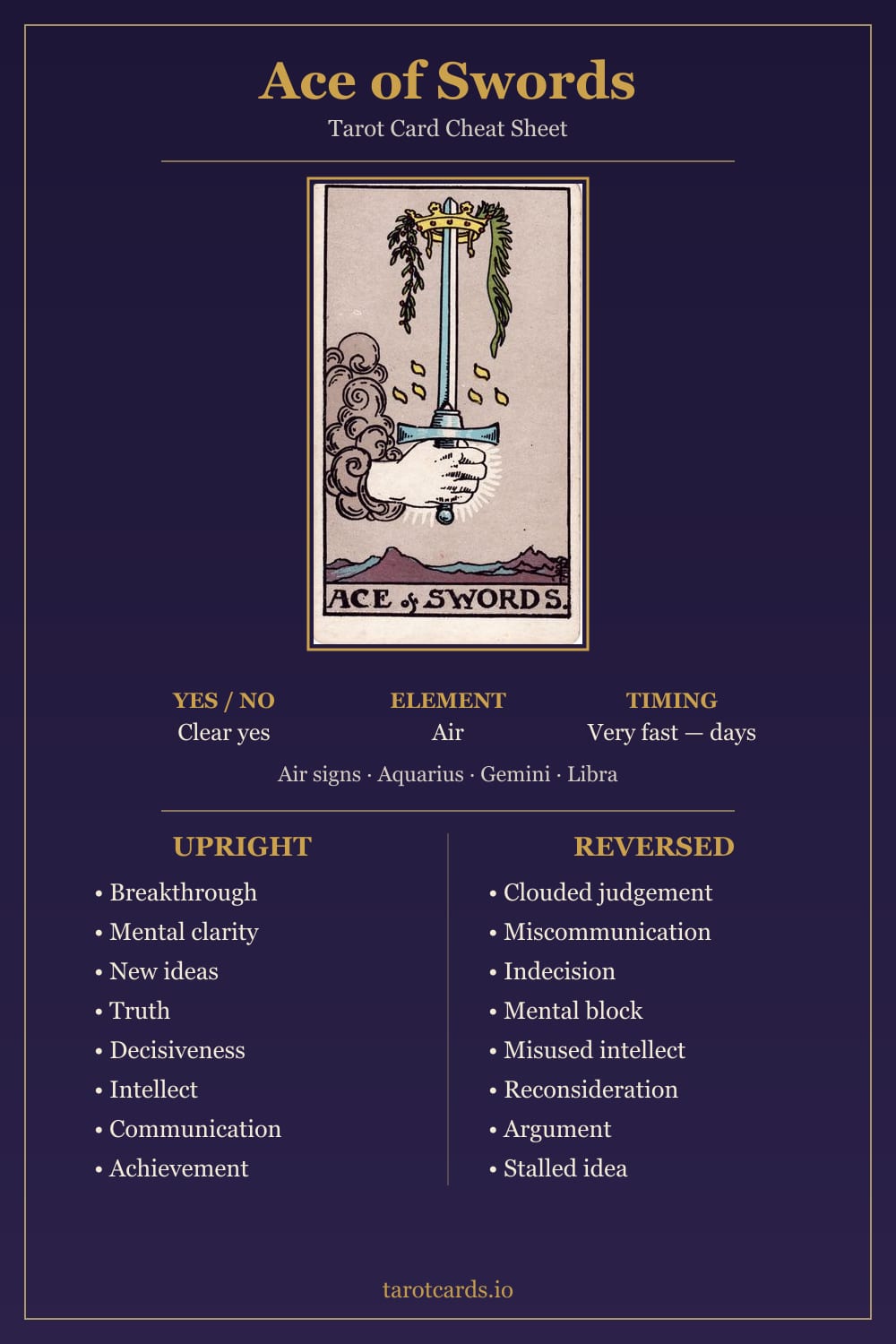
Upright
The Ace of Swords represents a clear idea, truth or decision that makes a difficult situation easier to understand. It can sharpen communication and reveal a useful direction. Test the insight against evidence, then express it precisely enough to guide action.
Keywords: Breakthrough, Mental clarity, New ideas, Truth, Decisiveness, Intellect, Communication, Achievement
Reversed
Reversed, the Ace of Swords suggests clarity that is missing or misused. An argument may sound convincing while resting on weak information, or wording may obscure the real issue. Check assumptions and refine the question before treating a sharp answer as a sound one.
Keywords: Clouded judgement, Miscommunication, Indecision, Mental block, Misused intellect, Reconsideration, Argument, Stalled idea
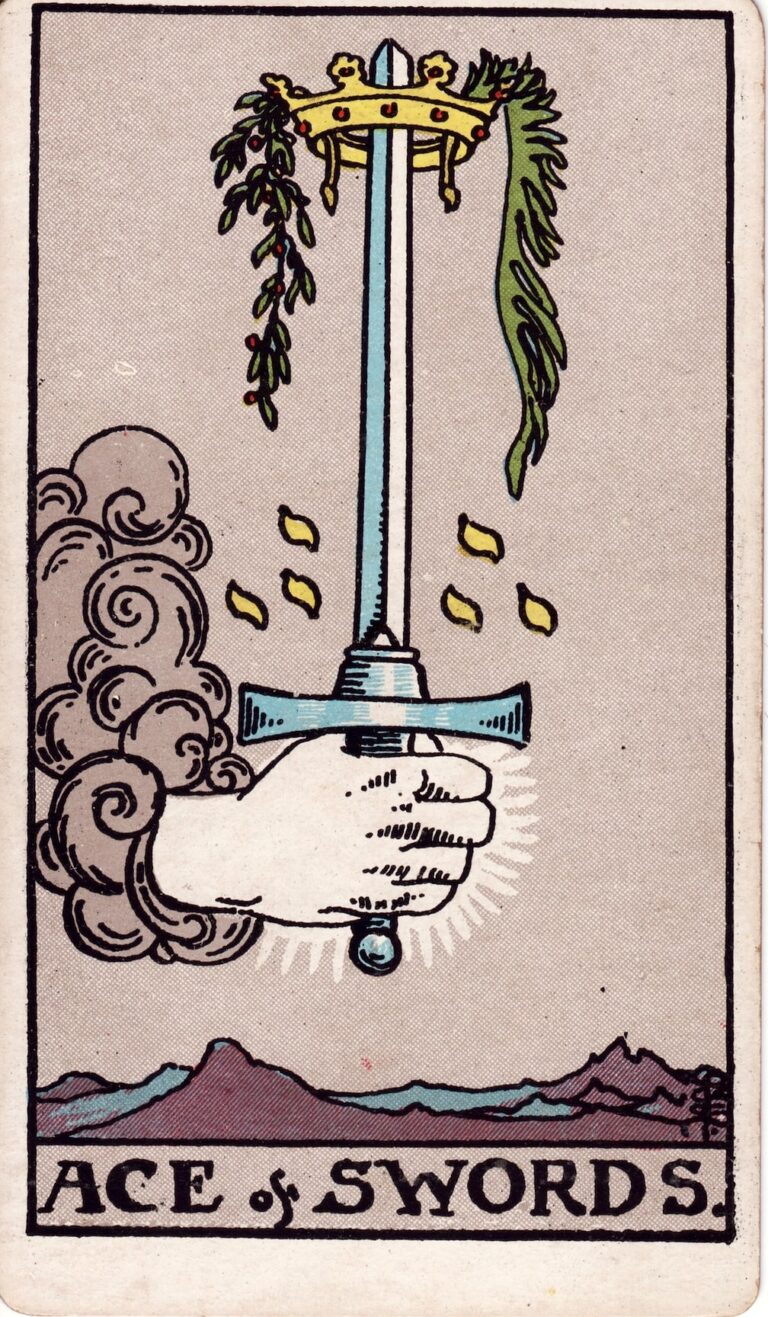
The Ace of Swords marks a breakthrough in thought: the idea, truth, decision, or sentence that cuts through confusion and makes the next move clear. Its promise is clarity, not guaranteed victory; the sword is double-edged, so the same mental force that frees you can also wound when used too hard or without care. In readings, this card usually lands when something needs to be named plainly. Once you can see the truth, you still have to decide what to do with it.
Ace of Swords description
In the Rider-Waite-Smith Ace of Swords, a hand emerges from a grey cloud and grips a tall, upright double-edged sword. The sword runs up the centre of the image, rising from the cloud towards a gold crown that encircles the blade tip. An olive branch hangs from one side of the crown and a palm branch from the other. Six small golden Yods fall beside the lower part of the blade against a pale sky.
The grey cloud gathers closely around the wrist, leaving the point from which the hand appears hidden. From there, the sword continues in a straight vertical line through the open space above it. The crown and its two hanging branches sit at the highest point of the composition, while the Yods appear lower down, just above the hand.
At the bottom of the card, jagged barren mountains form a low, distant line beneath the hand and sword. Much of the remaining background is pale, empty sky, keeping the central blade visually isolated from the mountain range below.
Also known as: the Ace of Épées in the Tarot de Marseille, with some modern decks using Blades. The Thoth deck keeps the name Swords, and in playing-card decks the suit maps to Spades; this guide focuses on Rider–Waite–Smith imagery and interpretation, which may differ from those traditions.
Symbolism: what’s in the Ace of Swords? (1–9)
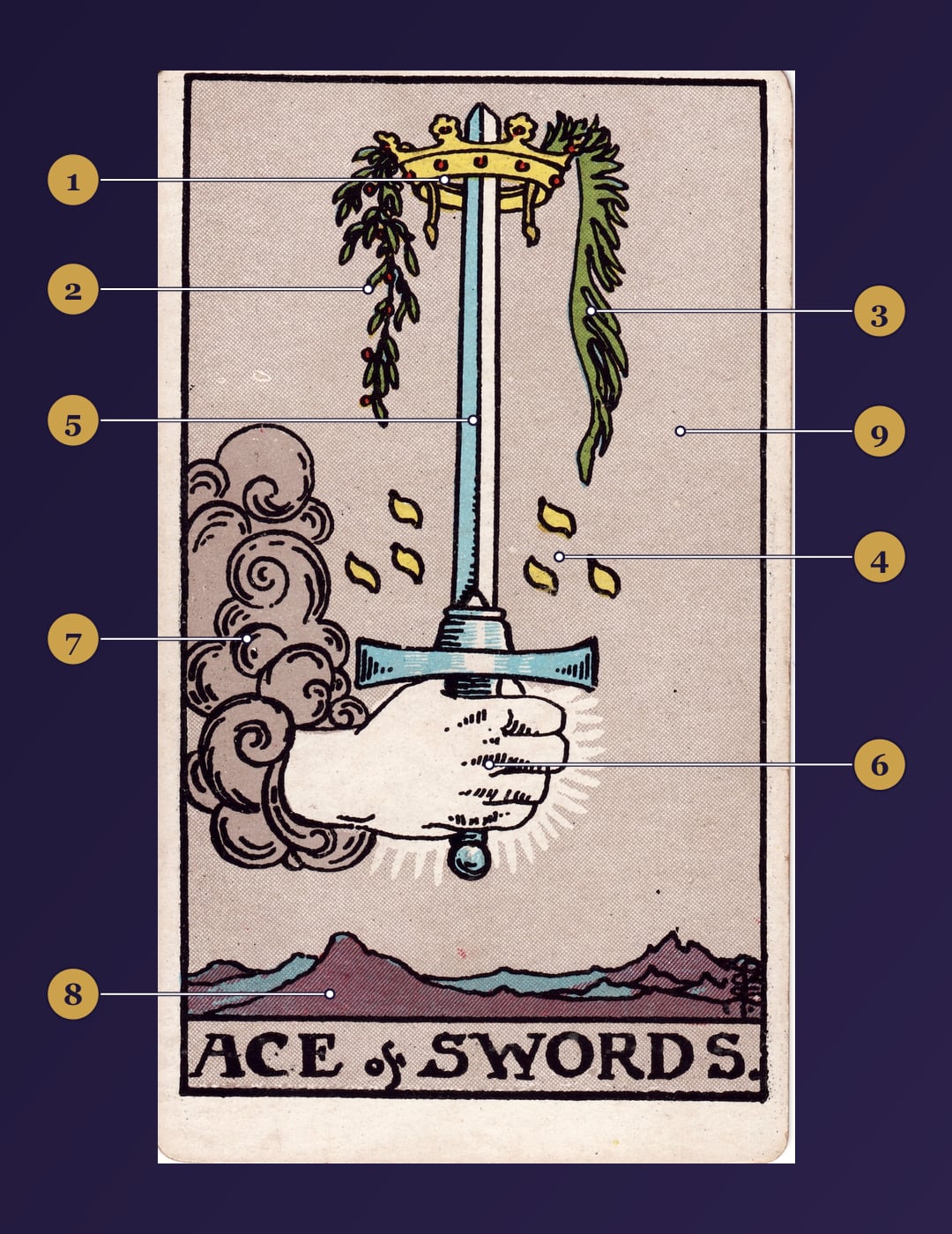
Choose a labelled symbol to highlight its number.
Read the numbered explanationsThe Ace of Swords shows nine main details, each adding a different layer to its picture of clarity, truth, and mental force.
- Gold crown encircling the blade tip: The sword does not simply point towards the crown; it pierces through it. That image links clear thought with achievement and makes this Ace unusually active. The mind is not waiting for luck to arrive. It is cutting through circumstance and claiming a result.
- Olive branch hanging from the crown: The olive branch brings peace into an image dominated by a weapon. Here, peace follows truth rather than avoidance. The card suggests that clear speech can settle what confusion keeps alive, although the truth may need to be spoken before calm is possible.
- Palm branch hanging opposite: The palm branch represents triumph, set directly opposite the olive branch. Victory and peace hang from the same crown because, in this card, truth can deliver both. The pairing also keeps success tied to what the sword has actually clarified, rather than to wishful thinking.
- Six golden Yods falling around the blade: The six golden Yods appear like small sparks descending through the open sky. They point to grace arriving with a new idea: the flash of understanding that seems to come all at once, before you have consciously worked out every step behind it.
- Upright double-edged sword: The sword is raw intellect made visible. Its upright position gives it directness, but both edges matter. The same insight that releases you from confusion can cut another person, harden into cruelty, or become excessive when sharp thinking is treated as permission to strike.
- Hand of Spirit emerging from a grey cloud: The hand arrives already holding the sword, suggesting that insight can appear before conscious effort has produced it. A thought, phrase, or decision may come into focus suddenly. What matters next is how deliberately you use what has been placed in your hand.
- Grey cloud at the wrist: The cloud hides where the hand begins, keeping the source of the idea unknowable. You can receive a clear thought without being able to explain why it arrived at that exact moment. The image leaves some mystery around the origin even while the blade itself is precise.
- Jagged barren mountains below: The mountains make the lower edge of the card severe and bare. They show the harsh terrain that truth may have to cross. Clarity comes before comfort here, and the wider Suit of Swords begins in thin soil rather than in an easy or sheltered setting.
- Pale empty sky: The open sky gives the sword almost nothing to compete with visually. Its paleness suggests uncoloured mental space: a place where feeling, noise, and distraction have been stripped back enough for one thought to stand out. The card asks for precision before decoration.
What does the Ace of Swords mean?
The Ace of Swords means a breakthrough in thought, truth, communication, or decision-making that cuts through what has been unclear. This is the Ace of the sentence that changes everything once it is said, or the idea that suddenly gives a problem a workable shape. Where Ace of Wands brings the surge of energy to begin, the Ace of Swords brings the thought that tells you exactly what beginning makes sense.
Its crown matters because this is the only Ace whose gift pierces one. The image is less about luck landing in your lap and more about the mind deliberately overcoming circumstance through clarity. You can make the decision, name the truth, or state the new idea sharply enough to act on.
The double edge keeps the card from becoming a simple promise of success. Waite warns that this force can become excessive in love as well as hatred. In readings, I treat the sword like a scalpel handed to you: precise, useful, and capable of harm if you confuse sharpness with wisdom. Conflict is not the card’s first message. It tends to follow when a clear truth is resisted, pushed too far, or used to win rather than understand.
What does the Ace of Swords mean in love?
In love, the Ace of Swords means a truth conversation that defines the relationship, bringing clarity whether or not the answer feels comfortable. This card wants the real subject named. If something has been vague, avoided, or left to assumption, direct conversation changes the shape of the connection.
If you’re attached, the focus is on getting onto the same page through clear words. You may define what the relationship is, settle a disagreement, or say something that has been circling without resolution. The gain is understanding, not automatic harmony; honesty can strengthen the bond, but it can also expose a difference that cannot be ignored.
If you’re single, the Ace of Swords favours mental connection and honest intentions over mixed signals. A new person may stand out through sharp conversation, or you may reach a clear decision about someone you have been considering. If you are moving on from a past relationship, the card also supports a clean break once the truth is clear.
What does the Ace of Swords mean for career?
For career, the Ace of Swords means a breakthrough idea, contract, or decision that gives your work a clear direction. You may suddenly see how to solve a problem, pitch a project, begin a new role, or choose between professional paths. The emphasis is not on enthusiasm alone; it is on having the thought sharp enough to organise action around it.
This is a strong card for putting things in writing while the edge is clear. Record the decision, draft the proposal, define the scope, or make the terms explicit rather than relying on everyone remembering the same conversation later. If you are leading colleagues or presenting a new idea, intellectual confidence helps, but the double-edged sword still applies. Being right does not excuse careless communication.
In readings, I would treat this as a prompt to commit to the clearest workable idea in front of you, then make sure the words, responsibilities, and expectations match it.
What does the Ace of Swords mean for money?
For money, the Ace of Swords means making decisions with a clear head, especially around spending, risk, and investments. It favours separating facts from excitement before you commit funds. If an opportunity looks appealing, write down what you actually know, what you are assuming, and what level of loss you are willing to accept.
The card can also point to a clean financial decision: cutting an expense, setting a firmer rule for discretionary spending, or choosing not to put money into something you cannot explain clearly to yourself. Its sharpness is useful when emotion has been muddying the choice.
The double edge matters here too. Confidence can become overconfidence quickly. A clever idea is not automatically a safe one, so let clarity reduce your risk appetite rather than tempt you into proving how certain you feel.
The Ace of Swords as feelings
As feelings, the Ace of Swords can symbolise a wish to understand a connection clearly or to put something important into words. It may reflect a realisation, but the card cannot establish what another person has decided about you.
The useful question is whether clarity is being expressed through actual conversation. Direct words may tell you more than trying to read warmth or distance as a hidden message; until someone speaks, their position may remain uncertain.
The Ace of Swords as actions
As actions, the Ace of Swords points to someone cutting through confusion with blunt honesty and making a decisive move. They may initiate the conversation everyone has been avoiding, name the truth plainly, put a decision into words, or champion a breakthrough idea with clear conviction.
As advice, this favours defining the issue and communicating a decision clearly. The double edge still applies: careful words can help resolve a problem, while a harsh delivery can create another one. It is a prompt for deliberate action, not a forecast of how someone else will respond.
Is the Ace of Swords a yes or no?
In a yes-or-no reading, the Ace of Swords is commonly treated as a yes, drawing on its themes of breakthrough, clarity and decisive thought. The answer is strongest when your situation depends on getting the facts straight, making a firm decision, or saying what needs to be said.
It is not a promise that every consequence will feel pleasant. The card gives you a sharp answer and the ability to act on it; what follows depends on how carefully you use that edge.
What does the Ace of Swords reversed mean?
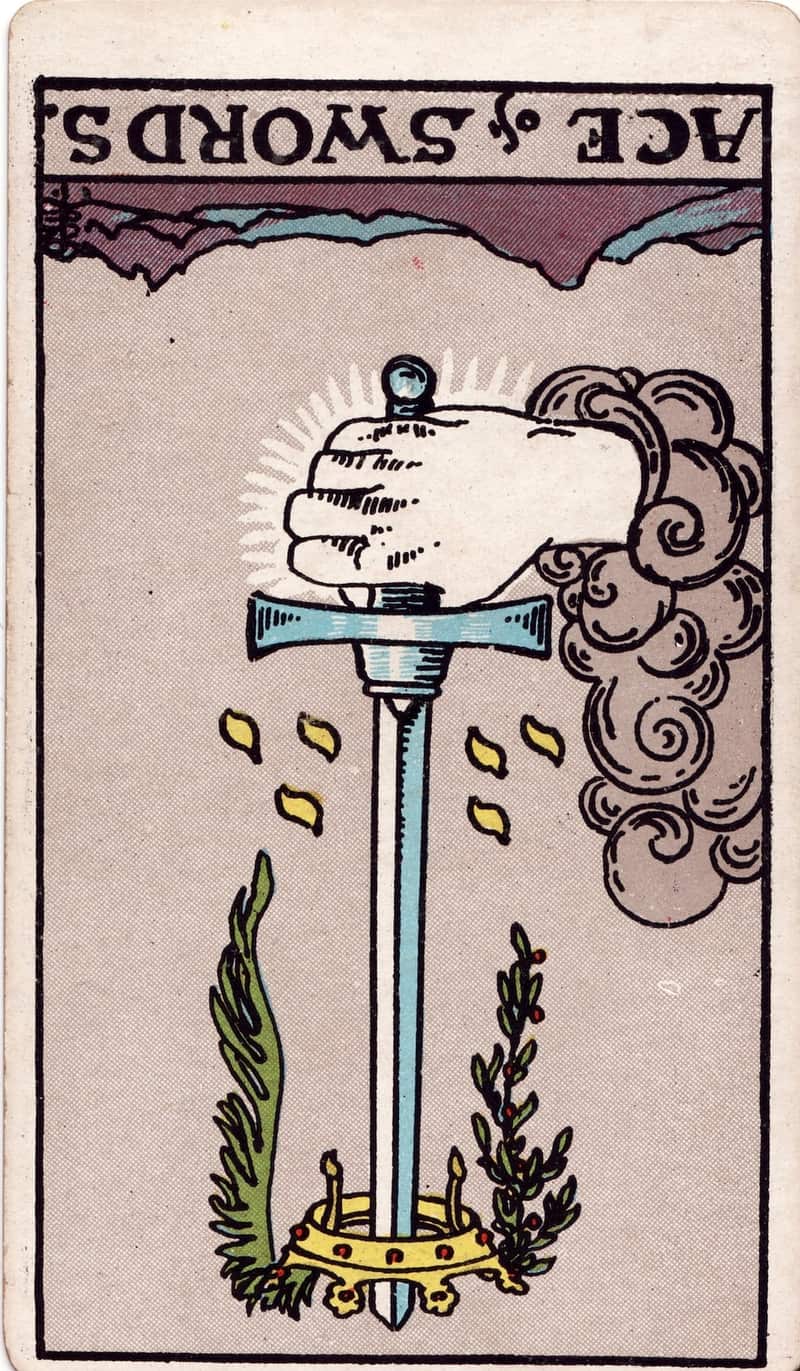
The Ace of Swords reversed means clarity is missing, distorted, or being used badly rather than simply turned into its opposite. You may be trying to decide without enough mental certainty, arguing from wording instead of substance, or holding an idea that sounds sharp but cannot yet survive contact with reality.
This is where the blade can turn on its owner. Intelligence becomes overthinking. Precision becomes pedantry. A conversation may be technically won while the real issue remains untouched, or a new idea may stall because it has not been defined well enough to launch. Indecision, miscommunication, and creative blockage all fit here, but the reversal is most useful when you ask where the missing clarity actually sits.
Sometimes the problem is fog: you cannot see the answer yet. At other times, the problem is misuse: you can see one narrow argument so clearly that you are cutting away context, goodwill, or common sense. Slow the conclusion down until the thought is clean enough to carry its own weight.
Reversed: love, career and money
Love
In love, the reversed Ace of Swords points to a conversation that creates more confusion than clarity. You may be arguing over the wording of what was said while the real emotional issue remains untouched, or discovering that you and another person have been using the same words to mean different things.
In an attached relationship, repeated misunderstandings can expose a disagreement about something fundamental. If you’re single, a new connection may feel mentally interesting but hard to read, especially when intentions stay unclear. Extending an olive branch can help, but only if it is paired with plain communication rather than another attempt to win the argument.
Career
For career, the reversed Ace of Swords points to a project, contract, or professional decision that is not clear enough to move forward cleanly. Instructions may be vague, colleagues may misunderstand one another, or a promising idea may remain stuck because nobody has defined what it actually requires.
This is not a cue to force momentum for its own sake. Re-read the brief, clarify the terms, and make sure the proposal says what you think it says before committing the team to it. If work feels stagnant, the card can also reflect feeling intellectually underused, but the immediate problem is still one of definition rather than ambition.
Money
For money, the reversed Ace of Swords warns against acting while the numbers, terms, or risks are still unclear. A mistaken assumption can turn a confident financial choice into an expensive one, especially if you are relying on a technical detail you have not checked properly.
This is the time to read statements, agreements, and investment information carefully, and to look for errors or omissions before moving money. If your spending has become reactive, pause decisions that depend on urgency or certainty you do not actually have. The card does not demand permanent inaction; it asks you to wait until your reasoning is clean enough to trust.
Timing
Timing systems differ. This site associates Swords with winter, while some readers use Air to suggest a quick pace or the Ace to suggest a first step. These are symbolic conventions rather than reliable dates; the useful question is what information or decision would allow progress.
Ace of Swords card combinations
The Ace of Swords is a powerful card that signifies a breakthrough of some sort. It can invite you to use clear reasoning when a decision matters. When it appears with supporting cards, however, the nuances of the Ace of Swords can shift. Some of its most interesting pairings include:
Ace of Swords and Ace of Cups
When the Ace of Swords and Ace of Cups appear together, the pair can suggest bringing clear thought together with emotional openness. Ask how a new idea could be expressed honestly and with care, rather than assuming the cards guarantee emotional stability or success.
Ace of Swords and The High Priestess
The High Priestess is a powerful Major Arcana card. When it appears with the Ace of Swords, it suggests that you have the intuition and wisdom to seek the insight you crave. If you have a new project to begin, this can be a strong combination.
Ace of Swords and Page of Swords
The Ace of Swords and Page of Swords are both key cards from the Suit of Swords. While the Ace of Swords indicates approaching a task with single-minded focus, Page of Swords suggests looking for signs and advice. A teacher or mentor may be able to show you the right path.
Astrology
The Suit of Swords is closely linked to the air signs: Aquarius, Gemini, and Libra. Air focuses on movement and communication. That connection fits the Ace of Swords, a card centred on clear thinking, decisive ideas, and the words that can change what happens next.
Conclusion
The Ace of Swords gives you clarity, but it also gives you responsibility for how you use it. Speak the truth, make the decision, or follow the breakthrough idea, while remembering that the same edge that cuts through confusion can cut too far.
From there, take the card back to your own question and see what becomes clearer once the real issue is named.
Reading approach: Use these Rider–Waite–Smith interpretations to explore the question and context. A card does not establish another person’s feelings or a future outcome; check practical decisions against observable facts.
Continue exploring the tarot with Two of Swords.
Curious about what lies ahead?
Get a free AI tarot reading and explore guidance designed just for you. Discover the messages the cards have to share and gain insight into your path.
Get a free tarot reading


