



The Eight of Swords Tarot Card Meaning: The Card of Mental Paralysis
Table of Contents
- Upright / Reversed keywords
- Eight of Swords description
- Symbolism: what’s in the Eight of Swords? (1–10)
- What does the Eight of Swords mean?
- What does the Eight of Swords mean in love?
- What does the Eight of Swords mean for career?
- What does the Eight of Swords mean for money?
- The Eight of Swords as feelings
- The Eight of Swords as actions
- Is the Eight of Swords a yes or no?
- What does the Eight of Swords reversed mean?
- Reversed: love, career and money
- Timing
- Eight of Swords card combinations
- Astrology
- Conclusion
Meaning at a glance
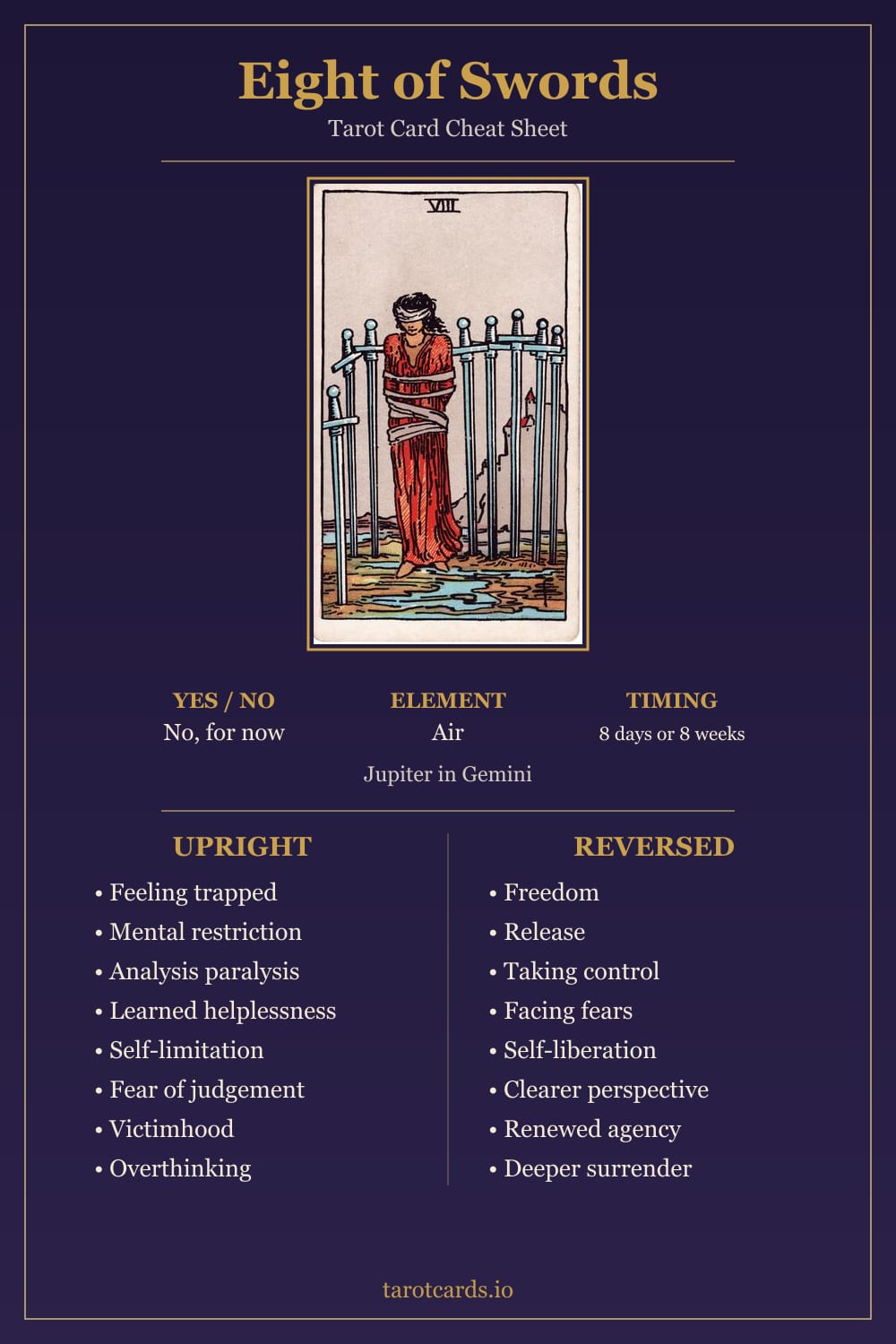
Eight of Swords: upright and reversed
Upright
The Eight of Swords represents restriction and difficulty seeing a safe next step. Fear can narrow perceived options, while real conditions may also limit them. Identify the constraints separately and consider what information or support could make one option more accessible.
Keywords: Feeling trapped, mental restriction, analysis paralysis, feeling powerless, self-limitation, fear of judgement, loss of agency, overthinking
Reversed
Reversed, the Eight of Swords can describe a growing awareness of choices or support that were difficult to see. Question an assumption of total powerlessness without denying real barriers. A small increase in freedom can matter even when the wider situation remains difficult.
Keywords: Freedom, release, taking control, facing fears, self-liberation, clearer perspective, renewed agency, deeper surrender
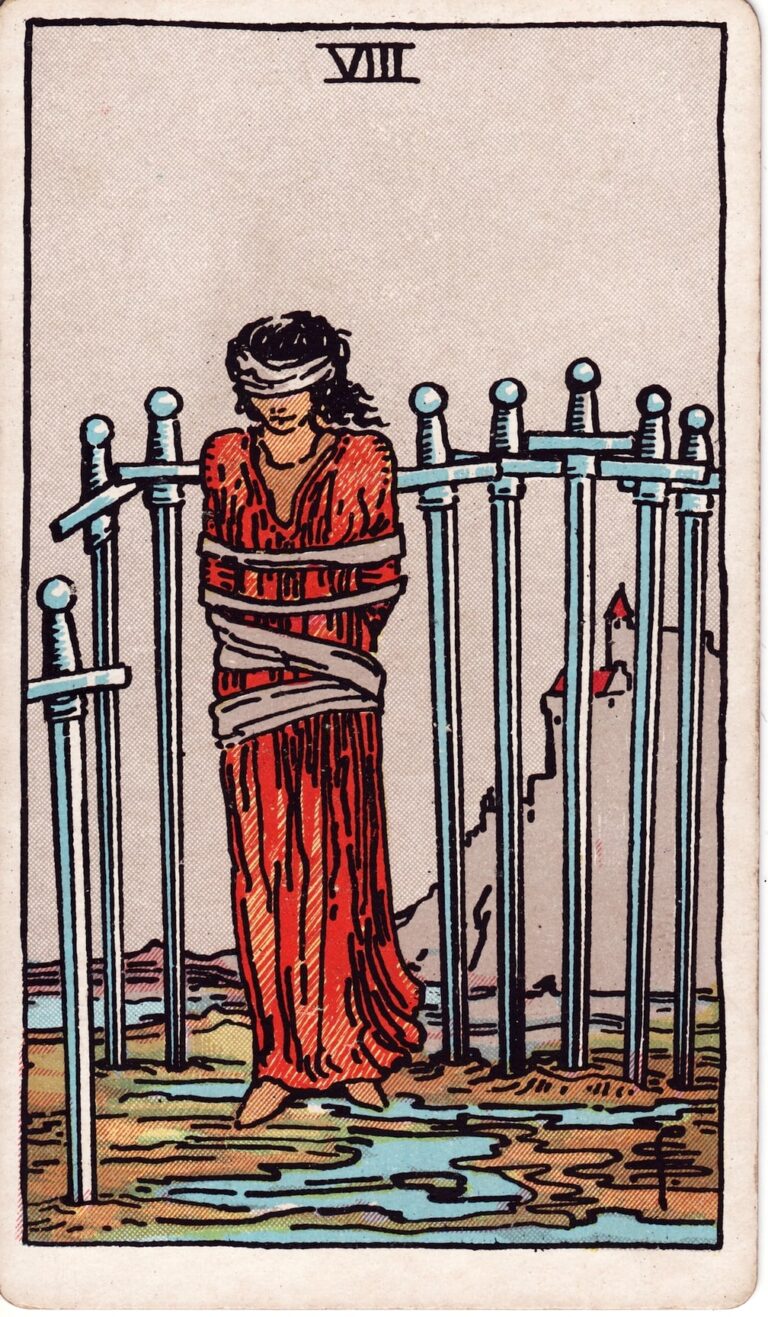
The Eight of Swords appears when fear, overthinking or a fixed story has made your choices feel smaller than they are, creating the experience of mental paralysis, helplessness and being trapped with no safe move available. The image offers a useful point of reflection: her feet are unbound and the swords leave open space around her, suggesting that some assumed limits may be worth testing. Real constraints can also exist, so the invitation is to distinguish them from fearful predictions without blaming yourself for feeling trapped.
Eight of Swords description
In the Rider-Waite-Smith Eight of Swords, the Roman numeral VIII sits above a grey, overcast scene. A grey castle stands high on a cliff in the distance. In the foreground, a woman in a red dress is blindfolded, with cloth wrapped around her upper body and arms.
Eight swords are planted upright in the ground around her, forming an uneven ring rather than a sealed enclosure. Directly ahead of her, the line of swords breaks and leaves a visible gap. The ground beneath her is wet and marshy, broken by shallow puddles instead of firm, dry earth. Her feet are bare and unbound.
Nothing in the scene moves towards her. The castle remains far away, the swords stand still, and the woman occupies the centre of the image with her sight covered and her body partly wrapped. Open space remains plainly visible around her and through the break in the line of blades.
Also known as: the Eight of Épées in the Tarot de Marseille, with some modern decks using Blades. The Thoth deck keeps the name Swords, and in playing-card decks the suit maps to Spades; this guide focuses on Rider–Waite–Smith imagery and interpretation, which may differ from those traditions.
Symbolism: what’s in the Eight of Swords? (1–10)
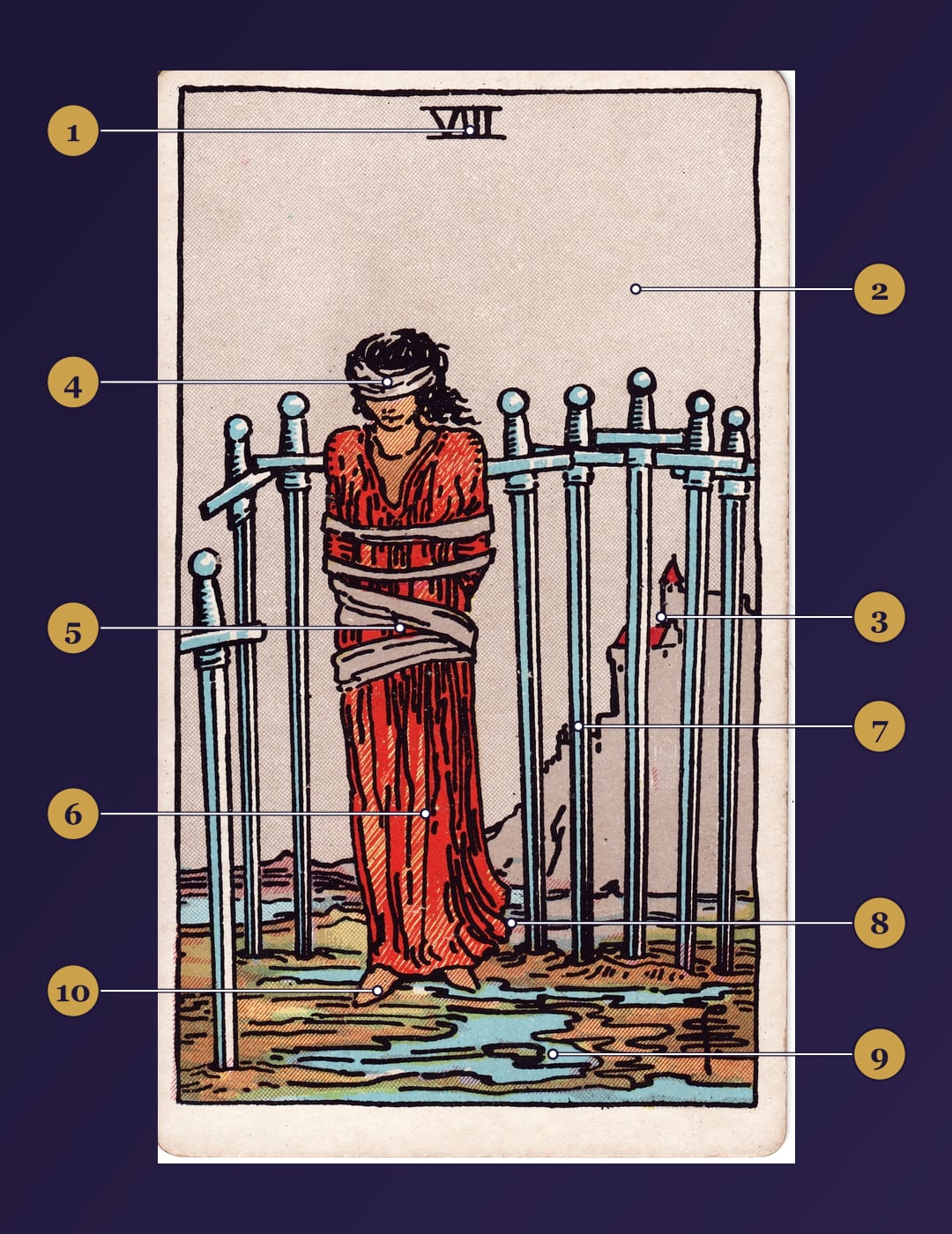
Choose a labelled symbol to highlight its number.
Read the numbered explanationsThe Eight of Swords contains ten key visual details, from the Roman numeral at the top to the woman’s bare feet below.
- Roman numeral VIII: The eight at the top gives the scene a repeated, enclosed feeling before you reach the figure below. Here, that structure belongs to the mind: one thought follows another until repetition starts to feel like proof, and self-imposed order hardens into a bind.
- Grey sky: The sky offers no brightness or clear horizon. Its grey tone reflects the mind’s overcast verdict that nothing can change. The card does not show that verdict as objective truth; it shows how thoroughly a bleak conclusion can colour everything you see.
- Grey castle on the cliff: The distant castle can suggest authority, social expectations or a place that feels difficult to reach. Its role is open to interpretation: the picture does not tell us who restrained the woman or whether other people are involved in her situation.
- Blindfold: The blindfold is the clearest sign that available options are not being looked at. It does not erase the exits around her; it keeps them outside her present view. In readings, this often lands as avoidance that has lasted long enough to become certainty.
- Cloth bindings: Cloth wraps the woman’s arms and torso, while her feet remain unbound. The image can prompt a question about what still permits movement, but it does not show how easily the restraints could be removed. In a real situation, assess practical limits rather than assuming determination is enough.
- Red dress: Beneath the grey setting and pale bindings, the woman’s red dress keeps vitality and desire visible. Her will has not vanished. The restriction covers and contains her body, but it has not extinguished the part of her that still wants, feels and can choose.
- Eight swords ringed around her: The swords look like a fence, yet they are also the suit’s language of thought. Together they picture ideas arranged into a barrier: assumptions, fears and repeated conclusions that stand around the woman until mental limits are mistaken for fixed facts.
- Gap in the sword-fence: The opening before her is the detail the whole card turns on. The swords do not complete a cage. An exit is already present, which is why the Eight of Swords challenges the claim that there are no options even while it respects how convincing that claim feels.
- Marshy, puddled ground: The ground is uncomfortable and unstable rather than solid. It shows emotional footing that does not feel safe enough for an easy first step. Staying still can seem less risky in the moment, even when remaining in place prolongs the discomfort.
- Bare unbound feet: Her feet are not tied, and there is open ground before her. Symbolically, this can invite attention to a possible next step. It does not mean that everyone who feels trapped has an immediate or safe way out.
What does the Eight of Swords mean?
The Eight of Swords can describe feeling restricted, uncertain or unable to see a safe next step. Fear may narrow the options you notice, but real circumstances can also limit them. The card is most useful as a prompt to examine which constraints are present and what information or support might help.
The blindfold recalls the Two of Swords, but the added bindings make this a more constrained image. The unbound feet and incomplete line of swords leave room for an interpretation about possibilities not yet visible to the figure. That possibility should not be confused with proof that her circumstances are self-imposed.
That does not mean the distress is imaginary. Some restrictions may be more flexible than they first appear; others require practical help or changes outside your control. When this card appears, separate what is genuinely outside your control from what fear has promoted into a rule. You may find that the list of hard constraints is shorter than the list in your head.
The Eight of Swords is strongest as an invitation to recover choice without shaming yourself for losing sight of it. Perfect confidence is not required before you move. One honest look at the gap is enough to begin.
What does the Eight of Swords mean in love?
In love, the Eight of Swords can describe feeling unable to leave, speak honestly or make a choice. Sometimes fear narrows the options you can see; sometimes coercion, financial dependence or other practical limits genuinely restrict those options. The card cannot distinguish these for you. Start with what is actually happening and what support or information would help you assess your choices.
If you are attached, you may be holding back needs, vulnerability or a difficult truth because you have already decided how your partner will respond. The card’s own imagery points first to perceived constraint rather than proof that another person is controlling you. Look at what has actually been said or done, then separate it from the outcome you are predicting.
If you are single, the same bind can appear as analysis paralysis. You may dismiss possible partners, avoid giving anyone a real chance or treat uncertainty as a reason not to begin. The gap in the swords asks for a small choice that gives reality a chance to answer you.
What does the Eight of Swords mean for career?
For career, the Eight of Swords means you may feel trapped in a role, project or professional identity that has more exits than you currently believe. This is the card of “I can’t leave” thinking at work: golden handcuffs, imposter syndrome, fear of being judged, or the belief that you lack the skills to progress.
Start by listing the constraints as plainly as possible. Your pay may matter, your current skills may need work, and a workplace may have rules you cannot instantly change. Then separate those facts from conclusions such as “no one else would hire me”, “I’m not leadership material” or “corporate life is rigged against me”. Those are the kinds of beliefs the Eight places inside its mental enclosure.
Most of the useful movement comes from making the situation specific. A project can be changed, a skill can be developed, an application can be sent, and judgement can be tested against evidence. The card does not promise that every professional limit disappears. It asks you to stop treating every feared limit as settled.
What does the Eight of Swords mean for money?
For money, the Eight of Swords means anxiety may be narrowing your financial choices and making avoidance feel safer than looking closely. This can show up as freezing around investments, refusing any risk because loss feels inevitable, or leaving spending and debt unexamined because the numbers themselves feel threatening.
The blindfold matters here. A limited view of your finances can make the situation seem either worse or simpler than it is, while missed information keeps you from seeing possible changes. Credit card debt, for example, is a real constraint; anxious assumptions about what that debt means for every future choice are a different matter.
Use the card to separate the balance, the spending pattern and the actual level of risk from the story around them. The goal is not reckless optimism. It is a clearer financial picture before you decide what to spend, save or invest.
The Eight of Swords as feelings
As feelings, the Eight of Swords can symbolise uncertainty about how to respond or difficulty seeing a workable choice. It does not establish that someone has hidden feelings for you or that fear is the only reason they have not acted.
If a person seems hesitant, their own words and circumstances matter more than a presumed story about what is holding them back. You can use the image to reflect on pressure and choice without deciding on their behalf what they feel or what they could safely do.
The Eight of Swords as actions
As actions, the Eight of Swords points to inaction: someone under this card’s influence is likely to stay passive because they believe their hands are tied. They may delay, avoid the conversation, make excuses or keep repeating the reasons nothing can be done.
As advice, the card can invite you to identify one manageable question: what is known, what is assumed and what support is available? A pause may be appropriate while those matters are clarified. The image does not establish that another person could act if they simply changed their thinking.
Is the Eight of Swords a yes or no?
In a yes-or-no reading, the Eight of Swords is often read as “not yet” or as a reason to examine the constraints around the question. That is an interpretive convention, not evidence that the outcome is blocked only by belief.
If the question depends on someone taking initiative, speaking up or changing course, consider whether more information or practical support is needed. The answer can change when the blindfold comes off and the real constraints are separated from the imagined ones. For the present moment, though, the card reads as stopped rather than moving.
What does the Eight of Swords reversed mean?
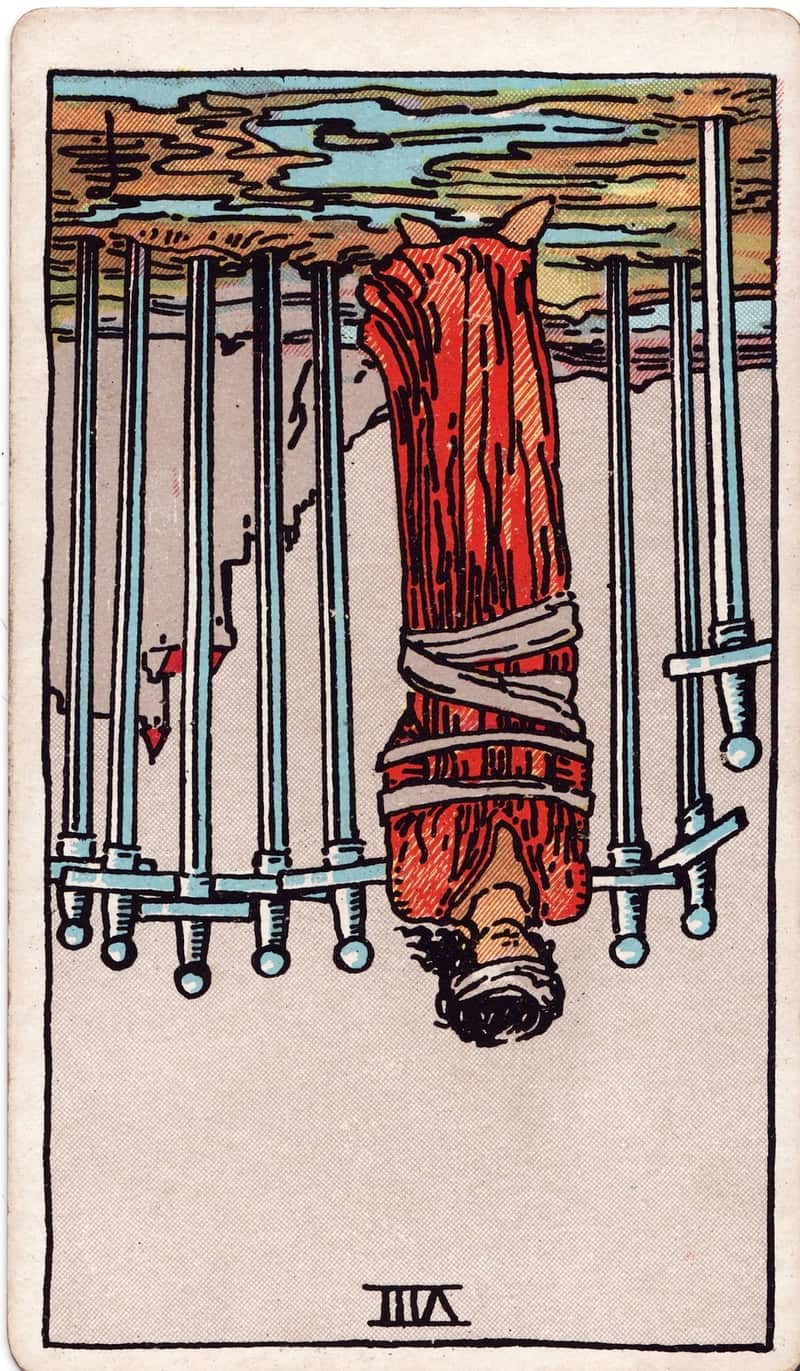
The Eight of Swords reversed means the blindfold is starting to slip: the story of powerlessness is losing its grip, and self-liberation becomes possible. This is not simply the upright card turned into its opposite. The key shift is that you begin to recognise which restraints were accepted, repeated or feared into solidity.
In its more constructive expression, the reversal brings clarity after mental paralysis. You face the fear you had been avoiding, test assumptions against what is actually happening and recover enough agency to make a first move. Freedom begins before every problem is solved because you are no longer treating every thought as a command.
In another reading, the reversal can describe feeling even more restricted or discouraged. That is not proof of choosing helplessness. It may be a reason to reassess the situation with support, particularly where barriers cannot be changed through perspective alone.
So the reversal asks for evidence of movement, not hopeful language alone. A choice made, a fear faced or a false rule dropped shows the blindfold coming off. Repeating “nothing can change” shows the old enclosure tightening.
Reversed: love, career and money
Love Meaning
In love, the Eight of Swords reversed means you are beginning to question the relationship story that kept you silent, guarded or convinced you had no choice. If you are attached, this can look like speaking more clearly, lowering old walls and deciding whether the relationship itself needs help rather than assuming the answer in advance.
For singles, the release may be from analysis paralysis or past fear that made every new connection feel unsafe before it began. The less constructive side is a deeper surrender to the same script: deciding that love always traps you, that nobody can be trusted or that nothing you say will matter. Evidence of release is strongest when belief is followed by a real change in behaviour.
Career Meaning
For career, the Eight of Swords reversed means the professional rut is starting to loosen because you are testing the beliefs that kept you there. You may consider leaving a stagnant role, apply for work you previously ruled out, develop a skill you thought you lacked or perform more freely because fear of judgement no longer runs every decision.
The reversal can also describe continuing frustration when a workplace’s limits remain hard to change. Consider which steps are realistically available, such as asking a question, building a skill or exploring another role. A lack of immediate progress does not mean you are refusing an easy solution.
Finances Meaning
For money, the Eight of Swords reversed means financial fear is becoming easier to examine, giving you a clearer sense of what you can actually control. You may look directly at spending, debt or investment choices that you previously avoided, then make decisions from the numbers rather than from a scarcity story.
The difficult version is deeper financial resignation. You may decide that the situation is hopeless, avoid checking what is happening and let fear replace judgement about risk. The reversal asks for practical evidence that agency is returning: clearer information, a changed spending choice or a deliberate investment decision. It is less about positive thinking than about no longer treating anxiety as your only source of financial guidance.
Timing
This site associates Swords with winter. Some number-based systems suggest eight days or weeks, but there is no agreed or dependable timing rule. A more useful approach is to ask what information, resources or support would make a next step possible.
Eight of Swords card combinations
The Eight of Swords can be a troublesome and daunting reading. However, we can learn even more about this when pairing the Eight with other cards from the deck.
The Eight of Swords and The Devil
The Eight of Swords with The Devil can invite reflection on constraints and difficult patterns. The Devil is often read in terms of attachment, while the blindfold can suggest limited perspective. Neither the cards nor The Devil’s chains diagnose addiction or show that someone is willingly choosing harm. Consider the real circumstances and what support could make change possible.
The Eight of Swords and The Tower
With The Tower, the pairing can explore what happens when an established view is challenged. The restrictive imagery of the Eight and the disruption of The Tower may prompt questions about beliefs, institutions or circumstances that are changing. It does not label someone an ineffective activist or diagnose a social-media addiction. The Tower offers a symbolic contrast, not a promise that disruption will free you.
The Eight of Swords and Six of Pentacles
Six of Pentacles creates an interesting dynamic because it’s centred around a very one-way support structure, in which one shares their wealth with someone in dire need. When paired with the Eight of Swords, this could mean you’re feeling as though you’re trapped in a caregiving role, or perhaps you’re providing some shelter to someone in need and are beginning to feel trapped.
However, there is another side to this pairing if you are the one receiving the help. This could be the help you need. It may not make you feel freer immediately, but the terms and suitability of that assistance are worth considering, and it can be a lifeline when enduring debt problems or a sense of powerlessness.
The Eight of Swords and Ace of Swords
Ace of Swords‘ core message is that you may be on the verge of a big breakthrough. This is precisely the complementary pairing that’s welcomed with the Eight’s paralysis. You may have been lacking ideas in life on what to do next, what project to begin or what area of your life to focus your energies. Having too many options can often make you feel like there are more problems than solutions, more questions than answers, and this particularly hinders your spiritual path. But Ace of Swords is the light at the end of this tunnel, inviting you to define one problem or question clearly enough to consider a next step.
The Eight of Swords and Four of Wands
The Eight of Swords can also be used to reflect on feeling uncomfortable in social settings. Alongside the Four of Wands, which often suggests gatherings or shared celebration, it may raise questions about belonging, pressure or the level of contact that feels manageable. The pairing does not diagnose social anxiety or another mental-health condition.
The Four of Wands can symbolise supportive company, but it does not have healing properties. Consider whether a trusted person or a smaller, less demanding gathering would feel helpful; there is no requirement to attend a party or share private feelings to prove progress.
Astrology
The Golden Dawn’s Book T assigns the Eight of Swords to Jupiter in Gemini. The contrast between Jupiter’s expansive symbolism and the card’s restriction can be used as an interpretive theme. It is not a claim that Gemini causes overthinking or that a planetary pairing explains someone’s mental state.
Conclusion
The Eight of Swords invites an honest look at what restricts you, which assumptions can be tested and what support may widen your options. Its unbound feet and open space can symbolise a possible next step, without denying barriers that are real or blaming you for not yet seeing a safe way forward.
Carry that distinction into the rest of your reading, especially where another card shows what becomes possible once you move.
Reading approach: Use these Rider–Waite–Smith interpretations to explore the question and context. A card does not establish another person’s feelings or a future outcome; check practical decisions against observable facts.
Continue exploring the tarot: revisit Seven of Swords, or move on to Nine of Swords.
Curious about what lies ahead?
Get a free AI tarot reading and explore guidance designed just for you. Discover the messages the cards have to share and gain insight into your path.
Get a free tarot reading


