



The Knight of Swords Tarot Card Meaning: The Card of Action and Ambition
Table of Contents
- Upright / Reversed keywords
- Knight of Swords description
- Symbolism: what’s in the Knight of Swords? (1–10)
- What does the Knight of Swords mean?
- What does the Knight of Swords mean in love?
- What does the Knight of Swords mean for career?
- What does the Knight of Swords mean for money?
- The Knight of Swords as feelings
- The Knight of Swords as actions
- Is the Knight of Swords a yes or no?
- What does the Knight of Swords reversed mean?
- Reversed: love, career and money
- Timing
- Knight of Swords card combinations
- Astrology
- Conclusion
Meaning at a glance
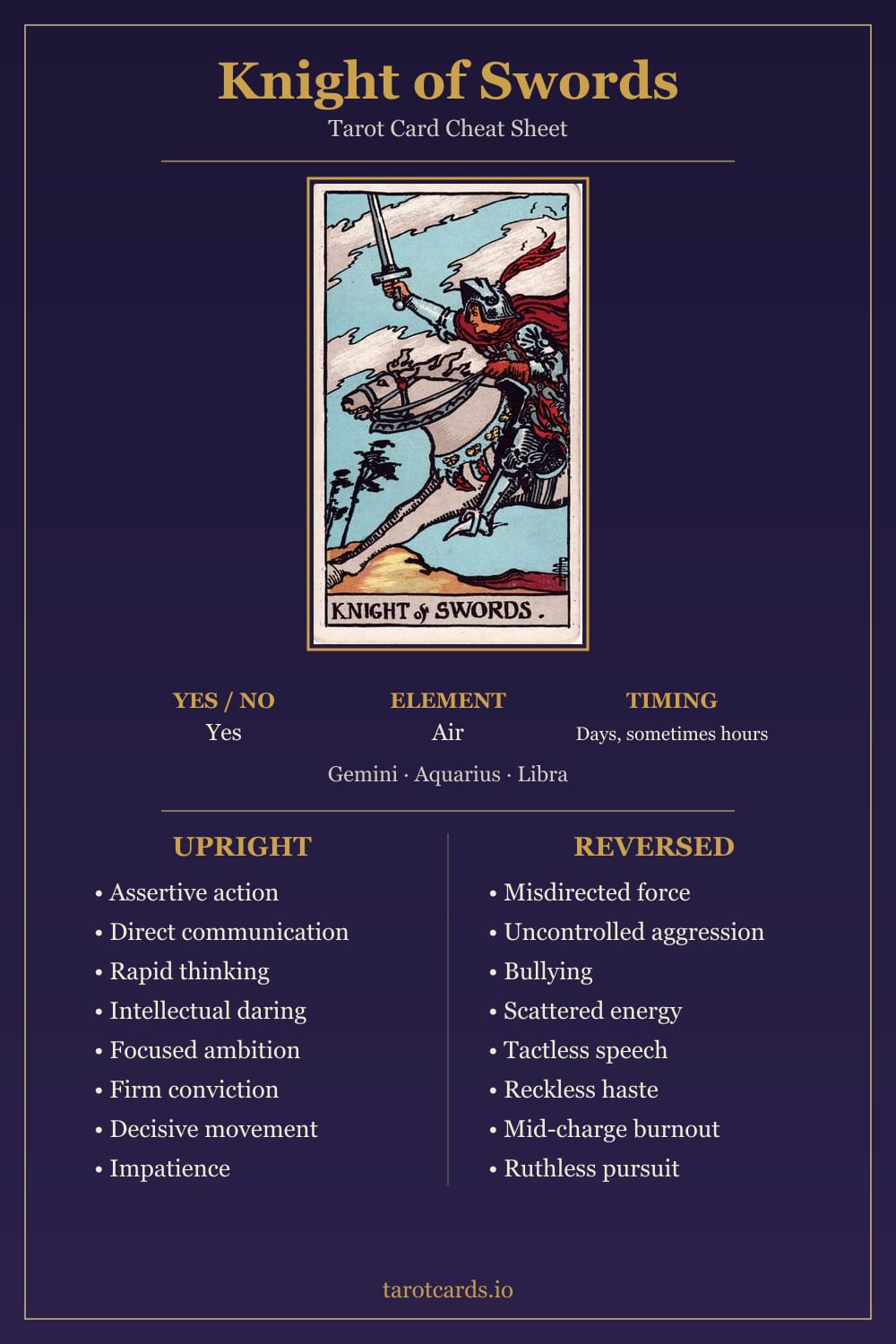
Knight of Swords: upright and reversed
Upright
The Knight of Swords represents conviction moving into decisive action. Clear thinking can help you meet resistance and speak when something matters. Keep sight of the purpose, the evidence and the people affected so that urgency does not choose the whole course for you.
Keywords: Assertive action, direct communication, rapid thinking, intellectual daring, focused ambition, firm conviction, decisive movement, impatience
Reversed
Reversed, the Knight of Swords suggests force that has lost its target. Impulsive words, scattered effort or abrupt hesitation may undermine a sound intention. Pause long enough to choose the issue worth addressing and a response proportionate to it.
Keywords: Misdirected force, uncontrolled aggression, bullying, scattered energy, tactless speech, reckless haste, mid-charge burnout, ruthless pursuit
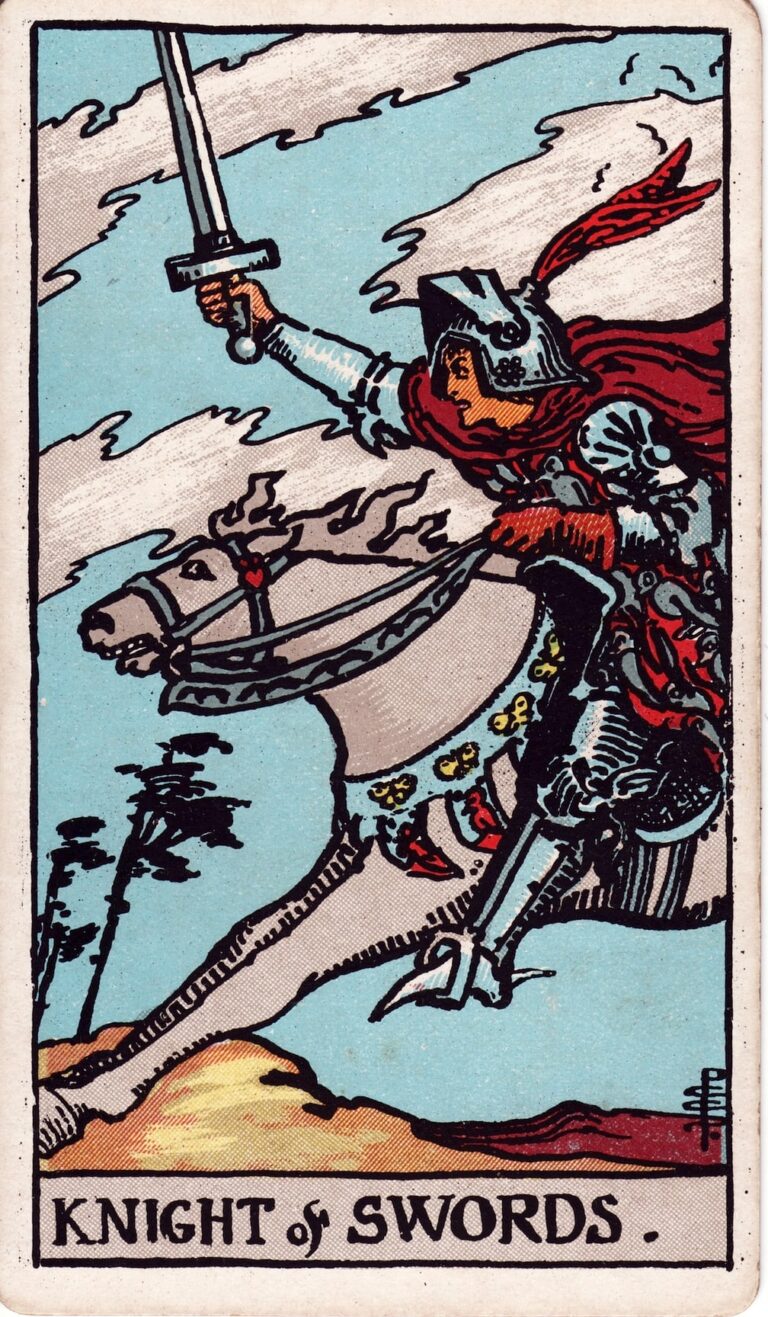
The Knight of Swords brings speed, sharp thinking and the nerve to act when a situation calls for a clear decision. His charge into the wind can suggest courage or recklessness, depending on the question and circumstances. The court card may describe a style of action to consider, rather than a particular person entering your life.
Knight of Swords description
In the Rider-Waite-Smith card, an armoured knight leans forward on a white horse at full gallop. His sword is raised in his right hand, his visor is open, and his face is fully exposed to the weather. A red plume and cape stream behind him as the horse drives across rough, churned ground.
Above them, ragged clouds streak the sky. Trees along the horizon bend in the wind. The knight and horse push through the unsettled weather, with the rider leaning forward and looking in the direction of the charge.
Bird and butterfly-like motifs decorate the horse’s tack. The horse stretches its head forward, its eye wide, as its legs extend into the gallop. Cloth streams, branches bend and clouds streak across the sky. From the moving clouds to the uneven ground, the composition stresses speed and pressure.
Also known as: the Knight of Épées in the Tarot de Marseille, with some modern decks using Blades. The Thoth deck keeps the name Swords, and in playing-card decks the suit maps to Spades; this guide focuses on Rider–Waite–Smith imagery and interpretation, which may differ from those traditions. In the Thoth deck this card appears as the Prince of Swords.
Symbolism: what’s in the Knight of Swords? (1–10)
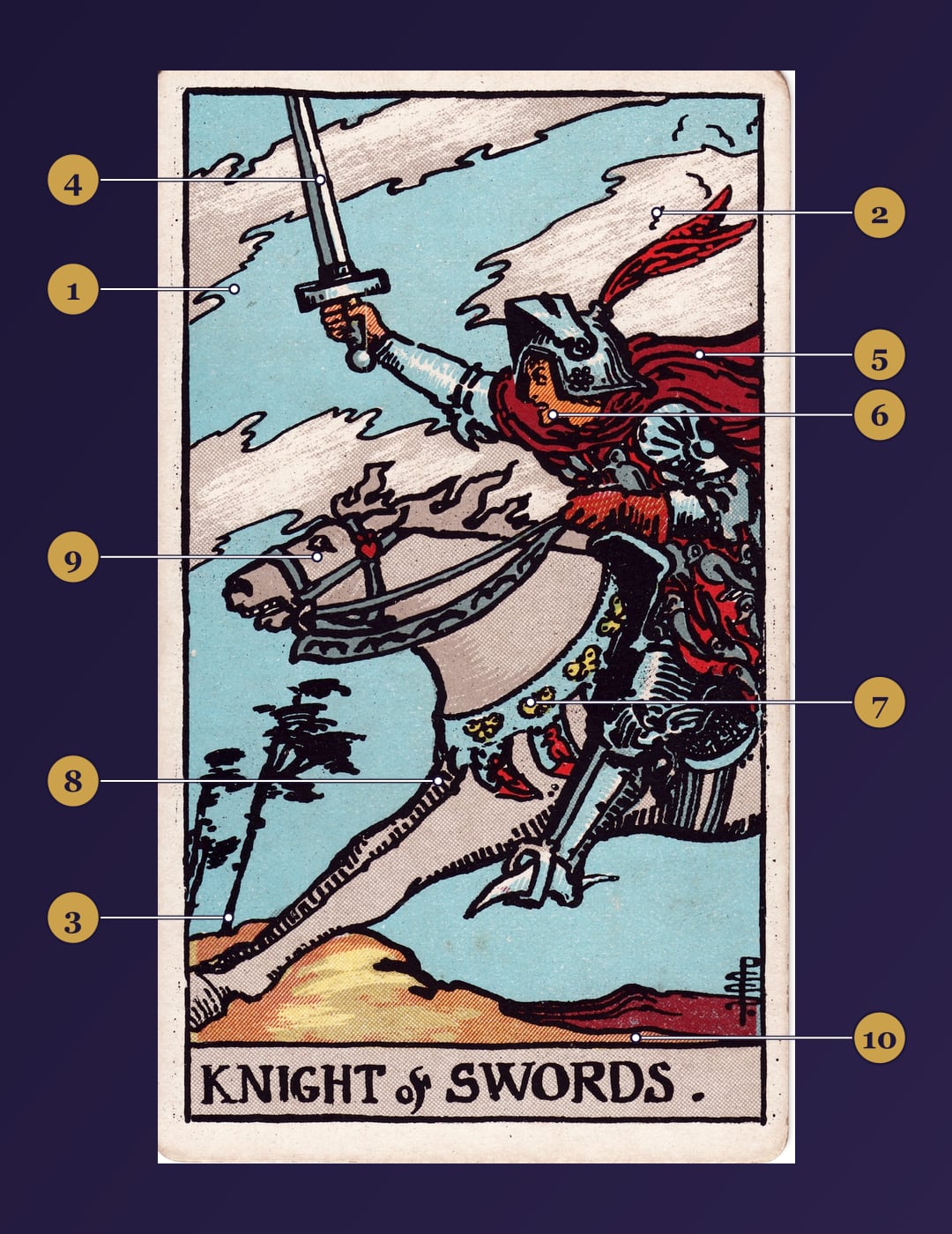
Choose a labelled symbol to highlight its number.
Read the numbered explanationsTen details show the knight’s speed, conviction and the cost of charging ahead.
- Storm-streaked sky with ragged clouds. The sky is not a threat behind the knight; it is the mental storm he chooses to enter. Those clouds move against his charge, so conviction appears here as motion into resistance rather than an easy advance across calm ground.
- Open sky between the clouds. The pale spaces leave the rushing rider exposed to the weather, with no shelter around him. Read symbolically, that openness can suggest acting before every uncertainty has been resolved. It does not make all risks visible or make speed a substitute for judgement.
- Wind-flattened trees. The trees show how much pressure is meeting the charge. Their branches bend under the force of the wind, but the knight does not alter course. Resistance is present and visible; sheer velocity is what he uses to push through it.
- Raised sword. The blade gives the charge one clear direction. It is single-pointed intent made visible, with the knight’s argument held like a weapon. His thinking is not exploratory here; it has become a conclusion he is ready to defend and impose.
- Red plume and streaming cape. Red brings the passion and energy already associated with the knight, but the fabric is pulled ragged by his speed. Desire fuels the advance while the headwind tests how much of that fire can stay controlled.
- Visor up, face exposed. The knight has not lowered his visor or prepared for impact. He meets the charge openly, which gives the image courage and danger at once. At full speed, there is no visible defensive planning and no pause to protect himself.
- Bird and butterfly-like motifs on the horse’s tack. These airy decorations can be read as images of thought, freedom and change carried into the charge. They give the forceful movement an intellectual setting, while leaving the reader to question whether the knight’s ideals are guiding his pace or being overtaken by it.
- White horse at full gallop. The horse is pure force beneath the knight’s idea. At full gallop, it turns intention into physical movement and carries the charge without hesitation. There is no pause between thought and action here, only the full release of energy once a direction is chosen.
- Horse’s forward head and wide eye. Horse and rider face into the charge. The stretched head and alert eye intensify the sense of effort and urgency. As a reading prompt, that detail asks whether conviction is being matched by enough attention to the conditions ahead.
- Churned, ignored ground. The earth beneath the horse is crossed rather than studied. Details are trampled, terrain is unconsidered, and the charge continues without adjustment. The knight may reach his target quickly, but the card keeps the cost of that speed in view.
What does the Knight of Swords mean?
Decisive thought has reached the point of action when the Knight of Swords appears upright. In readings, this card usually lands as a forceful push: speak plainly, choose a direction and move before the moment closes. The knight does not wait for perfect conditions. He rides into resistance, which makes conviction less about confidence and more about continuing while the wind is against you.
That same image holds the warning. Context decides if you are seeing a cavalry charge or a car crash. Speed can break a deadlock, win an argument or carry a plan through opposition; it can also flatten details, feelings and practical consequences. The card is neither purely heroic nor purely reckless. Its value is in showing that both outcomes come from the same engine.
Court cards can be read as people, and this one may describe someone brilliant, blunt and exhausting. It can equally describe your own drive or a need for decisive action. As advice, use the knight’s focus while checking the consequences first: urgency does not excuse avoidable harm, override consent or make every obstacle something to defeat.
What does the Knight of Swords mean in love?
In love, the Knight of Swords points to a whirlwind pursuit, with direct declarations, intense messages and very little patience for uncertainty.
If you are single, someone may come on strongly or you may feel compelled to chase an answer at once. The attraction can be thrilling because there is no guessing where the interest stands. Still, the pace can outrun emotional depth, and a connection that arrives in a rush may burn out just as quickly if neither person slows enough to learn who the other is.
If you are attached, this card brings urgent conversations and decisive moves. One of you may want the relationship defined, defended or changed now. Plain speech can clear the air, but the same force can turn every disagreement into a contest that must be won. Say what you mean, then leave enough room for your partner’s response; conviction does not excuse steamrolling their feelings.
What does the Knight of Swords mean for career?
For career, the Knight of Swords can symbolise an urgent push on a project, argument or decision. The useful question is how to act decisively while protecting the quality of the work and the people affected by it.
This is the energy of a launch, litigation, a campaign or a demanding project that needs someone to commit and drive it forward. You may need to make the call, state the case and keep moving while colleagues are still debating. In that setting, hesitation can weaken the position and the knight’s speed becomes an advantage.
The caution is not to confuse pressure with precision. A fast result can come with skipped details, strained working relationships or tasks left in disorder behind the main advance. Choose the target before you charge, decide which costs are acceptable, and keep your argument tied to the work rather than to pride. This card rewards bold ambition and intellectual nerve, but it expects you to own what your push displaces.
What does the Knight of Swords mean for money?
Financially, the Knight of Swords shows a high risk appetite and a strong urge to spend, invest or commit before doubt catches up.
You may feel drawn to a large purchase or a bold investment because acting quickly feels like trusting your instincts. Sometimes that speed pays off, but the card’s wild pace makes research essential. Check what you are buying, what you could lose and how exposed you would be if the decision turns against you.
This is not a ban on financial risk. It is a warning against treating urgency as evidence. Put a limit on impulsive spending, read the details before committing and separate a sharp opportunity from the pressure to do something dramatic. The knight can make money decisions with nerve; he is less reliable when excitement is doing the thinking.
The Knight of Swords as feelings
As feelings, the Knight of Swords can symbolise urgency, mental intensity or impatience for a clear answer. It does not prove that someone wants you or intends to pursue you. Use the card to explore the pace of the connection, then check that interpretation against what has actually been said and done.
When interest comes through debate, pressure or repeated demands for certainty, intensity can outrun understanding. Mutual interest still needs respect and room for each person to respond. A forceful approach is not evidence of emotional depth or a reason to overlook your boundaries.
The Knight of Swords as actions
As an action prompt, the Knight of Swords favours clear speech, focused preparation and a decisive next step. State what you want and what supports it, while allowing others to disagree. A card cannot tell you that another person will charge in or act without agreement.
The caution is acting faster than the situation can support. Before pressing ahead, check what needs consent, which details remain uncertain and who will bear the consequences. The knight’s useful drive comes from direction and discipline, rather than leaving other people to absorb the disturbance.
Is the Knight of Swords a yes or no?
In a yes-or-no reading, the Knight of Swords can be read as a conditional yes to purposeful action. That is an interpretive convention: it does not establish that a bold move will succeed or that delay is necessarily a mistake.
The caution flag is recklessness. A yes from this knight does not promise a gentle process or a clean result, so know what you are willing to risk before you commit. Move with purpose, not because speed itself feels convincing.
What does the Knight of Swords reversed mean?
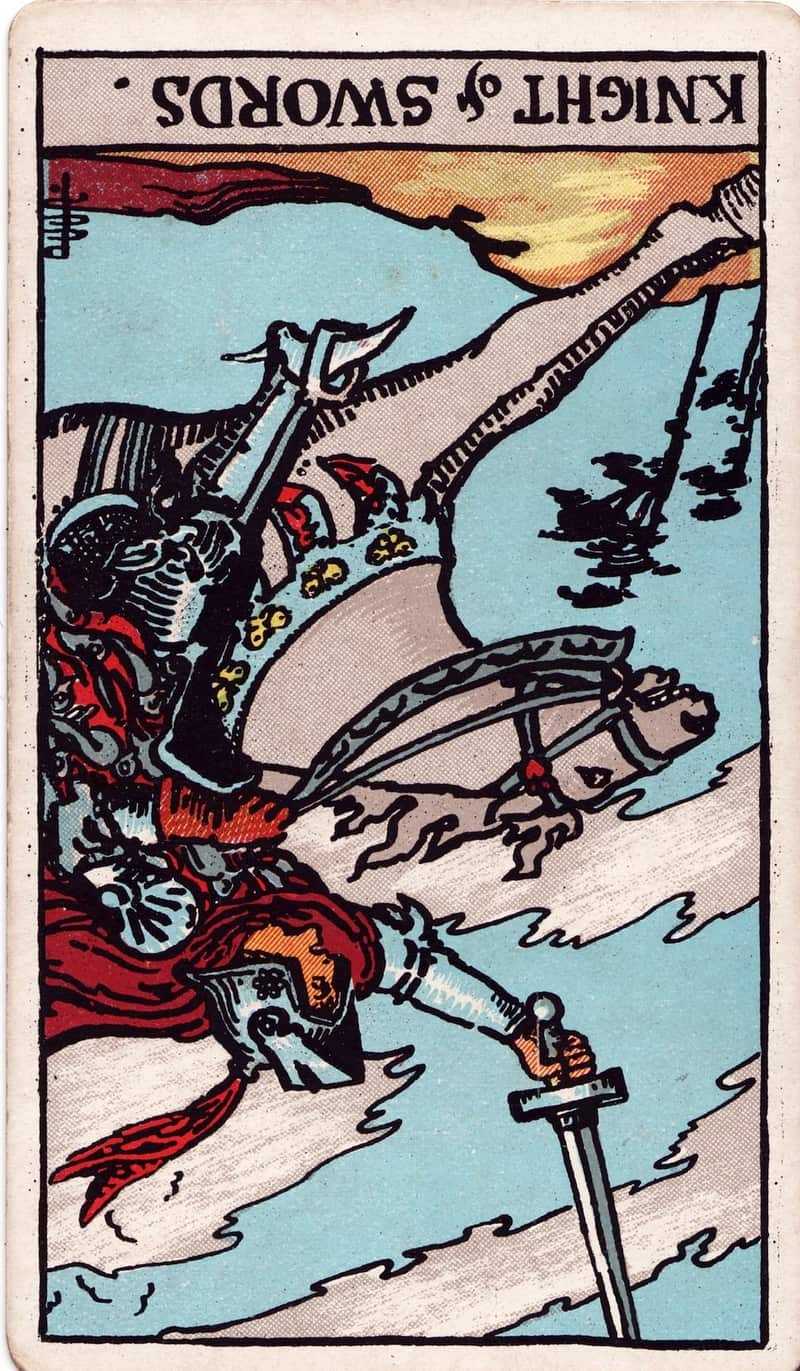
Reversed, the Knight of Swords means force has lost its target, leaving the same velocity scattered, misdirected or collapsing.
Instead of a clean charge, you may be rushing between ideas, starting fights you cannot finish or pushing so hard that the original purpose disappears. The sharp mind becomes tactless; confidence hardens into bullying; courage turns into aggression without control. In some readings, the reversal shows someone using argument as a weapon simply because they can.
The other expression is burnout mid-charge. You may have committed at full speed, ignored the ground beneath you and reached the point where your energy can no longer carry the plan. This is not a quiet pause. It is the sudden failure of momentum that was never given a clear direction or sustainable pace.
Slow down enough to name the target, the reason and the cost. The reversed knight does not need less intelligence or less drive; he needs a line worth following and limits that keep force from becoming damage. Until those are clear, every burst of action risks creating more resistance than it clears.
Reversed: love, career and money
Love
In love, the reversed Knight of Swords points to pursuit without care and communication sharpened into conflict. If you are single, you may be rushing towards the wrong person or pushing for certainty so hard that potential partners pull away. Attraction becomes a demand for an answer before trust has had time to form.
If you are dating or attached, impatience can turn small disagreements into full charges. Hurtful words arrive quickly, and one person may try to win rather than understand. The card asks you to stop using bluntness as proof of honesty. Slow the exchange before aggression burns through the connection you were trying to defend.
Career
At work, the reversed Knight of Swords shows drive without a workable plan. You may be attacking several tasks at once, changing direction mid-project or forcing decisions before the necessary details are in place. The result is movement that creates more work rather than progress.
It can also describe an aggressive colleague or a bullying work style that exhausts the people around it. Step back, set one target and order the work before pushing again. If burnout has already stopped the charge, rebuilding focus matters more than pretending you can recover the lost pace through another burst of effort.
Money
With money, the reversed Knight of Swords warns that pressure is feeding reckless behaviour. You may be tempted to make a risky investment, spend heavily or chase a dramatic fix because acting feels better than sitting with financial strain. That urgency can make weak options look decisive.
Pause before committing and check the details you would rather skip. A scattered approach to saving, spending or investing can burn through resources without solving the original problem. The answer is not a bigger gamble. It is a clear limit, a defined purpose and enough time to see if the decision still makes sense once the rush has passed.
Timing
For timing, the Knight of Swords can symbolise urgency or a fast-moving situation. Some readers translate that into hours or days, while this site uses winter as a seasonal convention for Swords. Neither provides a dependable deadline, and court-card zodiac assignments vary between systems; use the actual circumstances to judge whether quick action is needed.
Knight of Swords card combinations
Like much of the Suit of Swords, the Knight of Swords carries themes of action and intellect. The spiritual energy in tarot card readings, when the Knight of Swords is paired with other cards, can be even more insightful, sometimes challenging the Knight’s conviction and other times reinforcing it.
Knight of Swords and The Chariot
Paired with The Chariot, the Knight of Swords brings together speed and the need to direct it. Both cards can support a reading about commitment and determination, but neither makes momentum unstoppable. Choose a clear goal, keep competing demands under control and check whether the route remains workable before increasing the pace.
Knight of Swords and Knight of Cups
Sometimes, you may feel conflicted between emotion and intellect. This pairing validates that, as the Knight of Swords’ decisive energy meets the emotional depth and romanticism of Knight of Cups. Together, they give you hope of harmonising logic with feelings, and this is particularly important for your love life.
Knight of Swords and The Tower
The Knight’s swift energy meets the disruption symbolised by The Tower. This pairing can ask how you respond when a plan or assumption is challenged: quick thinking may help, but rushing to regain control can add to the problem. It does not predict disaster or promise that adaptability alone will resolve it.
Knight of Swords and Knight of Pentacles
As you can imagine, it is a good sign when these two Knights come together. The diligence and forward planning of Knight of Pentacles are exactly what the Knight of Swords needs to balance out his readiness. This combination is the encouragement you need to find a middle ground between immediate results and choosing the right path. It is particularly important for your finances and career.
Knight of Swords and Knight of Wands
This is a firework pairing, with both dominant Knights ambitious and energetic. With both being action-oriented, there is a coming together of direction and passion. You may be confronted with the dangers of being reckless, and the Knight of Wands pairing is a warning against that, but there is a deep sense of unfiltered enthusiasm that should be used as fuel.
Astrology
The Knight of Swords draws on Air as the suit’s symbolic element: thought, argument and communication put into motion. Gemini, Libra and Aquarius offer different astrological lenses on those themes, but the card does not identify a person’s birth sign.
Court-card correspondences vary because Rider–Waite–Smith, Golden Dawn and Thoth do not use all ranks in the same way. Rather than treating one sign or date range as universal, read the knight’s Air symbolism alongside the visible charge: is a sharp idea being turned into considered action, or is speed overtaking judgement?
Conclusion
The Knight of Swords asks you to use speed with intention: move towards resistance when the target matters, and stay honest about what your charge may damage. Upright or reversed, the card measures the difference between decisive force and force that has forgotten its purpose, asking you to act quickly without pretending pace can replace direction, care or judgement.
Continue through the court cards with Page of Swords or Queen of Swords.
Reading approach: Use these Rider–Waite–Smith interpretations to explore the question and context. A card does not establish another person’s feelings or a future outcome; check practical decisions against observable facts.
Curious about what lies ahead?
Get a free AI tarot reading and explore guidance designed just for you. Discover the messages the cards have to share and gain insight into your path.
Get a free tarot reading


