



The King of Swords Tarot Card Meaning: The Card of Intellectual Authority
Table of Contents
- Upright / Reversed keywords
- King of Swords description
- Symbolism: what’s in the King of Swords? (1–10)
- What does the King of Swords mean?
- What does the King of Swords mean in love?
- What does the King of Swords mean for career?
- What does the King of Swords mean for money?
- The King of Swords as feelings
- The King of Swords as actions
- Is the King of Swords a yes or no?
- What does the King of Swords reversed mean?
- Reversed: love, career and money
- Timing
- King of Swords card combinations
- Astrology
- Conclusion
Meaning at a glance
King of Swords: upright and reversed
Upright
The King of Swords represents clear reasoning put to responsible use. Evidence, consistent standards and a willingness to decide are central to his authority. Consider what is fair and what follows from the facts, including the consequences of the decision for other people.
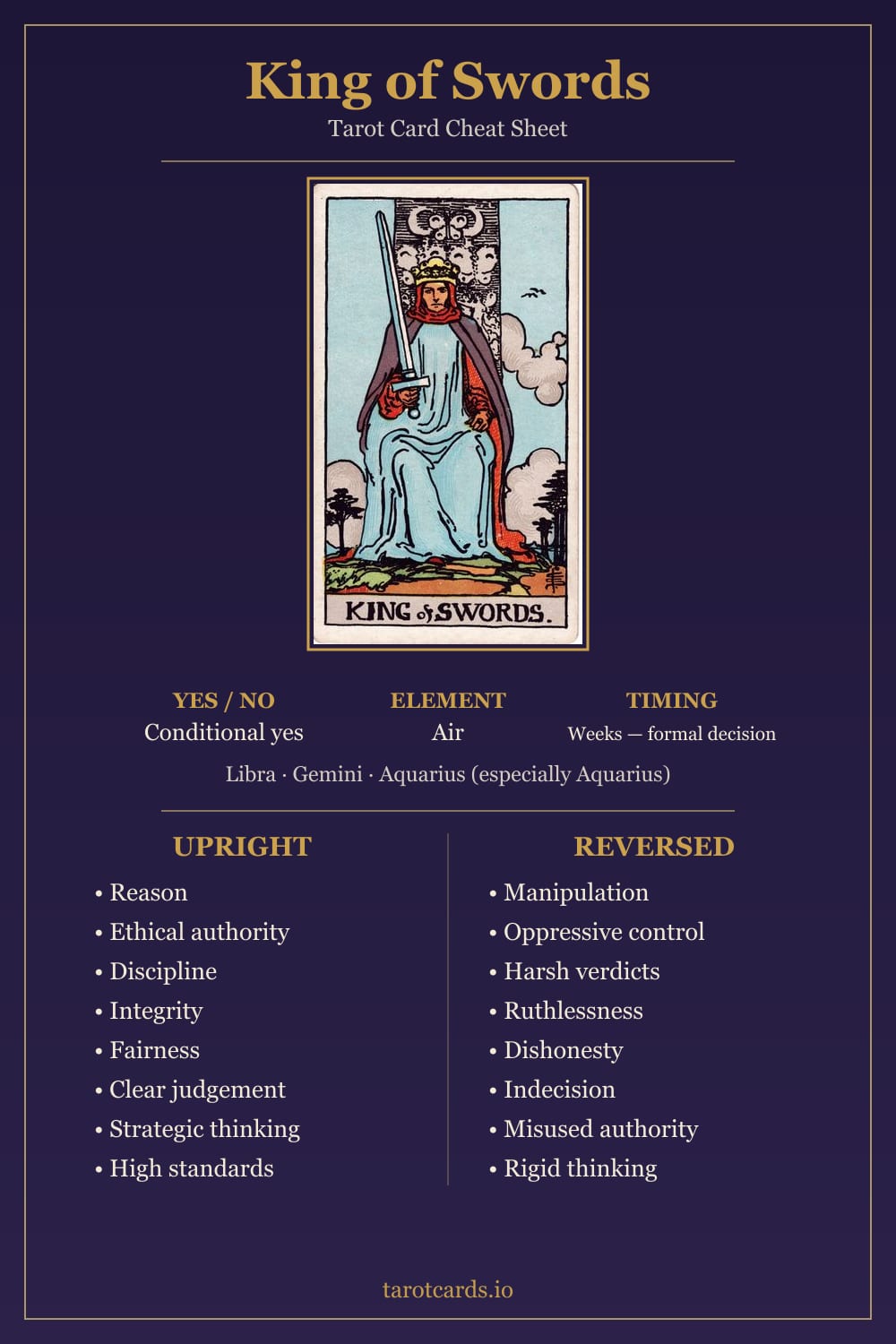
Keywords: Reason, ethical authority, discipline, integrity, fairness, clear judgement, strategic thinking, high standards
Reversed
Reversed, the King of Swords can describe intelligence used to control or justify unfairness, or authority unwilling to make a needed decision. Examine the reasoning and the use of power together. A confident argument deserves scrutiny as much as an uncertain one.
Keywords: Manipulation, oppressive control, harsh verdicts, ruthlessness, dishonesty, indecision, misused authority, rigid thinking
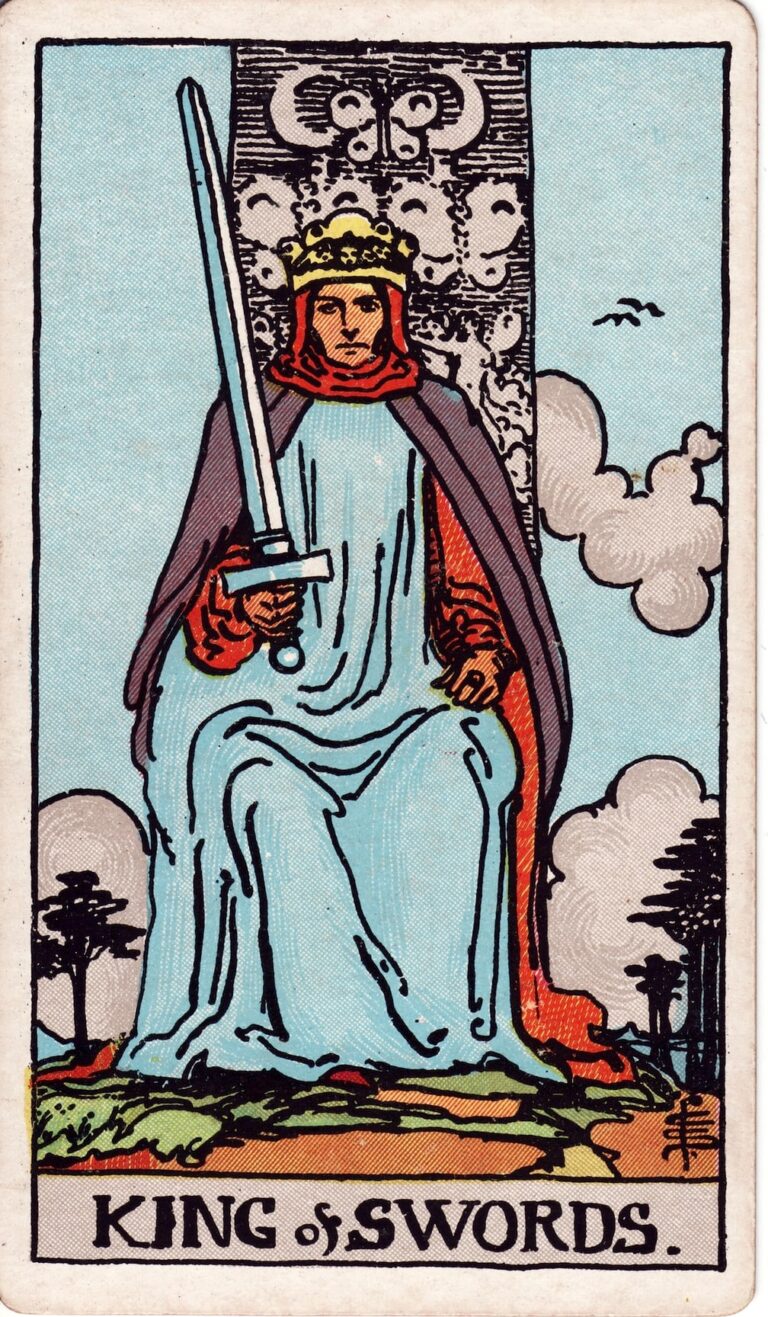
The King of Swords represents disciplined intellect, ethical authority, and judgement made from facts rather than impulse. Upright, he is not the deck’s cold villain: he is the fair judge you want when your case is sound, and just as often an instruction to take emotion out, apply the standard, and decide.
In readings, he can point to a judge, surgeon, engineer, editor, or anyone whose role depends on exact standards and clear decisions. His sword is upright yet slightly tilted, setting his judgement apart from Justice: reason stays firm, but mercy and nuance still have room to enter.
King of Swords description
In the Rider-Waite-Smith deck, the King of Swords sits almost square to the viewer on a carved throne. Two birds cross the clear sky high above him, while a few low clouds sit nearer the horizon. Trees form a low line behind the throne.
The throne back carries carved butterflies and crescent moons, with a small sylph-like figure positioned beside the King’s ear. He wears a blue tunic beneath a purple cape, giving the central figure a strong block of colour against the pale sky.
His posture is unusually direct for a Swords court card. One hand rests easily on his lap while the sword rises beside him, held upright but with a slight tilt rather than a perfect vertical line. From the birds at the top to the trees along the horizon, the composition is spare and ordered, keeping your attention on the seated King, the throne, and the blade.
Also known as: the King of Épées in the Tarot de Marseille, with some modern decks using Blades. The Thoth deck keeps the name Swords, and in playing-card decks the suit maps to Spades; this guide focuses on Rider–Waite–Smith imagery and interpretation, which may differ from those traditions. In the Thoth deck this card appears as the Knight of Swords — Thoth courts run Knight, Queen, Prince and Princess.
Symbolism: what’s in the King of Swords? (1–10)
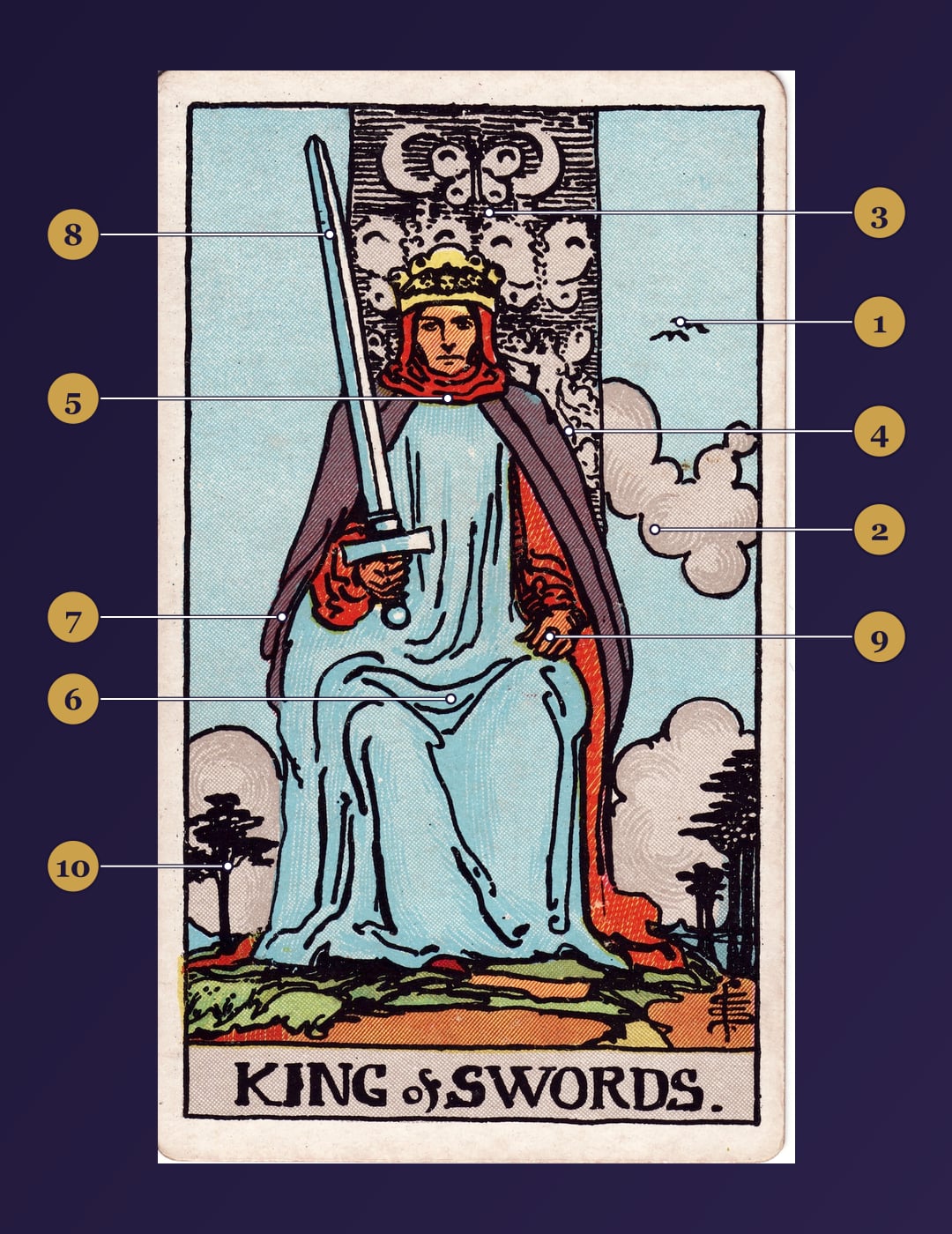
- Two birds high in the sky. The paired birds suggest judgement that has been checked rather than rushed. Logic is tested against counsel before the King decides. Set beside the Queen of Swords and her single bird, the image gives the King deliberation where the Queen carries lone clarity.
- Calm sky with few low clouds. The open sky points to a settled mental climate. The storms have been mastered rather than erased, so the King’s calm is earned. He can see clearly because disturbance no longer controls the whole field of his attention.
- Butterflies and crescent moons on the throne. These carvings bring soul-transformation and intuition into the seat of authority itself. His rule is intellectual, but the throne shows that reason is not empty of inner change or quieter perception.
- Sylph-like figure beside his ear. The small carved figure places inspiration close to the King’s stern reason. His judgement is exacting, yet the image leaves room for insight that arrives from somewhere other than hard analysis before a verdict is given.
- Nearly full-frontal posture. The King is the only Swords court to meet the viewer almost head-on. That directness suits his rank: truth here is delivered rather than hinted. When he speaks, the card expects a clear position rather than evasive wording.
- Blue tunic. Blue places the suit’s Air quality plainly on the King’s body. Intellect is not merely a tool he reaches for when needed; it is part of how he presents himself, thinks, and takes responsibility for decisions.
- Purple cape. The purple cape joins judgement with wisdom and rank. This is not raw cleverness on display. The King’s authority comes with the expectation that experience should shape how intelligence is used, especially when his decision affects other people.
- Sword upright but slightly tilted. The blade is firm without being perfectly vertical. Compared with the strict upright line of Justice, that tilt is the key difference: the King can deliver a verdict while still leaving room for nuance and mercy.
- Left hand resting on his lap. The relaxed hand shows power held in reserve. He does not need to clutch at authority to prove he has it. His command is already established, so force can remain unused unless the situation actually calls for it.
- Trees on the low horizon. The trees give his conclusions roots. His positions are meant to hold when conditions shift, rather than changing with every passing pressure. The image closes with firmness: a judgement should be able to stand once the wind picks up.
What does the King of Swords mean?
The King of Swords means fair, disciplined authority: use evidence, apply a clear standard, and make the decision. In readings, this card usually lands when intelligence has to become responsibility. Thinking well is no longer enough. You have to decide what is true, what is fair, and what follows from that conclusion.
This is why the upright King is poorly served by the idea that he is simply cold or severe. He is the judge you want if your case is sound. His standards are high, but the slightly tilted sword matters: unlike the strict vertical of Justice, his judgement can admit nuance and mercy without giving up principle.
Sometimes the card describes a person whose work depends on exact decisions, such as a judge, surgeon, engineer, or editor. Just as often, it describes what you need to do. Take the emotional heat out of the issue, check the facts, listen to sound counsel, then state your position directly.
The King is the suit’s mature intellectual authority, but maturity here is ethical as well as mental. Cleverness without integrity belongs closer to his reversal. Upright, he is the professional conscience of the deck: informed, exacting, accountable, and willing to put a clear verdict behind his reasoning.
What does the King of Swords mean in love?
The King of Swords in love points to a principled but emotionally reserved connection, where respect, honesty, and fairness matter more than grand displays of affection. This can feel cool if you want constant reassurance, but the upright card is not automatically unloving. It values conduct you can rely on.
If you are single, the King can describe someone who shows interest through consistency, intelligent conversation, and clear standards rather than romance for its own sake. You may also be asked to judge a potential partner by what they actually do, not by the heat of the moment.
If you are attached, clear communication and agreed boundaries carry extra weight. During conflict, the card favours a calm account of the facts over emotional escalation. In separation or divorce contexts, use it as a prompt to clarify agreements and responsibilities; it cannot establish that another person will honour them. The relationship question is whether both people are behaving fairly.
What does the King of Swords mean for career?
The King of Swords for career means authority earned through clear thinking, strong standards, and decisions that can be defended with facts. It is especially at home around law, strategy, technology, and roles where judgement matters more than charm.
At work, this card tells you to prepare your case. Bring the evidence, know the standard, and make your reasoning easy to follow. If a decision is contested, the person with the clearest facts and the strongest professional basis is likely to carry more weight than the person making the most noise.
The King can also describe a senior figure, adviser, or specialist whose opinion shapes what happens next. A judge, surgeon, engineer, or editor fits the card because each role depends on exact judgement and professional responsibility. If you need expert guidance on a project, brief, contract, or disputed decision, get the advice in writing. Precision protects the work when memories, preferences, or office politics start to blur what was actually agreed.
What does the King of Swords mean for money?
The King of Swords for money calls for controlled risk, disciplined spending, and investment decisions based on evidence rather than excitement. This is a card for knowing the rule you are following before you put money behind it.
Your financial choices benefit from a steady, rational view of the whole position. Check what you are spending, what you are committing to, and how each decision affects the longer plan. Short-term emotion can push you towards purchases or investments that look appealing now but do not survive close analysis.
The King’s symbolic approach to risk is measured rather than impulsive: understand the terms, test the reasoning and keep clear limits. A persuasive explanation is not enough to establish that financial advice is sound. Check the underlying evidence, costs and suitability instead of relying on either confidence or a tarot reading.
The King of Swords as feelings
As feelings, the King of Swords can symbolise measured interest, respect or an attempt to understand emotion through reason. That is a way to explore a connection, not access to another person’s private thoughts or proof that intellectual attraction is present.
Reserved expression can have many explanations. Look for consistency, fairness and clear communication rather than assuming that a cool manner hides tenderness or signals indifference. If you need to know where someone stands, ask and give their actual answer more weight than the card.
The King of Swords as actions
As an action prompt, the King of Swords favours clear standards, exact communication and responsibility for decisions. Define what needs to be decided, gather the relevant facts and explain the reasoning. The card does not establish that another person will take charge or issue a particular verdict.
A useful next step may be to formalise an agreement, correct an unsupported argument or make sure everyone is working from the same information. Precision is most helpful when it remains fair and open to correction, rather than becoming a way to dominate the conversation.
Is the King of Swords a yes or no?
For a yes-or-no reading, the King of Swords can be interpreted as a conditional yes when evidence, ethics and the relevant rules support a choice. It is a reading convention rather than approval of a plan or a promise that a decision will go your way.
Check the facts and ask whether your position would stand up to fair scrutiny. If important evidence or agreement is missing, resolve that gap before relying on confidence. The card can sharpen the questions you ask; it cannot settle them on its own.
What does the King of Swords reversed mean?
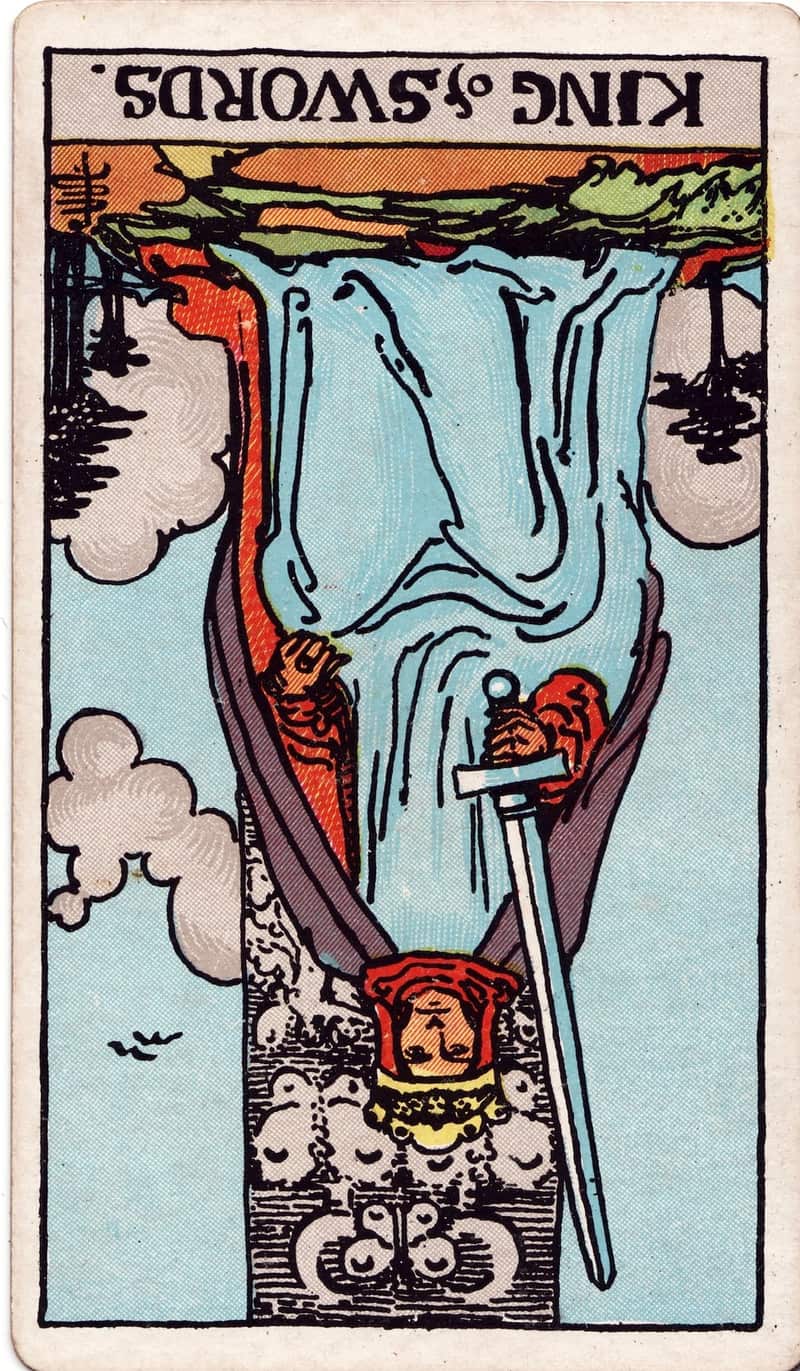
The King of Swords reversed means intelligence or authority is being misused, or that the person meant to decide has lost the firmness to do it. The key shift is not simply from clever to foolish. The mind may still be sharp, but its power is pointed in the wrong direction.
At one extreme, this is manipulation, harsh criticism, oppressive control, or a verdict delivered to dominate rather than to be fair. Someone may weaponise logic, use their position to silence disagreement, or apply standards selectively when it suits them. That kind of cold reasoning can alienate people and turn decisiveness into cruelty.
At the other extreme, authority goes soft. A person with responsibility may hesitate, avoid judgement, or fail to hold a clear line when one is needed. Rigid thinking can also become part of the problem, especially when new ideas are dismissed before they are properly considered.
In readings, check both possibilities: is someone using intellect as a weapon, or is the person with authority refusing to decide? Either way, the card asks for clearer standards, cleaner motives, and a decision that can survive honest scrutiny.
Reversed: love, career and money
Love Meaning
In love, the reversed King of Swords points to control, harsh judgement, or a relationship where intellect is being used to create a power imbalance. One person may pick apart the other’s words, set rules that only work in their own favour, or treat every disagreement like a case to win.
For singles, the warning is against becoming so cold or analytical that nobody gets close, while also watching for someone who uses apparent reasonableness to manipulate. Emotional openness matters because logic alone cannot make a connection fair.
For couples, unclear boundaries can make the imbalance worse. If criticism has become constant or one partner keeps rewriting what is reasonable, step back from the argument and look at how power is actually being used.
Career Meaning
In career readings, the reversed King of Swords can show a domineering or unfair authority figure, conflict with leadership, or poor judgement inside a role that demands objectivity. The problem is not simply having a strict boss; it is authority being applied without fairness or sound reasoning.
You may be dealing with someone who closes down disagreement, makes a decision before the facts are clear, or uses expertise to intimidate rather than guide. The card can also point back at you if frustration is making your own judgement less objective.
When professional decisions are disputed, separate the standard from the personality enforcing it. Clear evidence and precise reasoning matter even more when the person in charge is not using either consistently.
Finances Meaning
For money, the reversed King of Swords can prompt a review of confused reasoning, pressure from an adviser or a plan whose assumptions no longer hold. Financial strain can have many causes; living from one pay day to the next does not itself show impulsiveness or lavish spending. Check the real constraints before judging the decisions.
It can also flag a purchase or investment being sold through forceful claims rather than reliable logic. If the reasoning is vague, contradictory, or pushing you past your own boundaries, do not let confidence substitute for clarity.
The card also keeps ethics in view. Unethical investments or purchases may look clever in the short term, but they belong to the reversal. Reassess the strategy, check the information, and make sure the decision still makes sense when pressure is removed.
Timing
For timing, the King of Swords can suggest that a formal decision, clear agreement or review of evidence is the relevant milestone. This site uses winter as a seasonal convention for Swords, but neither a season nor a court-card correspondence provides a dependable deadline. Zodiac assignments also vary with the system used to map court ranks.
King of Swords card combinations
In combinations, the King of Swords brings standards, evidence and responsibility into the reading. A neighbouring card can challenge an overly narrow argument or show where judgement needs another perspective. These five examples offer starting points to adapt to your question and spread position.
The King of Swords and The High Priestess
The King’s explicit reasoning meets the inward attention of The High Priestess. Read together, they can invite you to notice what intuition is raising, then examine it alongside available evidence. The pair does not predict a coming situation or make a yes-or-no pull a substitute for an informed decision.
The King of Swords and Queen of Swords
This King and Queen pairing is a powerful symbol of high standards, mental clarity, and intellectual power. With the Queen of Swords, it represents a union of clarity and perception, and it can sometimes reflect on personal relationships, either with family members or romantic ones, in which trust and pragmatic thinking have become important. For your love life, it could mean connecting on a cerebral level in which you both share similar belief systems.
The King of Swords and King of Cups
The King of Cups brings emotional steadiness alongside intellectual authority. In a leadership question, this combination can ask how to make a clear decision while listening to the people it affects. Empathy and firm standards need not cancel each other out; the task is to use both fairly.
The King of Swords and Ace of Swords
The Ace of Swords supplies a new question or insight, while the King asks how well it holds up to scrutiny. For a project or disputed decision, the pair can suggest turning an initial idea into a clear argument with supporting evidence. A feeling of clarity alone does not establish that your conclusion is correct.
The King of Swords and Five of Wands
The Five in the Suit of Wands represents disagreements, so this pairing highlights the necessity of logic during any conflicts, and a keen eye on the truth during any clashes of ego. It suggests using your bright mind to mediate with a sense of fairness, as the King of Swords encourages, and warns against petty arguments or conflicts during struggles for power.
Astrology
The King of Swords belongs to the suit associated with Air, providing a symbolic framework for reason, language and judgement. Court-card zodiac assignments vary with the system and the mapping of Rider–Waite–Smith, Golden Dawn and Thoth ranks. This guide uses the Air theme without treating Aquarius as an exclusive birth sign or assigning the King a universal calendar window.
Conclusion
The King of Swords asks you to make the clearest decision you can defend: check the facts, apply the standard fairly, and leave enough room for mercy that judgement does not harden into cruelty. Reversed, the same sharp mind can become manipulative or oppressive, while weak authority can leave a necessary decision hanging.
Continue exploring the suit with Queen of Swords.
Reading approach: Use these Rider–Waite–Smith interpretations to explore the question and context. A card does not establish another person’s feelings or a future outcome; check practical decisions against observable facts.
Curious about what lies ahead?
Get a free AI tarot reading and explore guidance designed just for you. Discover the messages the cards have to share and gain insight into your path.
Get a free tarot reading


