



The High Priestess Tarot Card Meaning: Discover Your Inner Wisdom
Table of Contents
- Upright / Reversed keywords
- The High Priestess description
- Symbolism: what’s in The High Priestess? (1–9)
- What does The High Priestess mean?
- What does The High Priestess mean in love?
- What does The High Priestess mean for career?
- What does The High Priestess mean for money?
- The High Priestess as feelings
- The High Priestess as actions
- Is The High Priestess a yes or no?
- What does The High Priestess reversed mean?
- Reversed: love, career and money
- Timing
- The High Priestess card combinations
- Astrology
- Conclusion
Meaning at a glance
The High Priestess: upright and reversed
Upright
The High Priestess invites quiet attention to intuition, privacy and what is only partly understood. Her covered scroll suggests that some information is still missing. Give an impression room to develop while distinguishing what you feel from what you can verify.
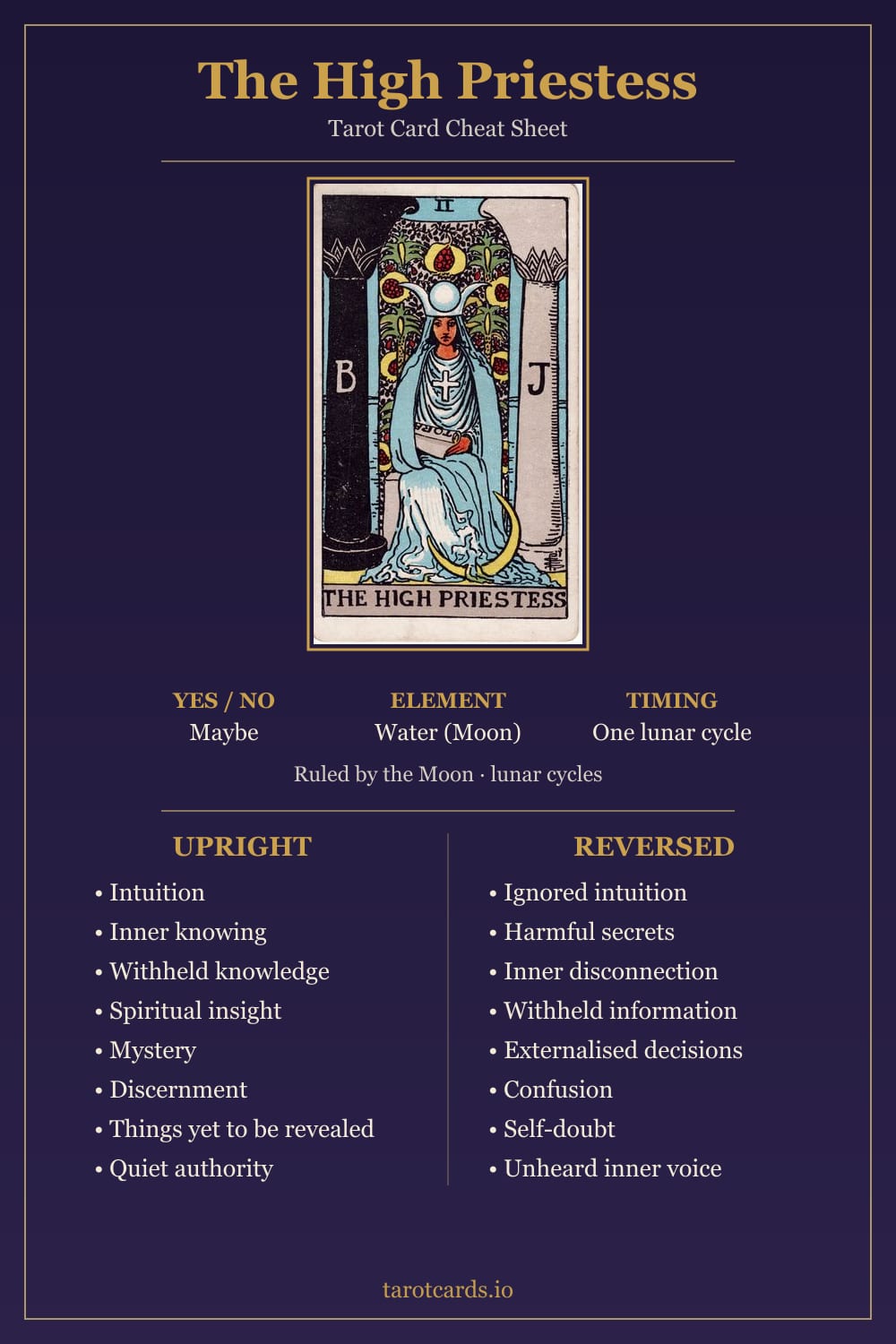
Keywords: Intuition, Inner knowing, Withheld knowledge, Spiritual insight, Mystery, Discernment, Things yet to be revealed, Quiet authority
Reversed
Reversed, The High Priestess can describe intuition drowned out by outside opinions, ignored boundaries or secrecy that has become unhelpful. Make space to hear your own response, then test it against the situation rather than treating either suspicion or reassurance as proof.
Keywords: Ignored intuition, Harmful secrets, Inner disconnection, Withheld information, Externalised decisions, Confusion, Self-doubt, Unheard inner voice
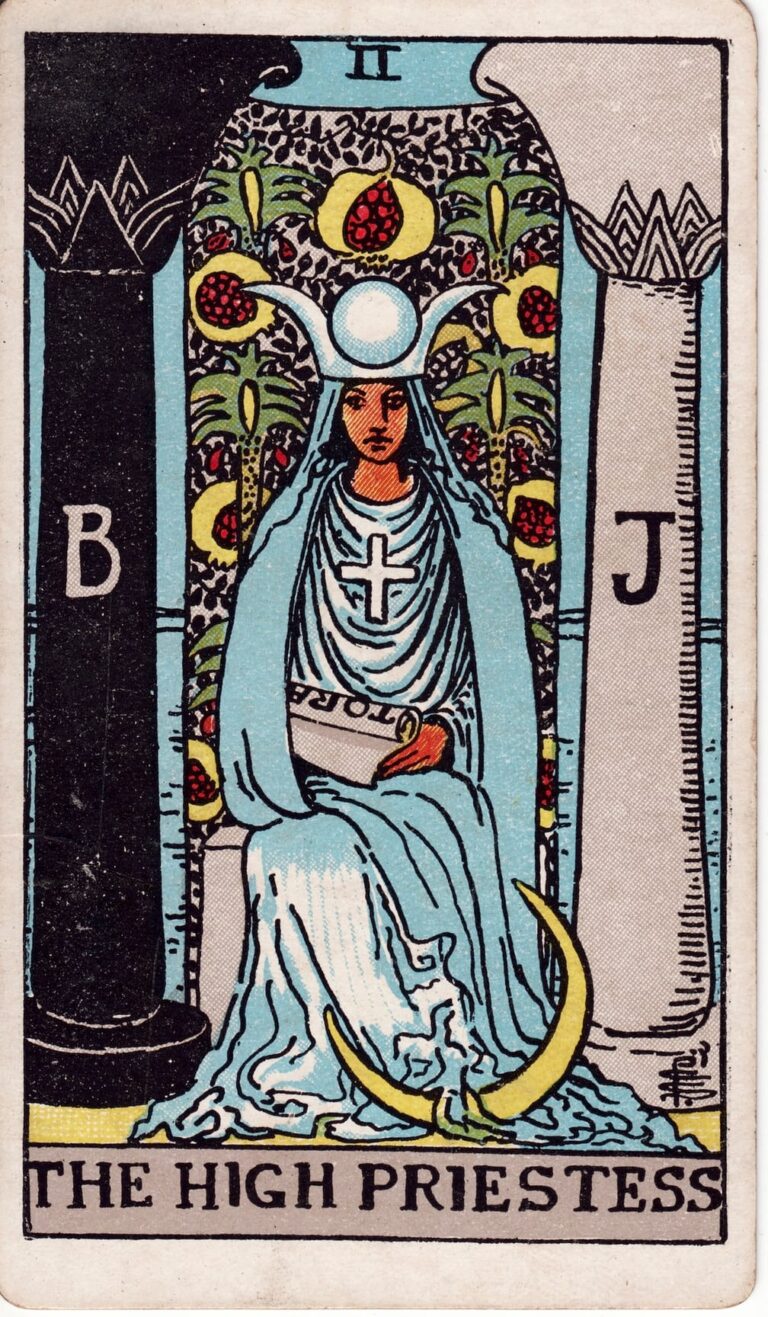
The High Priestess is the Major Arcana card of inner knowing, withheld knowledge, intuition, and the quiet authority to recognise what has not yet been said. Her stillness is not passivity: she guards the threshold between what is visible and what remains concealed, asking you to trust what you sense without forcing an answer before it is ready; in readings, she often appears when part of the truth is present but not yet available in full and outside reassurance cannot settle it.
The High Priestess description
In the Rider-Waite-Smith deck, the High Priestess sits front and centre between two tall pillars, one black and marked B, the other white and marked J. A patterned veil hangs behind her, decorated with pomegranates and palms, and a narrow glimpse of sea can be seen beyond it. She wears a pale dress beneath a long blue robe, with an equal-armed cross at her chest and a horned lunar crown above her head.
A scroll marked TORA rests across her lap, partly covered by the folds of her robe. At her feet lies a crescent moon. Her robe falls in broad, water-like folds towards the bottom of the card, while the two pillars rise on either side of her seated figure. She faces forward and holds the central space between them. Most of the background is occupied by the veil, so the water behind it appears only in small slivers around the edges of the scene.
Also known as: The Papess (La Papesse) in the Tarot de Marseille and The Priestess in the Thoth deck. This guide focuses on Rider–Waite–Smith imagery; related cards in other decks can differ in imagery and interpretation.
Symbolism: what’s in The High Priestess? (1–9)
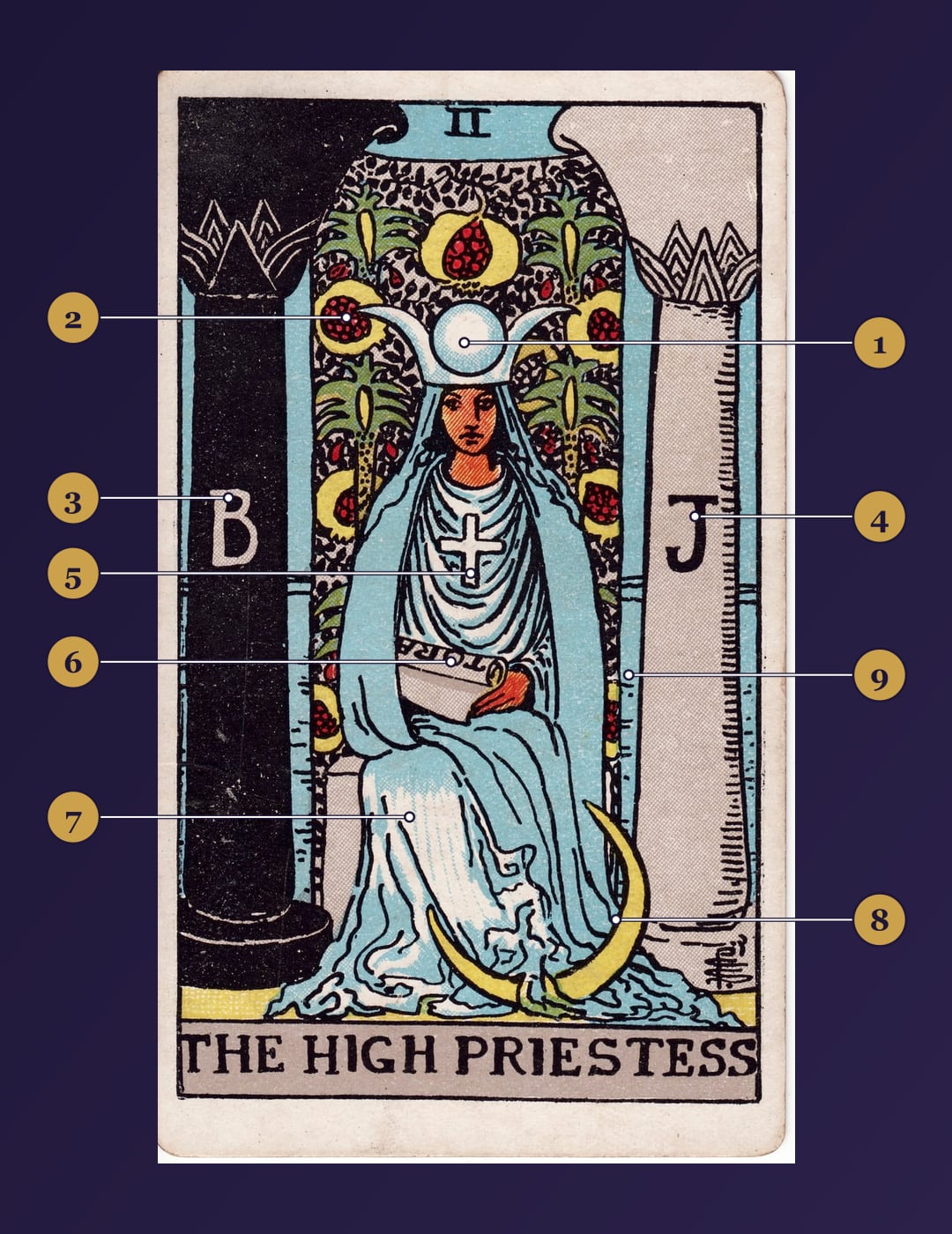
- Horned lunar crown: The horned crown frames a central sphere, a form often read through lunar symbolism. It places a cycle above the High Priestess’s head, suggesting knowing that develops, reaches fullness and recedes rather than arriving in a single flash of insight.
- Veil of pomegranates and palms: The patterned veil is the screen between conscious awareness and the subconscious. Its pomegranates carry the association with Persephone and feminine mystery, while the palms bring a masculine counterweight. Together they hold those forces in balance while keeping the deeper space behind them partly concealed.
- Pillar B, Boaz: The black pillar marked B is Boaz, one gatepost of Solomon’s Temple. It represents severity and the negative pole. The High Priestess does not sit beneath it or submit to it; she holds her place beside it as one side of a necessary opposition.
- Pillar J, Jachin: The white pillar marked J is Jachin, associated with mercy and the positive pole. Paired with Boaz, it makes the High Priestess’s position clear: she sits between opposites rather than choosing one, holding the point through which both sides must be understood.
- Equal-armed solar cross: The cross on her chest has four equal arms, linking it with balance among the four elements. Worn at the centre of her body, it shows spirit stabilised in matter. Her inward authority is therefore grounded rather than detached from the material world around her.
- TORA scroll: The scroll across her lap is only partly visible beneath her robe. It represents divine law, but even its title stays open to more than one reading: Torah, Tarot, or Rota. The key detail is concealment; the text is present, yet it is never shown in full.
- Blue robe: Her blue robe falls in folds that resemble flowing water, forming the source-stream of the subconscious. That water does not end with this card; it pools and flows through later images in the deck. Here, it begins with the High Priestess and the hidden depths she guards.
- Crescent moon: The crescent at her feet places intuition under her command rather than above her as an uncontrollable force. It also echoes Marian iconography. With the lunar crown above and the crescent below, the card surrounds her with moon imagery while keeping her seated and composed between them.
- Glimpse of sea: Behind the veil, only small portions of the sea can be seen. That hidden water stands for the vast subconscious: present, powerful, and much larger than the visible opening suggests. You are allowed a glimpse, not full access, which matches the card’s repeated insistence on partial revelation.
What does The High Priestess mean?
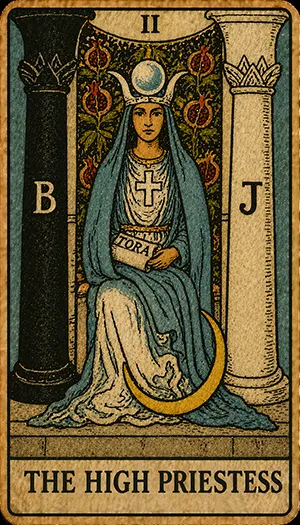
In an upright reading, the High Priestess invites you to attend to intuition while accepting that your understanding may be incomplete. An impression can be worth exploring without being established as fact. Waite described the card, in some respects, as among the highest and holiest of the Greater Arcana; the image keeps returning to partial revelation through the covered scroll, veiled sea and passage between the pillars.
That makes her different from simple passivity. The High Priestess is actively deciding what passes through the threshold and what stays behind it. She is also not simply a card of psychic powers; treating her that way misses the harder lesson about inner authority, restraint, and knowledge that cannot be dragged into the open on demand.
Placed beside The Hierophant, her role becomes clearer: he teaches outer doctrine, while she guards the inner mystery. Beside The Empress, she shows another face of feminine power. The Empress is embodied, fertile, and outwardly abundant; the High Priestess is veiled, interior, and selective. When she appears, observation can be an action, silence can be a boundary, and waiting can be a form of discernment rather than indecision.
What does The High Priestess mean in love?
In love, the High Priestess can represent feelings or questions that have not been fully spoken. It does not establish hidden attraction. If you are single, someone may be drawn to you without making their interest obvious, or you may find yourself pulled towards a connection that feels meaningful before either person can define it. This card advises you to notice the tone, timing, and unspoken exchanges rather than pressing for certainty too quickly.
If you are attached, the same secrecy can show up differently. There may be feelings, needs, or questions sitting beneath the surface even in a stable relationship. The High Priestess does not automatically make those hidden things negative; she asks you to sense what is present before turning every silence into an interrogation. Give the connection enough quiet for what is genuine to show itself, while keeping your own inner read intact. A bond under this card may resist labels for a time because part of its meaning is still taking shape.
What does The High Priestess mean for career?
For career, the High Priestess suggests observing carefully when an impression is difficult to explain. Before committing to a project, role, strategy or alliance, identify what you know, what you suspect and which information is still missing. The card does not establish that colleagues are withholding something from you.
Pay attention to what people avoid saying, which details arrive late, and where your instincts keep returning even when the formal case looks complete. You do not need to announce every suspicion or explain every private conclusion. The High Priestess can favour restraint while you check an impression against evidence, including evidence that challenges it. If you are studying or pursuing higher learning to support your ambitions, this card can represent the value of study: knowledge can strengthen your next move, but this card still asks you to distinguish what is taught openly from what you learn by close observation.
What does The High Priestess mean for money?
For money, the High Priestess asks you to slow financial decisions until you understand what is hidden in the numbers. Your risk appetite should be measured rather than impulsive, especially when an investment, purchase, or financial offer looks attractive but still leaves unanswered questions. A quiet doubt deserves attention before money leaves your hands.
With spending, this card favours awareness over restriction for its own sake. Notice the purchases you make automatically, the assumptions behind them, and the information you have not checked. For investments, do not treat intuition as a substitute for facts, but do not dismiss an unease simply because you cannot immediately explain it either. The High Priestess is strongest when inner caution and informed decision-making work together, with no pressure to act before you have enough clarity.
The High Priestess as feelings
As feelings, the High Priestess can symbolise privacy, reserve or an emotional response that is difficult to read. Someone may prefer to keep feelings to themselves, but the card cannot show whether attraction lies behind their silence. Let the interpretation identify uncertainty rather than fill it with a reassuring answer.
Privacy can be sincere and appropriate, yet it still leaves you with limits on what you know. Consider whether communication and observable behaviour give you enough clarity for the connection you want. The card does not require you to keep waiting for a hidden declaration.
The High Priestess as actions
As actions, the High Priestess represents observing, pausing and choosing carefully what to disclose. In your own situation, that could mean gathering context before speaking or protecting a reasonable boundary around personal information. It does not predict that another person will hold back or reveal their intentions later.
As a possible action theme, the High Priestess suggests restraint: listening, keeping appropriate privacy or waiting until you have enough information to speak. In a relationship question, distinguish that reflective approach from silence that leaves an agreement unclear. The card cannot tell you which motive another person has; their communication and behaviour provide the evidence.
Is The High Priestess a yes or no?
For yes or no, this guide reads the High Priestess as maybe: the question may need more information or reflection before a useful decision is possible. The card is a prompt to examine uncertainty, not proof that someone is concealing the answer.
If you need an answer now, her response is to wait rather than force one. What is hidden may surface later, and your own inner sense may be more useful in the meantime than repeated attempts to extract certainty from the situation.
What does The High Priestess reversed mean?
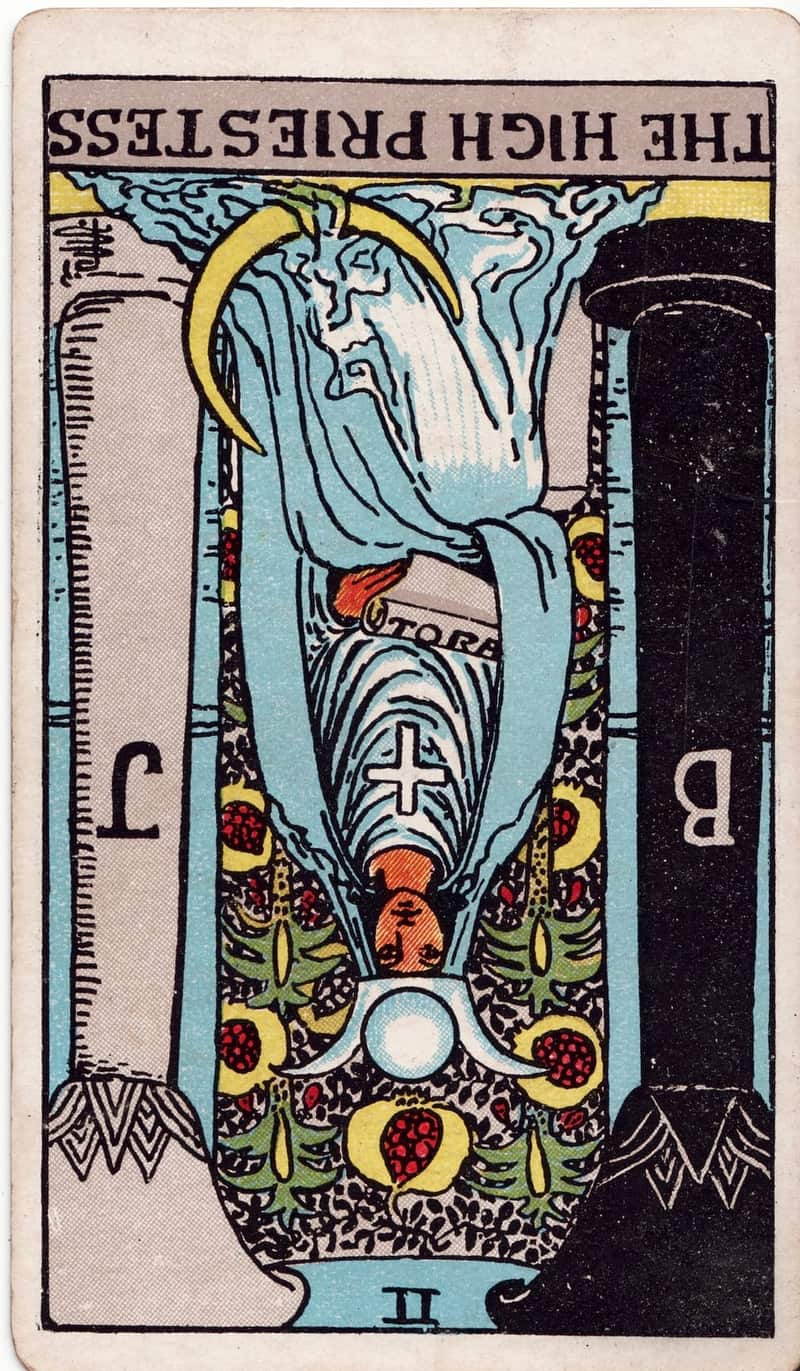
Reversed, the High Priestess means your connection to inner knowing has been disrupted, ignored, or handed over to outside voices. This is not simply the upright meaning turned upside down. The deeper shift is separation: you sense something, then talk yourself out of it; you know a boundary has been crossed, then ask everyone else to decide whether your reaction is valid; or a secret that once protected privacy starts causing harm because it cannot be acknowledged.
In the upright card, the veil controls access to hidden knowledge. Reversed, that veil can become a wall between you and what you already know. You may be collecting opinions, explanations, and reassurance because trusting your own judgement feels harder than outsourcing the decision. Important information can also be withheld from you, but the reversal asks you to look at your response to that gap and notice when you dismiss an inner warning simply because you do not yet have proof.
The way back is not to become suspicious of everything. It is to rebuild contact with your own observations, let secrecy stop doing damage, and separate genuine intuition from the noise created by fear or other people’s certainty.
Reversed: love, career and money
Love
In love, the High Priestess reversed points to feelings that have been buried so thoroughly that they start distorting the connection. If you are single, it can prompt you to examine assumptions about attraction and to distinguish your own wishes from what another person has actually expressed. Unwanted attention can also require a clear boundary rather than polite self-doubt.
If you are attached, withheld feelings can harden into resentment and surface through arguments about something else. The problem is not simply that emotion is private; it is that secrecy has stopped protecting the relationship and started preventing honest contact. Listen to what you already know needs to be addressed.
Career
In career matters, the reversed High Priestess can prompt you to examine gaps between workplace impressions and the information available to you. If you feel excluded from decisions or held back, look for specific examples of missing context and ask for clarification where possible. The card alone does not establish that someone is obstructing your advancement.
Do not turn suspicion into accusation without evidence. The practical correction is to stop dismissing your own observations, keep a clear record of what is happening, and avoid outsourcing every professional judgement to people who may not have your interests in mind.
Money
For money, the reversed High Priestess warns against spending or investing while disconnected from your own caution. An unexpected expense can strain your finances, but the larger risk is ignoring what the figures are already telling you or relying on another person’s confidence instead of checking the details yourself.
If an offer feels wrong, pause and examine why. If secrecy surrounds a financial arrangement, do not treat that as sophistication. The reversal asks you to bring hidden information into view, look directly at your spending, and make decisions from what you can verify rather than from pressure, wishful thinking, or borrowed certainty.
Timing
In the Golden Dawn system, Book T associates the High Priestess with the Moon. Some readers use one lunar phase cycle, about 29.5 days, as a symbolic timing interval; others focus on waiting for clearer information. Neither method establishes a deadline for an event or another person’s disclosure.
The High Priestess card combinations
As you already know, the meaning of one card in tarot spreads also depends on the other cards in those spreads, and that’s why it’s so important to understand the interactions between the cards. Below are some of the most important combinations of the High Priestess and other cards.
The High Priestess and The Hierophant
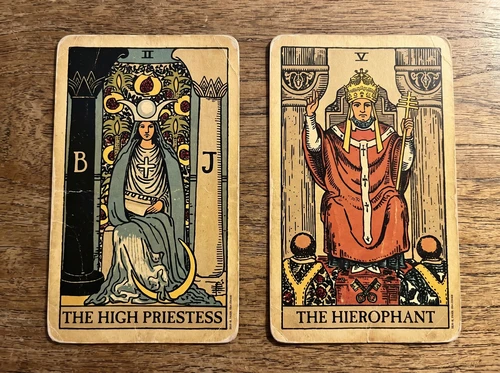
Both these cards are cards of inner wisdom, but they have opposite, complementary approaches to the concept. While the High Priestess is more about intuition, mystery, subconsciousness, and hidden knowledge, The Hierophant is more about formal education, tradition, and societal norms. With The Hierophant, you walk on an established path, but with the High Priestess, you make your own way. The High Priestess rewards people who slow down long enough to listen, and a one card reading is one of the quickest ways to do that.
This doesn’t mean that one approach is better than the other or that you must choose between them. The combination of these two cards reminds you to do both. Sometimes, it would be better for you to follow tradition, while in other cases, you should make some unorthodox decisions. Pick your battles: you don’t always have to rebel against societal norms, but you shouldn’t be too scared to break them when needed.
The High Priestess and Wheel of Fortune
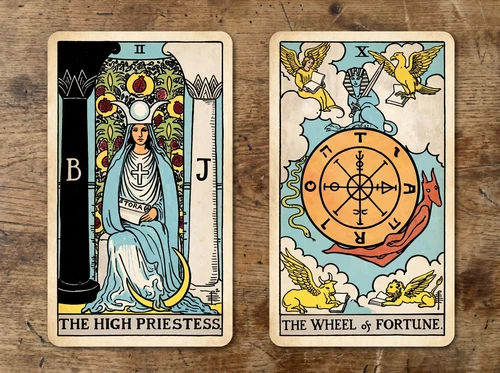
The High Priestess and the Wheel of Fortune bring reflection and change together. A shift in circumstances may call for new knowledge or a different understanding of what you already know. Make time to observe and learn before deciding which changes to accept and which choices remain yours.
When you get the High Priestess and Wheel of Fortune together, the pairing can prompt you to notice recurring patterns without assuming every difficulty is a lesson you have failed to learn. Reflection may help you respond differently where you have a choice; it does not make you responsible for every change in circumstances.
The High Priestess and The Hanged Man
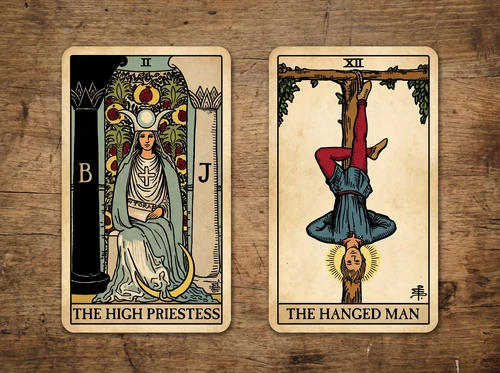
Sometimes, to fully understand some things, you need to look at them from a different perspective. That’s exactly the meaning behind the High Priestess and The Hanged Man duo. When you see these two cards in the same tarot spread, it’s a message that you need to shift your perspective. Surrender your biases and assumptions to get a clear picture of the situation.
The High Priestess and The Fool
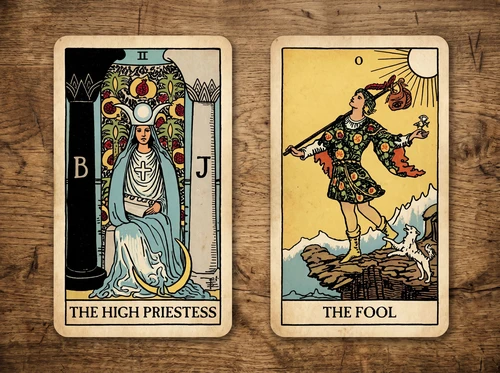
This is quite a combination: a card representing knowledge and wisdom beside a card literally named The Fool. The Fool is the first card in the tarot deck, and that’s not a coincidence. This card is a card of innocence and naivety, as well as a card of new beginnings and adventure.
This card combination reminds us that there is a hidden wisdom in innocence and naivety, even when it seems contradictory. If we all tried to go back to that state of childlike innocence, the world would be a much better place. Sometimes, we mistake someone’s simplicity for foolishness, but it can actually be a sign of a much deeper wisdom.
Astrology
This card is connected to the Moon, our mysterious yet captivating celestial friend. Both the High Priestess card and the Moon represent your feminine side, your intuition, and your spiritual insight. They are reminders that our minds hide so much and that there is so much we don’t know, even about ourselves.
Conclusion
The High Priestess asks you to respect what is partly hidden: trust the knowledge already forming inside you, but do not force the rest into the open before it is ready. Upright, that restraint protects inner authority; reversed, it shows what happens when the veil cuts you off from your own judgement.
Reading approach: Use these Rider–Waite–Smith interpretations to explore the question and context. A card does not establish another person’s feelings or a future outcome; check practical decisions against observable facts.
Curious about what lies ahead?
Get a free AI tarot reading and explore guidance designed just for you. Discover the messages the cards have to share and gain insight into your path.
Get a free tarot reading


