



The Hierophant Tarot Card Meaning: Tradition, Teaching and Shared Values
Table of Contents
- Upright / Reversed keywords
- The Hierophant description
- Symbolism: what’s in The Hierophant? (1–9)
- What does The Hierophant mean?
- What does The Hierophant mean in love?
- What does The Hierophant mean for career?
- What does The Hierophant mean for money?
- The Hierophant as feelings
- The Hierophant as actions
- Is The Hierophant a yes or no?
- What does The Hierophant reversed mean?
- Reversed: love, career and money
- Timing
- The Hierophant card combinations
- Astrology
- Conclusion
Meaning at a glance
The Hierophant: upright and reversed
Upright
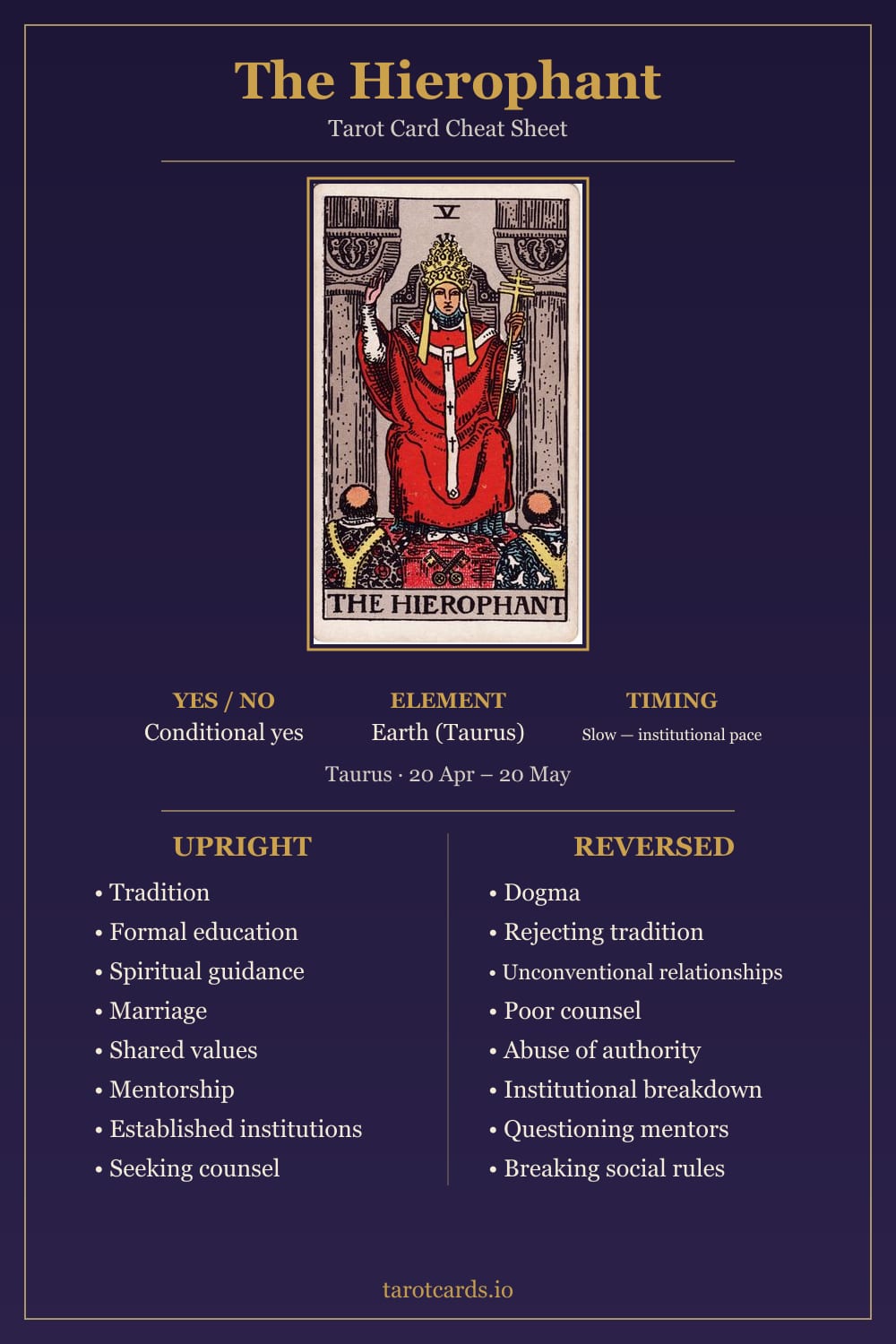
The Hierophant concerns teaching, tradition and the institutions that pass on shared knowledge. A mentor, qualification or established practice may offer useful guidance. Examine what the tradition teaches, who interprets it and whether its values deserve your participation.
Keywords: Tradition, formal education, spiritual guidance, marriage, shared values, mentorship, established institutions, seeking counsel
Reversed
Reversed, The Hierophant questions inherited rules and the authority behind them. You may be outgrowing a convention or noticing dogmatic guidance. Decide what remains worth learning and what needs challenging; disagreement alone does not make every alternative sound.
Keywords: Dogma, rejecting tradition, unconventional relationships, poor counsel, abuse of authority, institutional breakdown, questioning mentors, breaking social rules
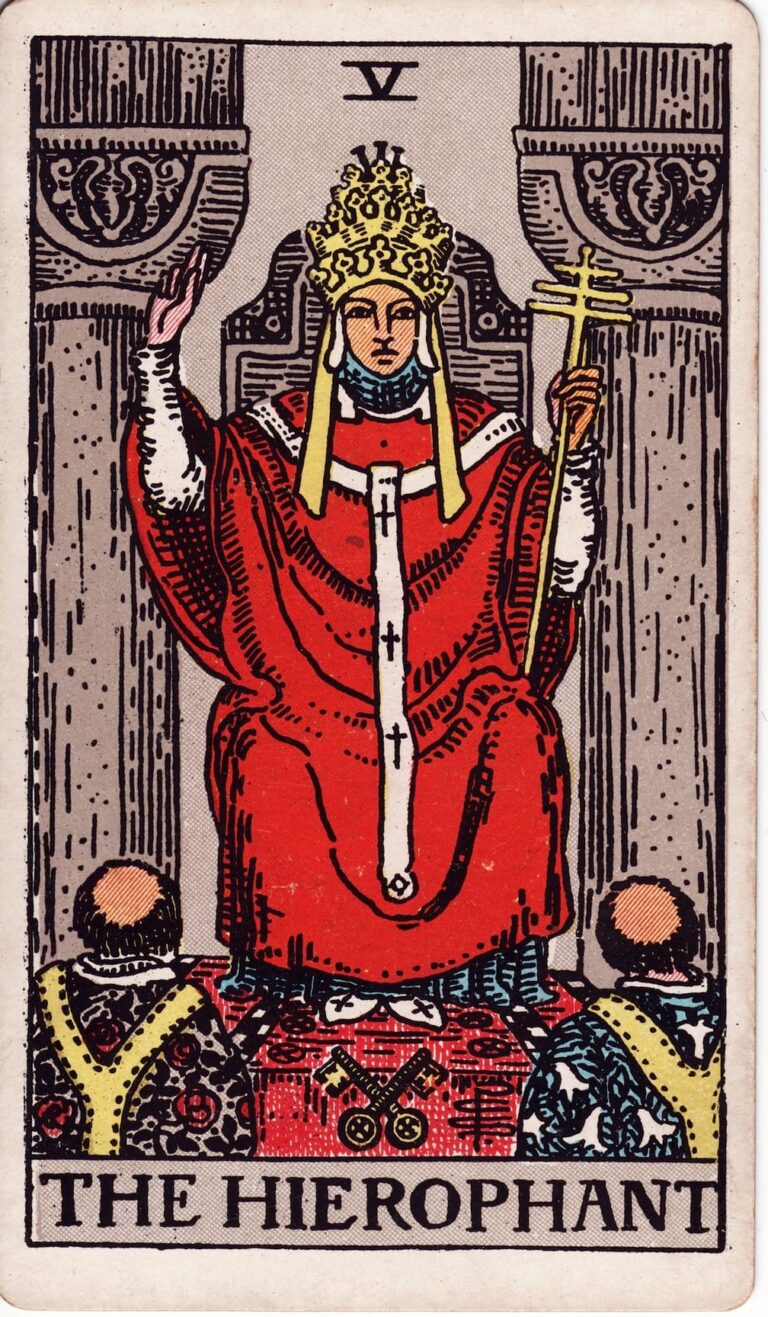
The Hierophant is the card of tradition, teaching and the shared rules that turn private beliefs into something a group can recognise, from religious practice to marriage, education and professional life; when he appears, the question is how much authority you are willing to give those structures. He is often reduced to religion or rigid conformity, but his real domain is any established framework of meaning, and he asks whether that convention still serves you; in love, this distinction matters because he makes the recognised stage of commitment available rather than guaranteeing marriage.
The Hierophant description
In the Rider-Waite-Smith card, a religious figure is framed by two plain grey pillars. He wears a red outer robe over blue and white vestments, with a triple crown on his head and a straight band marked with crosses running down the front of his clothing. One hand is raised in a formal blessing, with two fingers pointing upward and two downward, while the other holds a triple-barred cross sceptre. The pillars, sceptre and long vestment band give the upper part of the image a strong vertical emphasis.
Below him, two tonsured acolytes kneel. One figure’s robe carries red roses, while the other’s shows white lilies. A pair of crossed keys lies at the Hierophant’s feet. His dark grey-green slippers rest on a red dais, completing a scene in which the clothing, gestures and objects all appear carefully ordered. From the crown at the top to the platform beneath his feet, the image is built around ceremony and formal display.
Also known as: The Pope (Le Pape) in the Tarot de Marseille and older decks. The Thoth deck keeps the name The Hierophant; this guide focuses on Rider–Waite–Smith imagery, rather than treating the decks as interchangeable.
Symbolism: what’s in The Hierophant? (1–9)
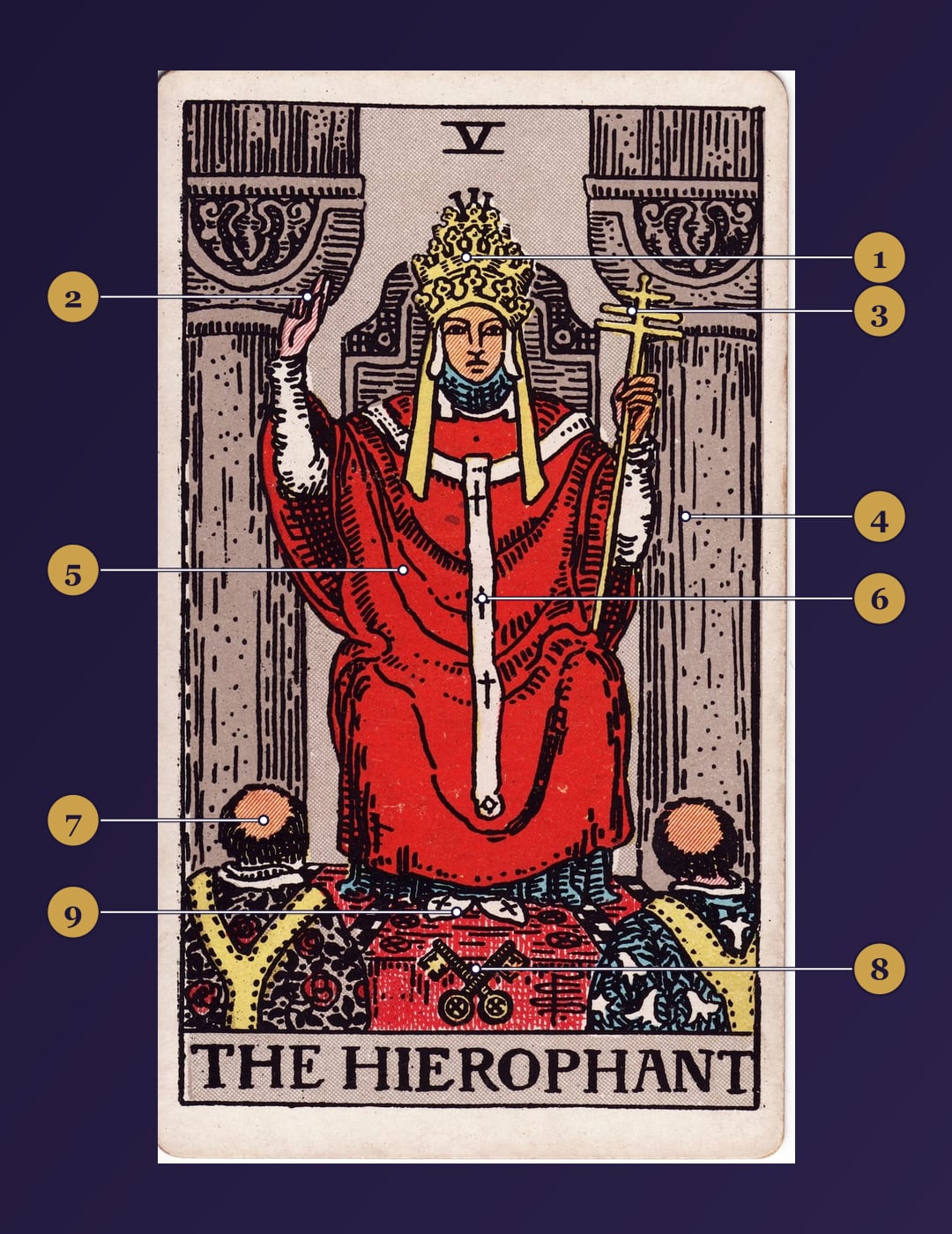
The Hierophant contains nine marked symbols, moving from the crown above him to the dais beneath his feet.
- Triple crown: At the top of The Hierophant is a triple crown, the papal tiara that places authority above the rest of the image. Its three levels correspond to the conscious, subconscious and superconscious worlds, showing that the office reaches across all three rather than belonging to ordinary social rank alone.
- Raised hand in benediction: His right hand gives a formal blessing, with two fingers pointing upward and two downward. The gesture bridges heaven and earth, while its divided form suggests that part of the doctrine is openly shown and part remains concealed from those receiving it.
- Triple-barred cross sceptre: The sceptre in his other hand repeats the card’s threefold structure. Its three horizontal bars mirror religious authority across the same conscious, subconscious and superconscious worlds, reinforcing that his role is to carry sanctioned teaching between different levels of understanding.
- Two grey pillars: The pillars frame the Hierophant as an established institution rather than a solitary seeker. Their plain grey stone differs from the charged polarity of the pillars behind The High Priestess, shifting the emphasis from guarded mystery to a public structure with recognised rules.
- Red robe over blue and white vestments: The layered clothing shows spirit clothed in office. Red dominates the outer figure, while blue and white remain underneath, drawing attention to the difference between the man himself and the formal role he has taken on.
- Cross-studded vertical band: The straight band running down his vestments is marked with crosses and reads like the yoke of ordained office. Teaching here is not casual advice passed between equals; it moves through a formal channel, with the role carrying duties as well as authority.
- Two kneeling acolytes: The tonsured figures show knowledge being passed down through hierarchy. One wears red roses linked with desire, while the other wears white lilies linked with thought, placing different human impulses beneath the same system of teaching.
- Crossed keys: The keys at his feet represent access to the mysteries. Paired together, they point to the conscious and subconscious minds being opened at once, but the keys sit within the Hierophant’s institution, suggesting that entry comes through an established form of instruction.
- Grey-green slippers on the red dais: Even the lowest part of the card is formalised. His dark slippers rest on the red platform, suggesting that every step of the office is ritualised and that doctrine does not stop with lofty teaching; it reaches the ground he walks on.
What does The Hierophant mean?
Upright, The Hierophant means tradition, formal teaching and the shared systems that give beliefs a recognised shape. In readings, this card usually lands when there is an existing structure around you: a university, a religious body, a professional organisation, an apprenticeship, a family custom or marriage as an institution. The point is not simply to obey it. The card asks you to understand what is being handed down, who has the authority to teach it and whether that convention still deserves your participation.
His mirror is The High Priestess. She guards esoteric knowledge behind a veil and keeps her scroll partly hidden; he brings doctrine into public life through teachers, rituals, rules and institutions, with the keys placed openly at his feet. That contrast helps explain why The Hierophant is larger than organised religion. In Marseille decks this figure is known as the Pope. The Rider-Waite-Smith title, Hierophant, means a revealer of sacred teachings and makes the teaching role explicit alongside the religious one.
Upright, the card can favour learning from an experienced guide, respecting a proven method or joining a system that gives your efforts recognition. It can also describe conformity that is useful for a time. The real test is whether the framework helps you live your values or asks you to surrender them without examination.
What does The Hierophant mean in love?
In love, The Hierophant points to a relationship becoming recognised, formal or rooted in shared values. It is less a card of raw passion than of belonging to something both people, and often the people around them, understand as a commitment. Engagement, marriage, families meeting or an explicit agreement about what the relationship means all fit this card.
If you’re single: The Hierophant can show that you are looking for long-term compatibility rather than a connection with no agreed direction. A future relationship may become serious, but the card does not promise marriage by itself. It shows that the institutional stage is available if the values and commitment are there.
If you’re attached: This card favours making the relationship official or strengthening the customs that already hold it together. Shared beliefs about marriage, family and commitment matter more than dramatic chemistry here, especially when you are deciding what the next recognised step should be.
What does The Hierophant mean for career?
For career, The Hierophant points to progress through established professional structures rather than through improvisation. Qualifications, accreditation, mentorship, corporate ladders and formal training can work in your favour now because this card rewards learning the recognised method before trying to replace it.
A boss, senior colleague or experienced teacher may have useful knowledge to pass on, especially when you are still building authority of your own. Training and CPD are natural expressions of this card: the value comes from entering a system where knowledge is taught and recognised by others.
The Hierophant can also describe you in the teaching role. If you already have experience, your next step may involve training colleagues or working within a professional body. This is not the strongest signal for going completely off-script. Follow the certified route where it exists, then decide what you have earned the experience to change.
What does The Hierophant mean for money?
With money, The Hierophant favours a cautious, rule-based approach to spending, borrowing and investing. Use that theme to reflect on staying within your limits and making repayments on time. Familiar institutions and conventional products still carry risks, so examine the terms rather than treating either tradition or novelty as a reason to trust an offer. Borrow only what you can keep under control, and make regular repayments part of the plan.
Savings fit the card well because they turn good intentions into a regular practice. Setting money aside for an emergency fund or a future need is more in keeping with The Hierophant than impulsive spending. If you are considering an investment, the card leans towards familiar structures, clear rules and advice you can check rather than an unconventional move made mainly because it feels exciting.
The Hierophant as feelings
As feelings, The Hierophant can represent an interest in recognised commitment, shared values and a relationship that fits an established way of life. Meeting family, exchanging rings or agreeing on expectations are examples of that symbolism. The card does not establish that another person wants those things with you.
The useful question is whether your expectations about commitment are compatible and have been discussed. Someone may value approval and continuity, but a serious relationship depends on mutual agreement rather than what a card appears to promise.
The Hierophant as actions
As actions, The Hierophant represents following an established procedure, seeking guidance or honouring an agreement. They may seek advice from a mentor, ask for family approval, honour an existing commitment or use an established institution to formalise what they intend.
In a relationship, that can mean a formal proposal or another recognised step. In a wider reading, it can mean following procedure, consulting an authority or relying on a time-tested rule. The theme is making intentions clear through a recognised process, while deciding whether that process actually suits the people involved.
Is The Hierophant a yes or no?
For a yes-or-no reading, a conditional yes: The Hierophant gives its strongest support when you take the conventional, approved path. If your plan depends on following established rules, seeking recognised guidance or making something official, the card leans clearly towards yes.
That support weakens when the question depends on rejecting the accepted route. For an unconventional plan, The Hierophant can lean towards no unless you are willing to work within the structure first.
What does The Hierophant reversed mean?
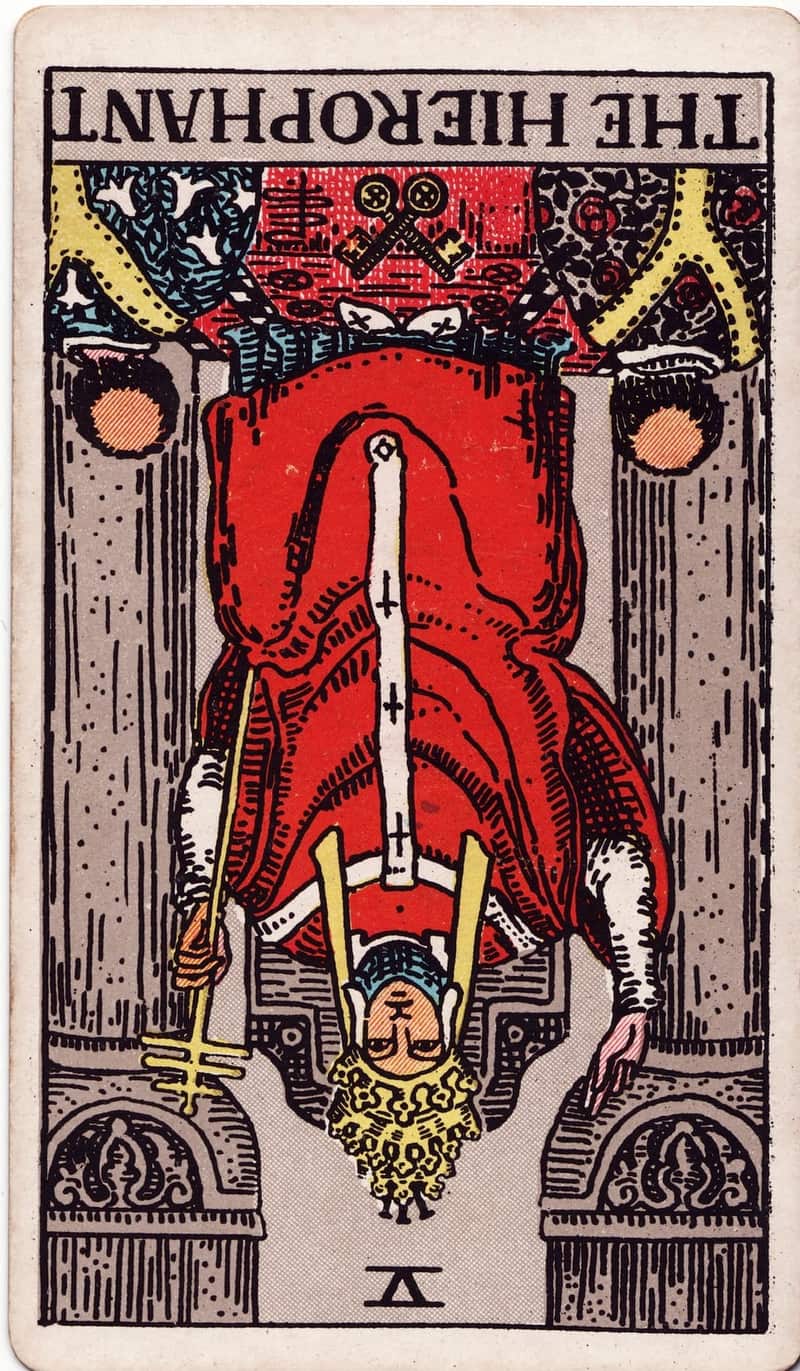
Reversed, The Hierophant means a convention is being challenged, questioned or refused. Instead of treating tradition as automatically correct, the card turns your attention to the authority behind it. A mentor may give poor counsel, an institution may misuse its position, or a family or social rule may no longer deserve the obedience it expects.
This reversal can be freeing when the structure has become hollow. It supports breaking from dogma, creating new traditions or choosing an unconventional relationship when the old form cannot hold what is true for you. The same impulse can become reckless, though, if you reject a sound system only because you dislike being told what to do.
In readings, the key is not rebellion for its own sake. The Hierophant reversed asks you to separate living wisdom from empty authority. Question the teacher, rule or institution closely, then decide what should be kept, revised or left behind. When authority has been abused, refusing the old arrangement may be the responsible choice.
Reversed: love, career and money
Love
In love, The Hierophant reversed points to a relationship that does not fit the expected template or that is under pressure from tradition. An age gap, different cultural backgrounds or conflicting religious beliefs may make the relationship harder for family or community to recognise, even when the bond itself matters to you.
The card can also show resistance to the conventional next step. That is not automatically a problem. The real strain appears when one person wants the sanctioned version of commitment and the other wants to rewrite the rules, especially if neither is willing to examine which values can bend and which cannot.
Career
At work, The Hierophant reversed can show you questioning a boss, mentor or professional structure that no longer deserves automatic respect. Peer pressure, unfair expectations or someone taking advantage of your work can make the standard way of doing things feel restrictive rather than useful.
This card can support an unconventional method, but only when you understand the system you are challenging. Speak plainly about what is not working and protect the boundaries of your role. Rejecting poor authority is different from rejecting every form of training, procedure or experience simply because it comes from above you.
Money
For money, The Hierophant reversed warns against throwing out sensible financial rules without a good reason. You may be tempted to ignore spending limits, fall behind on repayments or treat an unconventional investment as attractive simply because it sits outside the usual system.
If poor habits have already started, reduce spending before debt becomes the structure controlling your choices. The positive side of this reversal is selective independence: you can question financial advice or institutions, but do so after checking the facts and understanding the risk you are choosing to carry.
Timing
The Hierophant corresponds to Taurus in the Golden Dawn system. Readers using zodiac timing may choose roughly 20 April to 20 May; a context-based reading may instead focus on an institution’s approvals and formal calendar. These are symbolic approaches, not evidence that an event will occur within a particular window.
The Hierophant card combinations
The exact meaning of any tarot card is influenced by the other cards in a spread. There is a spectrum of meaning in tarot, and the meaning that fits you will depend on how the cards around The Hierophant interact. These pairings show useful shifts in context.
The Hierophant and The Wheel of Fortune
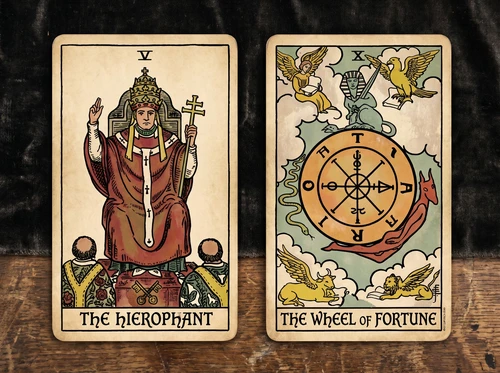
The Hierophant and Wheel of Fortune bring established structures into contact with change. If a rule, routine or institution no longer fits, the pairing can help you examine what should adapt and what remains useful. It does not promise that an external change will arrive or that another card pull can provide a verdict on an important decision.
In a job or relationship, ask which expectations are constraining you and what options you actually have. Change may involve a conversation, a revised agreement or a planned departure, depending on the facts. The cards cannot decide which ties to end or guarantee that leaving will feel freeing.
The Hierophant and The High Priestess
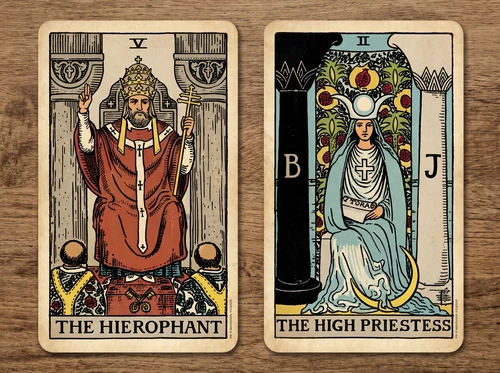
While The Hierophant is the Major Arcana tarot card that traditionally represents power and knowledge, The High Priestess represents those same concepts in a magical and mysterious way. The Hierophant is about following the rules, while The High Priestess is about following your own rules. Seeing those two cards together is a reminder that you should find a balance between following social norms and making your own traditions.
The Hierophant and The Lovers
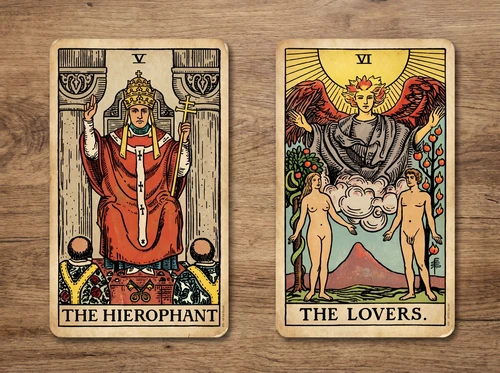
If you get The Lovers together with The Hierophant, it is a good sign. However, it also reminds you that your relationship will likely only succeed if you and your partner have shared values; otherwise, no matter how much you try to ignore your differences, they will continue haunting you. Obviously, you can’t find someone with exactly the same opinions and morals as you, but you should at least agree on the most important things, such as marriage and having kids.
The Hierophant and The Emperor
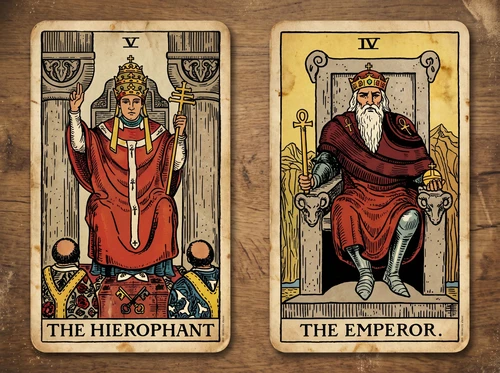
Both The Hierophant and The Emperor are symbols of power, authority and structured systems, and together, they can prompt you to examine who sets the rules and whether those rules are applied fairly. The pairing may suggest useful structure or excessive control, depending on context. If the question concerns a legal matter, a card cannot establish the facts, your responsibilities or the likely outcome.
The Hierophant and The Chariot
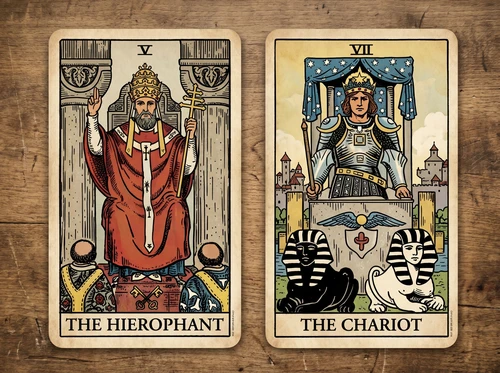
The wish to move forward is represented by The Chariot. It can be balanced by The Hierophant’s concern for an agreed process. Pursue your goals without treating success as a reason to ignore responsibilities. There are certain rules you shouldn’t break, and The Hierophant reminds you of that.
Astrology
The Hierophant corresponds to Taurus in the Golden Dawn system. Taurus is traditionally associated with steadiness, continuity and material stability, which complement the card’s themes of established practice. These are symbolic parallels rather than facts about every Taurus person’s personality or preferences.
Conclusion
The Hierophant asks you to look closely at the rules, teachers and institutions shaping your choices, then decide which ones still deserve your trust. Upright, he can show the value of recognised teaching and commitment; reversed, he shows the point at which inherited authority needs to be questioned rather than obeyed automatically.
Continue exploring with The Emperor or move on to The Lovers.
Reading approach: Use these Rider–Waite–Smith interpretations to explore the question and context. A card does not establish another person’s feelings or a future outcome; check practical decisions against observable facts.
Curious about what lies ahead?
Get a free AI tarot reading and explore guidance designed just for you. Discover the messages the cards have to share and gain insight into your path.
Get a free tarot reading


