



Two of Swords Tarot Card Meaning: How to Overcome Indecision & Move Forward
Table of Contents
- Upright / Reversed keywords
- Two of Swords description
- Symbolism: what’s in the Two of Swords? (1–10)
- What does the Two of Swords mean?
- What does the Two of Swords mean in love?
- What does the Two of Swords mean for career?
- What does the Two of Swords mean for money?
- The Two of Swords as feelings
- The Two of Swords as actions
- Is the Two of Swords a yes or no?
- What does the Two of Swords reversed mean?
- Reversed: love, career and money
- Timing
- Two of Swords card combinations
- Astrology
- Conclusion
Meaning at a glance
Two of Swords: upright and reversed
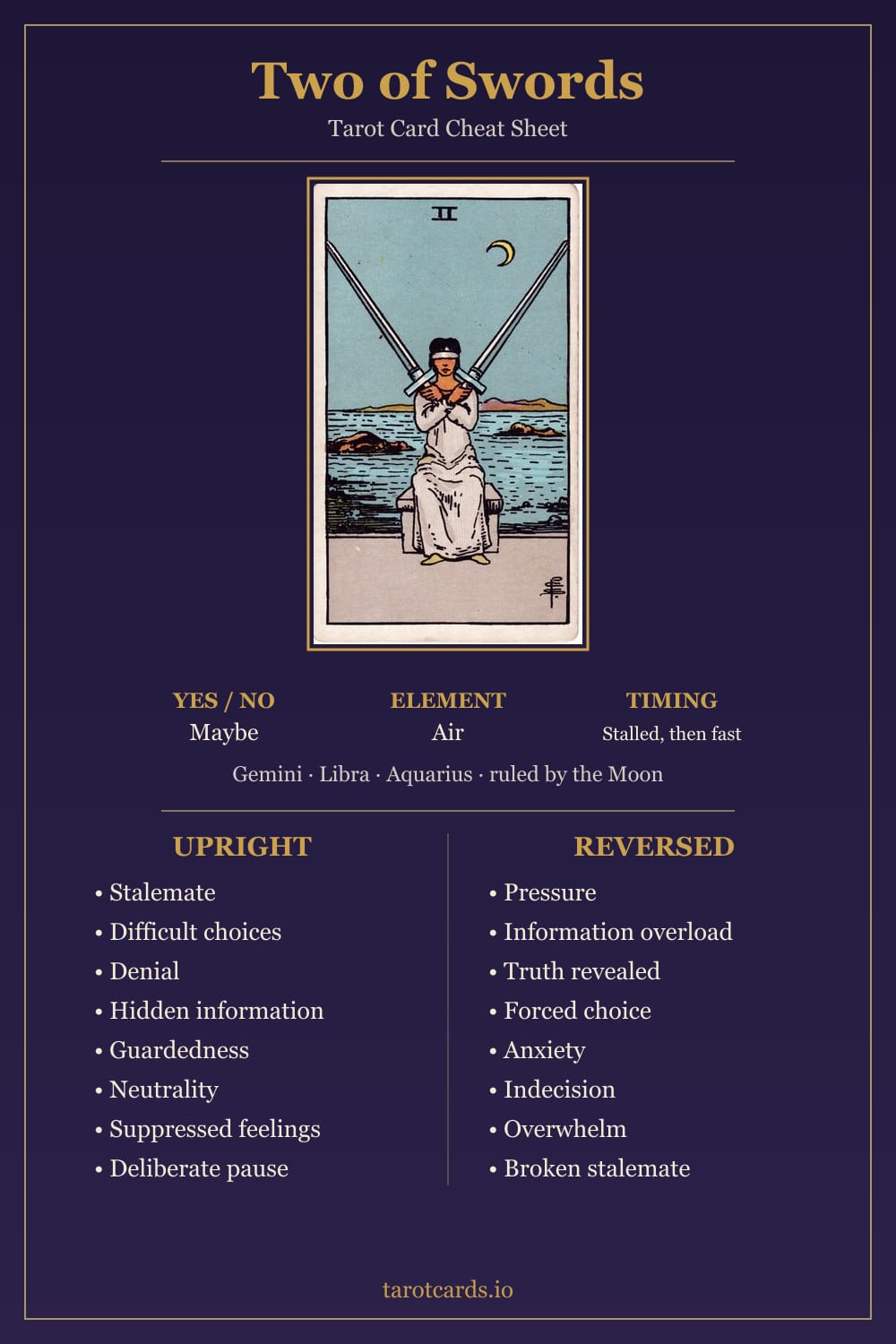
Upright
The Two of Swords represents a difficult choice held in suspension. A temporary truce may create space to think, but maintaining it also takes effort. Identify what you do not know and whether the pause protects clear judgement or avoids an uncomfortable decision.
Keywords: Stalemate, difficult choices, denial, hidden information, guardedness, neutrality, suppressed feelings, deliberate pause
Reversed
Reversed, the Two of Swords suggests a stalemate beginning to break as information or pressure gets through. The change can bring clarity or overload. Separate the relevant facts from the urgency you feel, then consider the choice in manageable parts.
Keywords: Pressure, information overload, truth revealed, forced choice, anxiety, indecision, overwhelm, broken stalemate
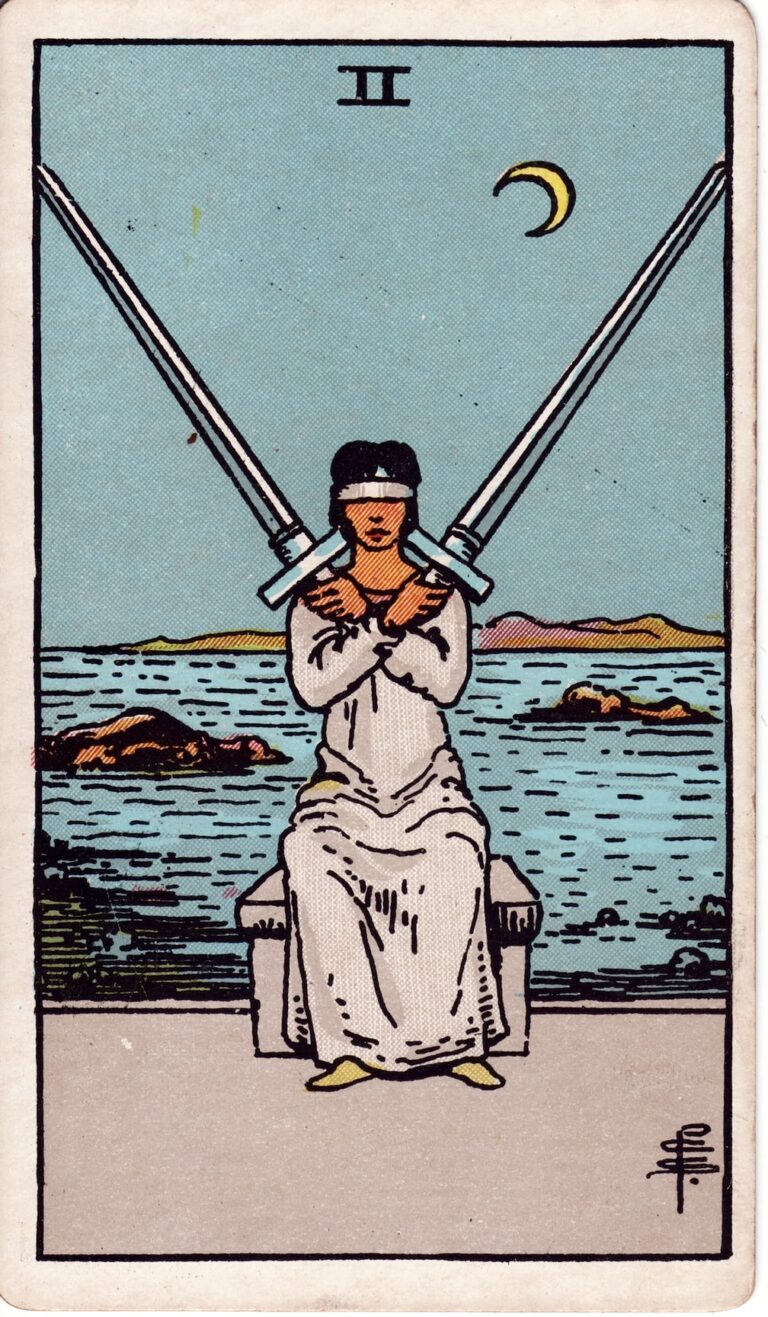
The Two of Swords appears when a difficult choice has been held in suspension: two positions remain balanced, feelings stay behind a guard, and no side is allowed to win. What makes this card sharper than simple indecision is that the stalemate is actively maintained; the blindfold can show avoidance or a deliberate withdrawal from outside noise to hear what you already know inside, but either way, it costs effort to keep holding the truce and puts responsibility for ending it back with you.
Two of Swords description
In the Rider-Waite-Smith Two of Swords, a young woman sits alone on a stone bench beneath a twilight sky. The Roman numeral II stands at the top of the card, while a waxing crescent moon hangs in the upper-right corner.
She wears a white robe and a white blindfold. Her arms are folded tightly across her chest, and she holds a sword in each hand. Her crossed arms hold the two blades angled upward and outward, creating a balanced guard rather than the movement of a fight.
Behind her, the sea stretches across the card. Rocky islets break through the water at different points, but the woman has her back to them. The whole image is still: she stays seated, her sight covered, with the swords held in place across her body. She faces forward while the water and rocks remain behind her, and the raised blades frame the upper half of the scene.
Also known as: the Two of Épées in the Tarot de Marseille, with some modern decks using Blades. The Thoth deck keeps the name Swords, and in playing-card decks the suit maps to Spades; this guide focuses on Rider–Waite–Smith imagery and interpretation, which may differ from those traditions.
Symbolism: what’s in the Two of Swords? (1–10)
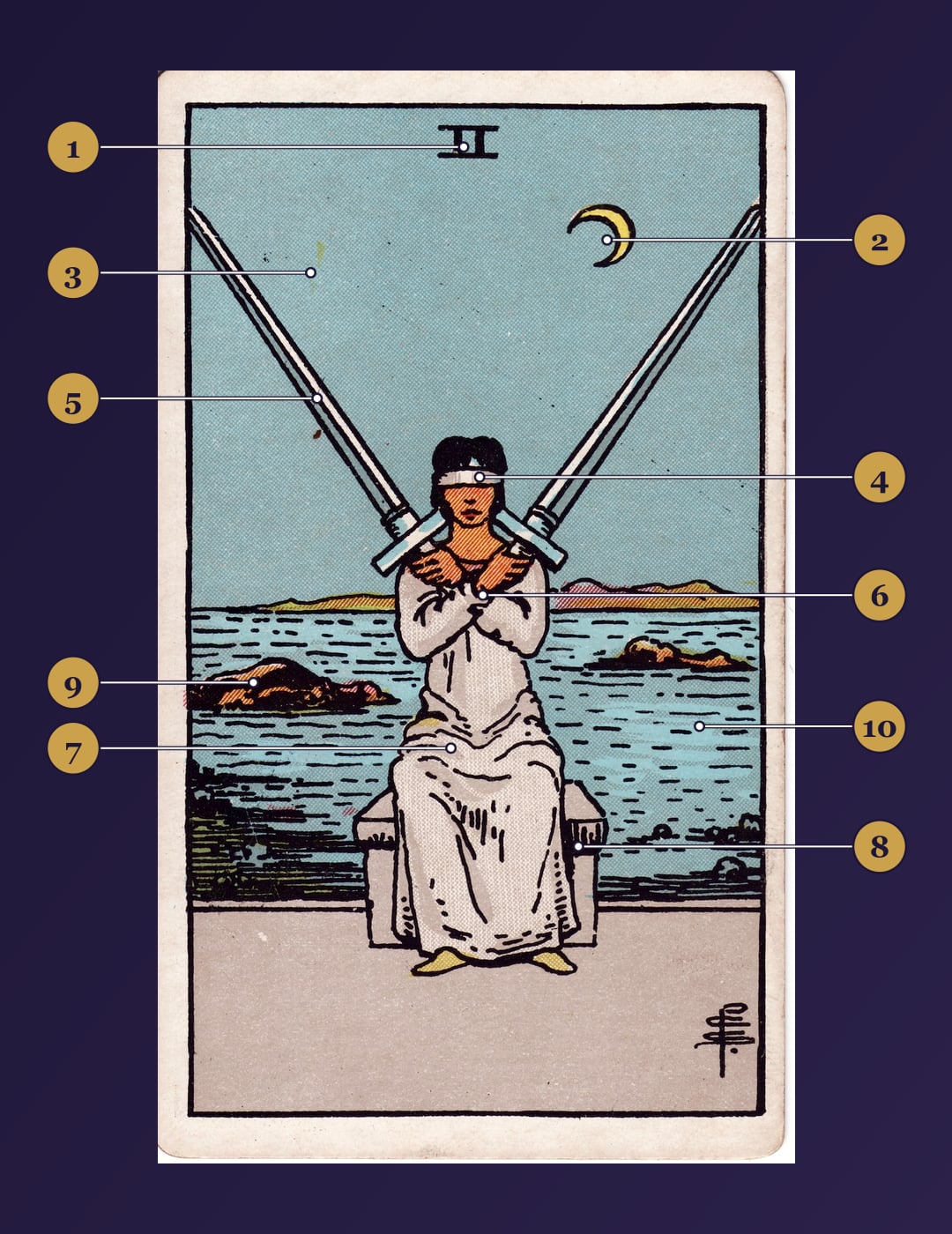
Choose a labelled symbol to highlight its number.
Read the numbered explanationsThe Two of Swords contains ten marked elements, running from the Roman numeral II at the top to the sea behind the seated figure.
- Roman numeral II: The II places duality at the top of the card before you even reach the figure below. Two positions are present, and neither has been allowed to outweigh the other. The number frames the scene as a balance that is being deliberately held.
- Waxing crescent moon: High at the right, the waxing crescent shows that intuition is present, but faint. The woman is not without inner guidance; she is choosing not to consult her feelings openly. That makes the moon a quiet counterpoint to the logic of the swords.
- Twilight sky: The half-light keeps the scene between clear day and full darkness. It suits a decision that has not moved into certainty. You can see enough to know that a choice exists, but the situation remains suspended before one direction is fully claimed.
- Blindfold: The blindfold is chosen not-seeing. It can show avoidance dressed up as neutrality, especially when you already know what you do not want to face. At other times, it can suggest turning sight inward for a time, blocking outside pressure so inner knowing has room to speak.
- Two balanced swords: Her crossed arms hold the blades upward and outward; the swords are not clashing. The balanced pose can suggest opposing thoughts held in a truce rather than a victory. Maintaining that guard takes effort and keeps the heart protected.
- Crossed arms over the heart: Her arms do more than hold the swords. They close across the heart, putting feeling behind a barrier of thought. The pose shows how keeping emotion out of the decision can create temporary control while also making genuine movement harder.
- White robe: The white robe supports the figure’s refusal to take a side. She presents herself as neutral, untouched by either option, but the card does not treat neutrality as empty space. Staying uncommitted is still a position, especially when it is deliberately maintained.
- Stone bench: The woman sits on a hard stone bench rather than somewhere made for lasting comfort. Such a seat fits a pause, not a permanent way of living. A stalemate can hold for a time, but the image does not present it as a home.
- Rocky islets: The rocky islets break the surface of the sea behind her, showing the complications she has turned away from. They remain present even when she does not look at them. Ignoring the difficult parts of the situation does not remove them from the picture.
- Sea behind her: Water fills the background, but the woman faces away from it. The sea represents emotional information she is refusing to face directly. Her position keeps those feelings behind her, leaving the swords and their mental balance to dominate what happens in front.
What does the Two of Swords mean?
The Two of Swords means you are holding two competing positions in a deliberate truce, and the choice stays suspended because you are supplying the effort that keeps it that way. In readings, this card usually lands as a stalemate, denial, hidden information, or a difficult decision you do not yet want to make.
The picture matters here. Those swords are balanced rather than fighting, and nothing restrains the seated woman except the posture she keeps. That makes the card less about being trapped by circumstances and more about what you are doing to preserve the pause. Sometimes that is avoidance. You may be keeping facts or feelings outside the frame because looking at them would force an answer.
There is another side to the blindfold, though. Like a harder echo of The High Priestess, the Two of Swords can show a deliberate turn away from outside noise so you can consult your inner knowing. A pause can be useful when it creates clarity. It becomes a problem when neutrality is used to keep a decision from ever arriving.
The question this card hands back to you is not simply which option is right. It is what you are having to suppress, ignore, or hold in place to keep not-deciding, and how long you are willing to pay that cost.
What does the Two of Swords mean in love?
The Two of Swords in love points to an avoided conversation or a heart that has been deliberately walled off. That relationship impasse lasts while someone keeps their real feelings or doubts out of view; it begins to break when those things are finally looked at.
If you’re single, you may be caught between two possible partners, unsure whether to move towards someone, or protecting yourself so carefully that no option can develop. The card does not say you have no feelings. It shows you holding them behind a guard until you are ready to admit what they are asking of you.
If you’re in a relationship, an unresolved issue may have settled into an uneasy truce. You and your partner can keep avoiding the subject, but that does not solve it. If one person refuses to choose or speak, the other may eventually make the decision for them. The useful move is to face the part of the situation that has been deliberately kept outside the conversation.
What does the Two of Swords mean for career?
The Two of Swords for career means a work decision is being deferred because a key piece of information or practical consideration is not being faced. You may be choosing between two roles, two directions for a project, or two competing positions at work, yet neither option can move while the missing information stays outside your view.
This card can also appear when you are caught between colleagues and trying to remain neutral. That can keep the peace for a short time, but neutrality becomes its own choice when the conflict affects your work or responsibilities.
Rather than collecting endless opinions, identify the one piece of information you have been avoiding because it could make the decision harder to postpone. It may be an uncomfortable fact about a role, a project, or the people involved. Once that data is in front of you, the balanced stalemate has less reason to continue, and a clear professional choice becomes possible.
What does the Two of Swords mean for money?
The Two of Swords for money means your financial choices are stalled because you are avoiding part of the picture. That can show up as refusing to look closely at spending, postponing a large purchase decision, or staying frozen between taking a financial risk and keeping everything exactly as it is.
The card asks for a clear view before you commit. If you are considering an investment or major purchase, weigh the options with the relevant information in front of you rather than making the decision from anxiety. When spending has become difficult to face, looking away only preserves the pressure.
There is no need to force a choice before you understand it, but there is a difference between gathering facts and using delay as protection. The Two of Swords asks you to notice which one you are doing with your money.
The Two of Swords as feelings
As feelings, the Two of Swords can symbolise uncertainty, guardedness or difficulty deciding how to respond. It does not establish that someone is secretly suppressing affection; the same outward quietness can have several explanations.
If communication feels limited, consider what has actually been said and whether there is room for a direct, respectful question. The image offers a way to reflect on emotional protection and uncertainty without treating silence as a hidden answer.
The Two of Swords as actions
As actions, the Two of Swords shows someone stalling, withholding their position, and refusing to choose a side. They are likely to keep the situation suspended rather than give you a direct answer, especially if a decision would require them to face facts or feelings they have kept out of view.
As advice, this may invite a deliberate pause while you gather information, followed by an honest statement of what you can and cannot decide. It cannot tell you how long another person will remain distant or whether their silence will change.
Is the Two of Swords a yes or no?
In a yes-or-no reading, the Two of Swords is often treated as a maybe or an unresolved choice. A clear yes or no is unlikely while the blindfold stays on and both sides are being deliberately held in balance.
If you need a decision, look for the fact or feeling that has been excluded from the question. Once that missing piece is faced, the answer can move quickly. Until then, the card advises against pretending uncertainty has already become certainty.
What does the Two of Swords reversed mean?
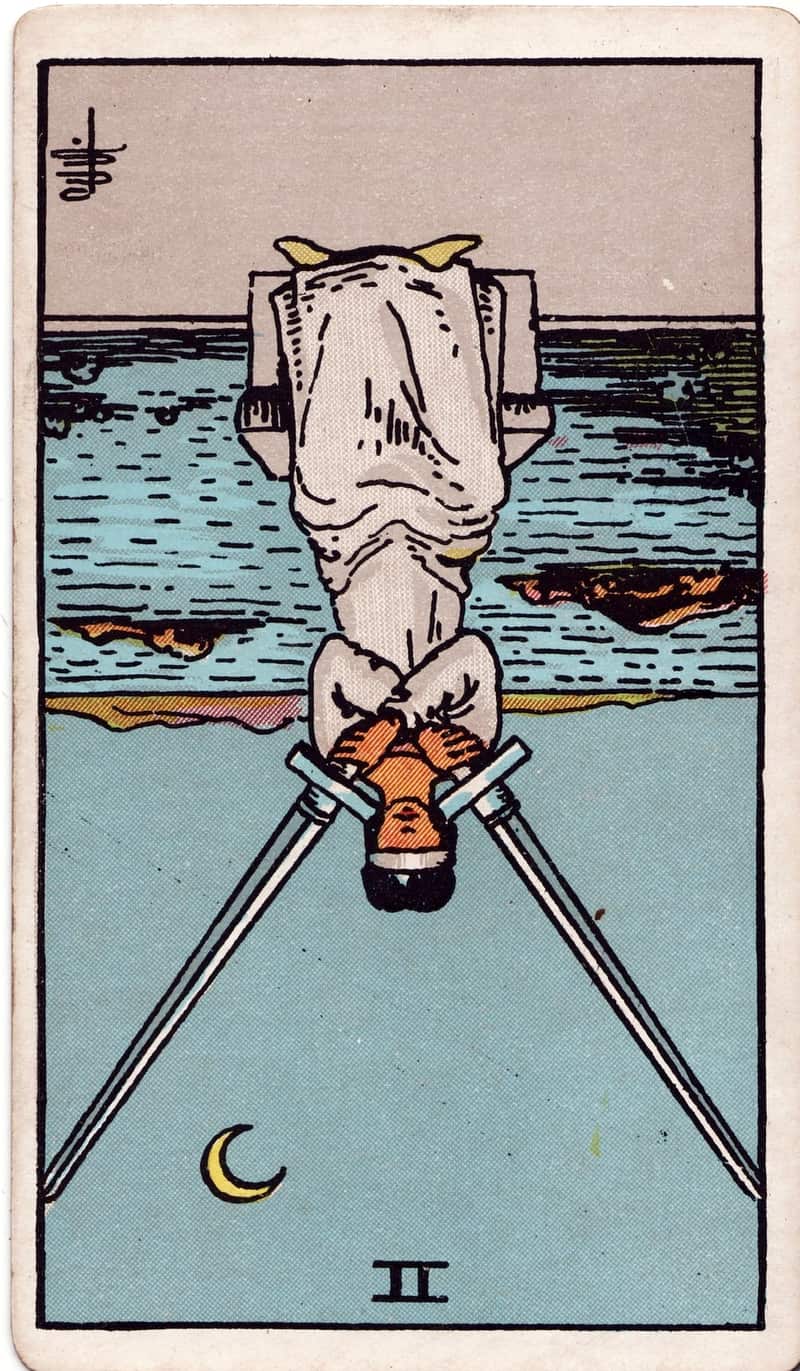
The Two of Swords reversed means the truce is breaking: information is finally getting through, or the pressure of not choosing has become too strong to contain. Her blindfold slips whether you feel ready for that or not.
In one reading, this can bring relief. Hidden facts come into view, a truth is revealed, or you finally accept information you had kept at a distance. The balanced pause loses its purpose because you can no longer claim not to know what the decision involves.
In another reading, the same break feels harsher. Too much information may arrive at once, indecision may turn into anxiety, or outside pressure may force a choice before you feel settled. The card does not simply flip upright hesitation into easy certainty. It shows the cost of maintaining the stalemate reaching a point where something has to give.
Either way, the reversal changes the condition of the pause. The careful balance is no longer stable, and movement begins because the information, emotion, or pressure that was held back has crossed the barrier.
Reversed: love, career and money
Love
In love, the reversed Two of Swords means an avoided emotional decision can no longer stay neatly contained. A conversation that has been postponed may finally happen, or feelings kept behind a cold, withdrawn front may come through under pressure.
If you have been trying not to see a problem in a relationship, the reversal brings that problem closer to the surface. That does not guarantee an easy outcome. It does mean the old truce is harder to maintain. You may have to decide what the relationship can actually support rather than continuing to hold two incompatible positions at once. The discomfort comes from the truth becoming harder to keep outside the room.
Career
For career, the reversed Two of Swords means a delayed work decision is being pushed into motion, often because the information you lacked has arrived or because there is now too much of it to ignore. You may still have no perfect option, but the pause itself is no longer workable.
If you run a business, this can describe a difficult choice between clients or the need to let someone go. In other settings, competing demands may force you to take a position you had hoped to avoid. Information overload can increase anxiety, so separate the facts that actually decide the issue from the noise around them. Relief comes when the work decision is finally made rather than endlessly held open.
Money
For money, the reversed Two of Swords means the financial picture is becoming harder to avoid, and that can bring a surprising sense of calm once you accept it. The numbers may not be where you want them to be, but seeing them clearly gives you something concrete to respond to.
This reversal can mark the end of looking away from spending, risk, or a difficult financial choice. It is less about suddenly having perfect options than being willing to work with the truth you now have. If information arrives all at once, slow down enough to separate facts from panic before making a purchase, investment, or other commitment.
Timing
This site associates Swords with winter. Some readers use the Two as a symbolic number or interpret this card as a pause before a decision, but neither the number nor the season provides a dependable date. Consider what would need to become clearer before action is possible.
Two of Swords card combinations
The Two of Swords is a card of difficult choices, guardedness and deliberate pauses. But when it is presented alongside other tarot cards, the relevant information from each card changes slightly. The key meanings of this card are most interesting when presented in the following card combinations:
The Two of Swords and the Ace of Swords
The Two of Swords and the Ace of Swords are both cards from the Suit of Swords. While the Ace of Swords signifies mental clarity, the Two of Swords signifies being stuck by indecision. Together, they can frame the difference between holding a choice open and finding the information needed to make it. Ask which fact or conversation would clarify your options.
The Two of Swords and The High Priestess
The Two of Swords is a Minor Arcana tarot card while The High Priestess is a Major Arcana card. These two cards make a very powerful combination with the blindfolded sword card almost contradicting the intuitive priestess. The pairing can invite a quieter examination of what you know, what you suspect and what still needs to be checked.
The Two of Swords and the Ace of Cups
The Ace of Cups is the first card in the Suit of Cups. When this card appears in your tarot reading alongside the Two of Swords, the pairing can highlight the tension between emotional openness and keeping a decision on hold. It may be useful when considering how to approach a connection, without promising new love.
Astrology
The Suit of Swords is associated with Air in the reading framework used here. The Golden Dawn’s Book T assigns the Two of Swords to the Moon in Libra. That correspondence offers a way to explore feelings alongside balance and decision-making; it does not mean that people of an Air sign bring inevitable change.
Conclusion
The Two of Swords asks you to notice that a stalemate can feel stable only because you are spending energy keeping both sides balanced, and that the blindfold may be protecting a useful inward pause or helping you avoid what you already know. Your next step is to face the fact or feeling that changes the balance and decide what the truce is costing you. From here, revisit Ace of Swords or continue to Three of Swords.
Reading approach: Use these Rider–Waite–Smith interpretations to explore the question and context. A card does not establish another person’s feelings or a future outcome; check practical decisions against observable facts.
Curious about what lies ahead?
Get a free AI tarot reading and explore guidance designed just for you. Discover the messages the cards have to share and gain insight into your path.
Get a free tarot reading


