



Three of Swords Tarot Card Meaning: Heartbreak, Healing & Moving Forward
Table of Contents
- Upright / Reversed keywords
- Three of Swords description
- Symbolism: what’s in the Three of Swords?
- What does the Three of Swords mean?
- What does the Three of Swords mean in love?
- What does the Three of Swords mean for career?
- What does the Three of Swords mean for money?
- The Three of Swords as feelings
- The Three of Swords as actions
- Is the Three of Swords a yes or no?
- What does the Three of Swords reversed mean?
- Reversed: love, career and money
- Timing
- Three of Swords card combinations
- Astrology
- Conclusion
Meaning at a glance
Three of Swords: upright and reversed
Upright
The Three of Swords represents painful clarity: a truth, loss or separation that is difficult to keep at an emotional distance. Acknowledge what hurts before trying to explain it away. The image gives grief a language without determining what has happened in your life.
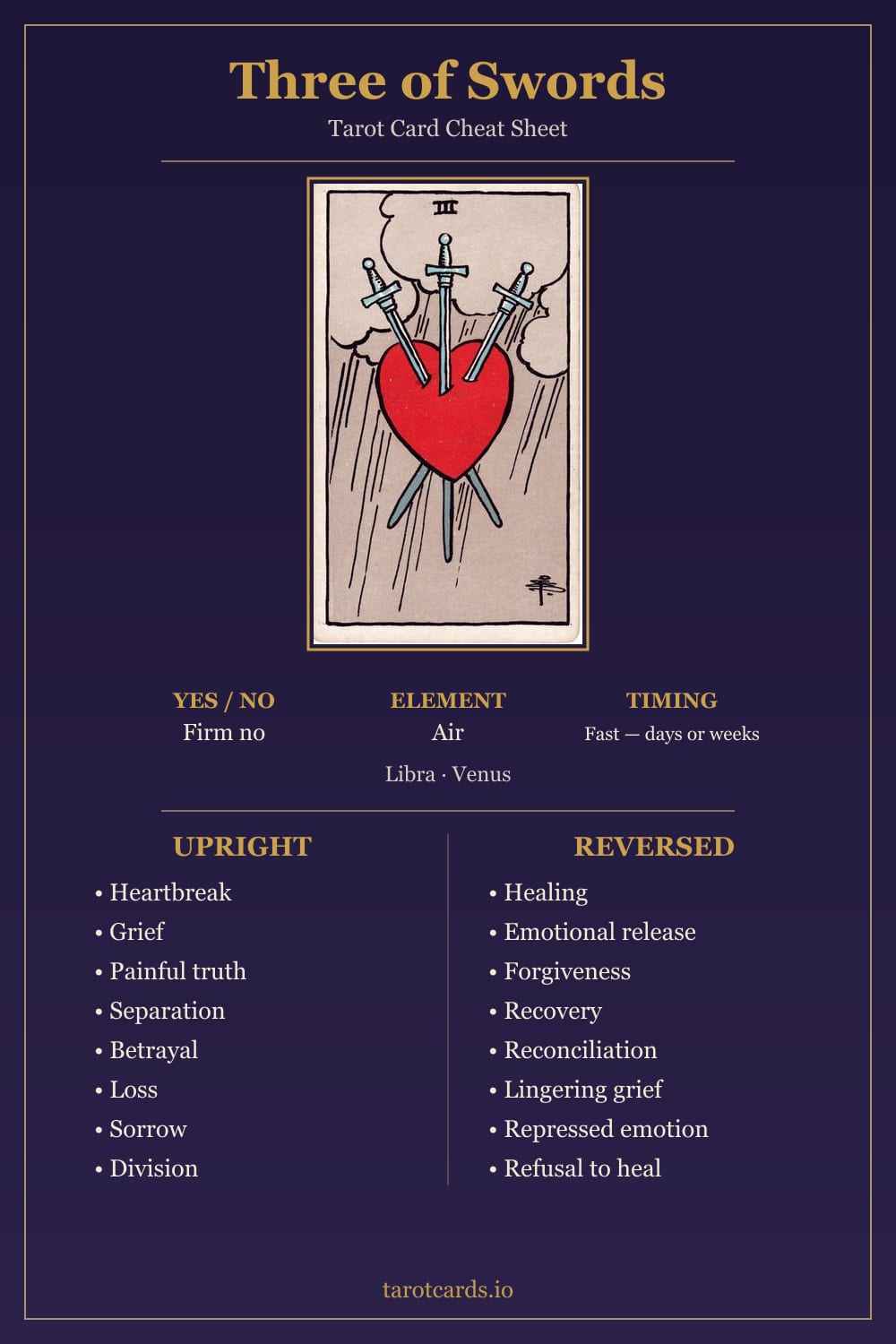
Keywords: Heartbreak, grief, painful truth, separation, betrayal, loss, sorrow, division
Reversed
Reversed, the Three of Swords asks how pain is changing. Sorrow may be easing, or unspoken hurt may still need attention. Consider what would support release or repair without forcing forgiveness or assuming that feeling better must happen on a fixed schedule.
Keywords: Healing, emotional release, forgiveness, recovery, reconciliation, lingering grief, repressed emotion, refusal to heal
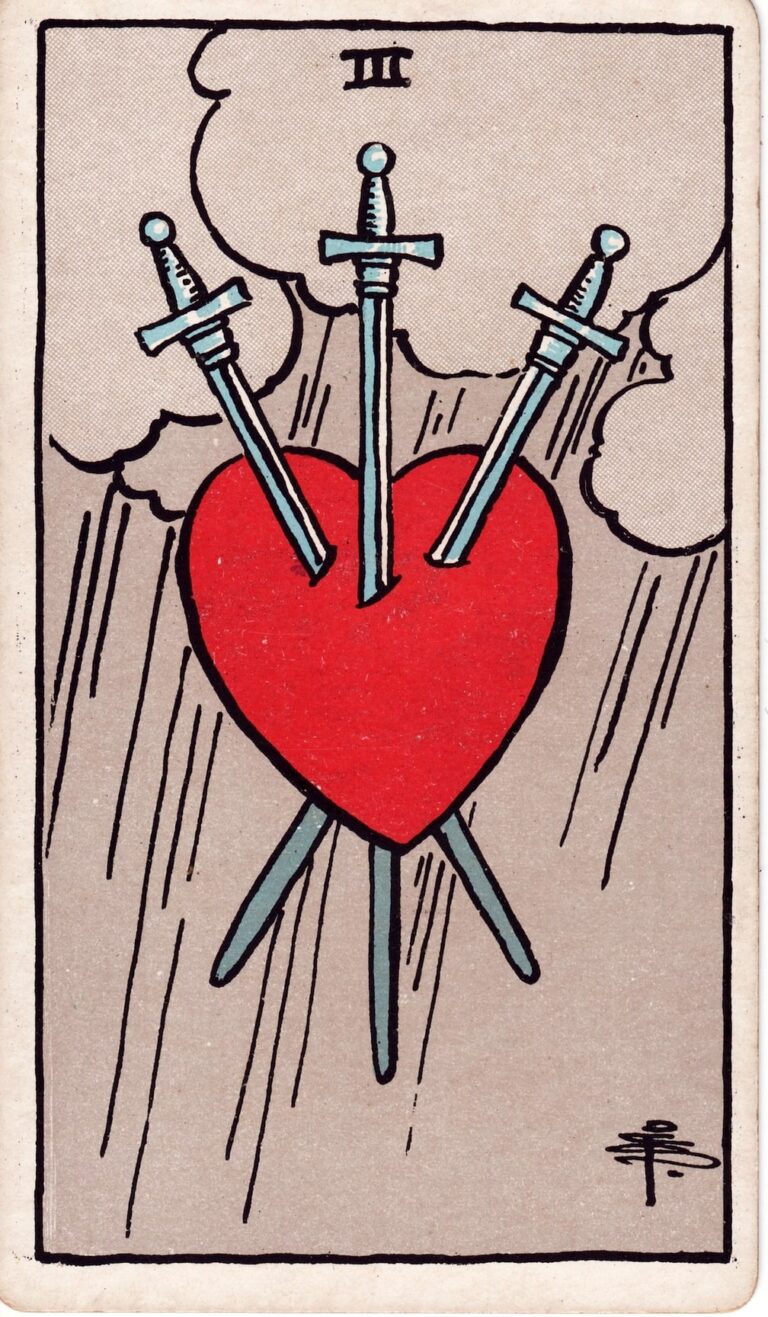
The Three of Swords is the card of heartbreak, grief, separation and painful clarity, the moment something you hoped was not true becomes impossible to avoid; its scope is wider than romance, covering absence, delay, division and removal. Its sharpest lesson is that the wound is not always an external betrayal: just as often, it is the pain of a necessary truth you already suspected, while the rain shows release beginning at the same moment the hurt is finally felt.
Three of Swords description
The Rider-Waite-Smith Three of Swords is unusually stripped back. At the top sits the Roman numeral III. Below it, heavy grey storm clouds fill the upper part of the card, with long lines of rain falling at a slant across the image.
At the centre is a large red heart, floating by itself with no human figure attached to it. Three long swords pierce the heart at the same time. One enters from above while the other two cross in from either side, creating a balanced, almost symmetrical arrangement around the heart.
There is no person reacting to what has happened, no ground beneath the heart and no wider setting around it. The background remains flat and grey from top to bottom, apart from the darker cloud shapes and the rain. Compared with many Rider-Waite-Smith cards, there is very little visual detail to distract your eye from the heart and the three blades passing through it.
Also known as: the Three of Épées in the Tarot de Marseille, with some modern decks using Blades. The Thoth deck keeps the name Swords, and in playing-card decks the suit maps to Spades; this guide focuses on Rider–Waite–Smith imagery and interpretation, which may differ from those traditions.
Symbolism: what’s in the Three of Swords?
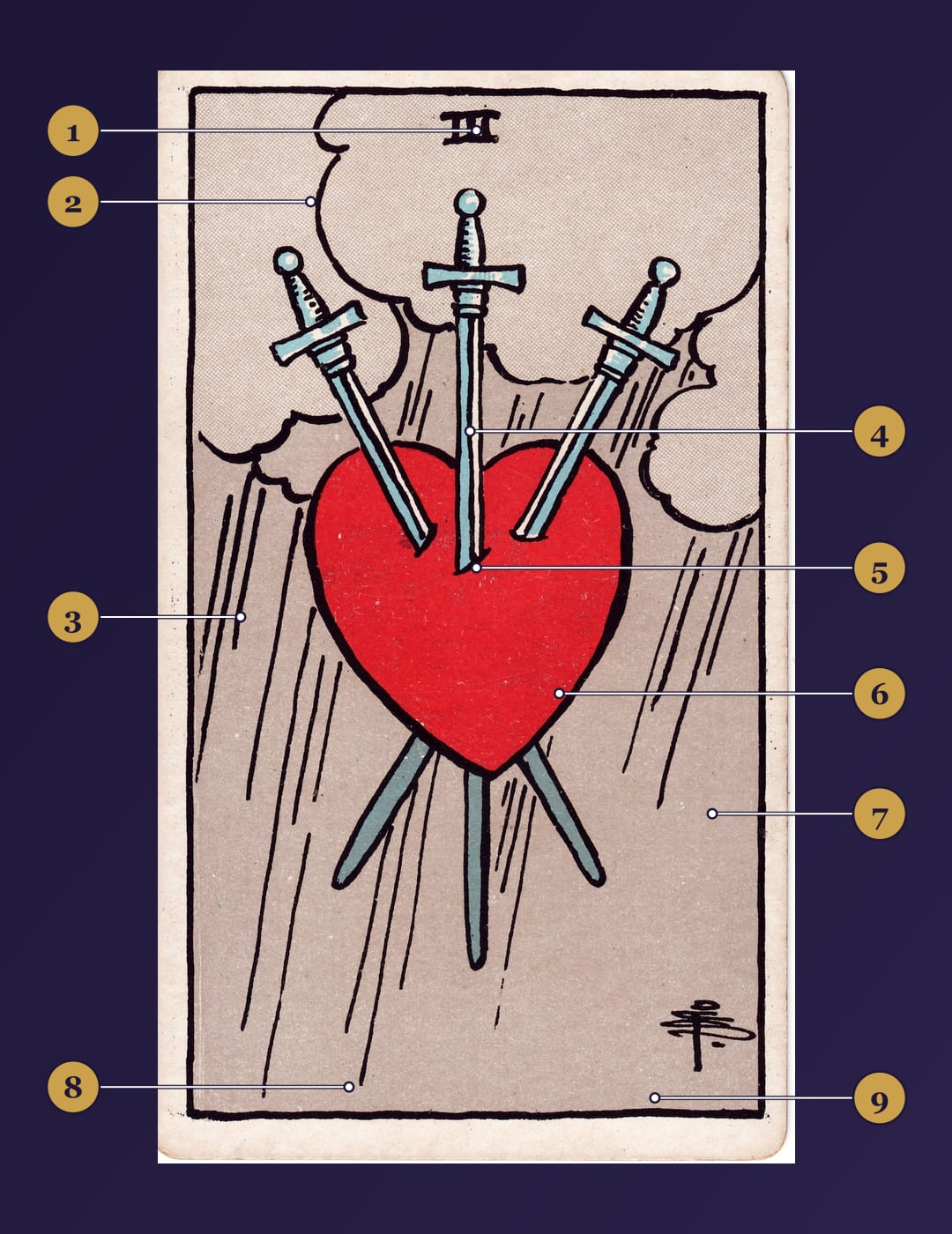
- Roman numeral III at the top: The three marks the first unavoidable pain in the Swords sequence. After the uneasy truce of the Two of Swords, the suit reaches a point where distance and suspension can no longer hold. Something breaks through, and you have to feel the result.
- Heavy grey storm clouds: These clouds reflect the mental weather of grief. Swords belong to thought and communication, yet here the mind cannot stay cool or detached from what has happened. The sky feels crowded and heavy, matching the way painful knowledge can occupy almost every thought at first.
- Slanting rain: The rain shows that the card contains release as well as hurt. Tears are not a failure to cope here; they are part of the cleansing process. Once the pain has been acknowledged rather than denied, it can begin to move instead of remaining locked in place.
- Three swords piercing together: The blades bring thought, word and truth onto one wound at once. A fact may be understood, spoken aloud and finally believed in the same painful moment. That convergence is why the card can feel so sudden even when part of you already knew what was coming.
- Symmetrical piercing pattern: The three blades form a clean, precise arrangement rather than a chaotic attack. This is pain with a clear point. You may dislike what you have learned, but the card leaves little room for pretending the situation is something else. The hurt is sharp because the truth is exact.
- Red heart, oversized and central: Nothing competes with the heart for your attention. Its size makes the emotional core impossible to minimise, while the bright red keeps the wound immediate and exposed. The card asks you to meet the feeling itself before you explain it away, justify it or turn it into a story.
- Absence of any human figure: With no person shown, the Three of Swords removes identity and backstory from the image. What remains is pain in its pure state. In a reading, that can point to the first raw phase of hurt, before you decide who was wrong or what happens next.
- No ground or wider setting: The heart hangs without a visible place to stand. Grief can feel like that: normal time and location recede while the painful fact takes over. The missing ground keeps the card suspended in the instant of impact, before ordinary routines have fully returned around the loss.
- Flat grey background: The grey creates the numb, monochrome feeling that can follow first heartbreak or shock. There is no colourful distraction and nowhere for the eye to escape. That visual flatness suits the moment when everything else briefly seems less vivid because one painful truth has taken up all the space.
What does the Three of Swords mean?
In an upright reading, the Three of Swords means painful clarity: a truth, separation or loss has broken through, and you can no longer keep it at a safe emotional distance. In the sequence of the suit, the truce of the Two of Swords has ended. The pause is over, the blades have reached the heart, and this card shows what that break feels like before you have had time to rationalise it.
Heartbreak is its best-known meaning, but it is too narrow to make romance the only story. Waite’s own meanings include removal, absence, delay and division, so the card can describe a friendship ending, a family separation, a plan being cut short or any situation in which the truth hurts because something cannot continue as you hoped.
In readings, this card usually lands as a clean wound rather than vague anxiety. You may already have suspected what is now becoming clear. That does not make the knowledge painless, but it does make it usable: once you stop arguing with what you know, grief can begin doing its work. The rain matters for exactly this reason. The Three of Swords does not promise that pain disappears quickly; it shows that feeling it fully is already part of its release.
What does the Three of Swords mean in love?
In love, the Three of Swords means heartbreak, betrayal or a painful truth surfacing between you and another person. If you are attached, this can mark a breakup, a breach of trust, third-party involvement or the moment an existing problem is finally named. It does not automatically predict that someone will betray you; sometimes the cut comes from admitting what both of you have been avoiding.
If you are single, the card often points backwards before it points forwards. An old rejection or relationship breakdown may still be occupying the space where new affection would have to land. You do not need to pretend the hurt is gone, but replaying it is different from grieving it.
The wound in this card is clean and visible. Give the pain its proper name, let the tears come if they need to, and resist turning one heartbreak into a permanent rule about what love will always be.
What does the Three of Swords mean for career?
For career, the Three of Swords means a painful professional truth has landed, often through harsh feedback, rejection or separation from a role, team or project. You may be dealing with a job loss, a proposal that was turned down, a conflict that can no longer be ignored or words from a colleague or client that cut more deeply than expected.
What matters here is the clarity inside the disappointment. A rejection can show you that a path is closed; criticism can expose a weakness in the work; leaving a role can confirm that the situation was no longer sustainable. None of that makes the experience pleasant, but it gives the pain a clear source instead of leaving you in uncertainty.
If you are looking for work, repeated rejection may feel personal under this card. Treat the answer you have received as information about this opening or this moment, rather than proof that your ability or ambition has no place elsewhere.
What does the Three of Swords mean for money?
In money readings, the Three of Swords means financial pain is affecting the way you make decisions about spending, saving or investments. A loss, debt or other money pressure can make every choice feel sharper, especially when the numbers confirm something you would rather not face.
This is not a good card for reacting from the first sting. You may become so cautious that you avoid every reasonable risk, or so distressed that spending becomes an attempt to blunt the feeling for a moment. With investments, a painful loss can also tempt you to chase back what has already gone.
The useful side of the card is precision. Look directly at the loss or pressure, separate the facts from the emotional shock, and make your next money decision from what is actually in front of you rather than from the urge to erase the hurt quickly.
The Three of Swords as feelings
As feelings, the Three of Swords can symbolise hurt, disappointment or grief within the question. If you are asking about another person, treat that as a possible theme to explore rather than proof that they feel betrayed or associate you with pain.
An existing disagreement or loss may give this interpretation context; a new connection may instead bring your own worries about earlier hurt into view. Listen to what the person actually communicates before deciding which, if either, applies.
The Three of Swords as actions
In an actions position, the Three of Swords can point to difficult communication, acknowledging a painful truth or deciding how to respond after a hurt. A rejection or separation is one possible context, but the card does not establish that someone is about to betray or wound you. Read it alongside what is already known about the situation.
As advice, it may invite honest communication instead of continuing to avoid a problem. Honesty can still be considerate: identify what needs to be said, choose an appropriate time and allow the other person to respond. Clarity is the aim, rather than causing pain for its own sake.
Is the Three of Swords a yes or no?
In a yes-or-no reading, the Three of Swords is usually interpreted as a cautionary no, reflecting disappointment or separation. That convention does not establish what will happen; consider whether the question involves a difficulty that needs to be addressed before proceeding.
The nuance is that this no may still bring needed clarity. An answer, rejection or ending can hurt while also confirming what you already suspected and stopping you from remaining stuck in uncertainty.
What does the Three of Swords reversed mean?
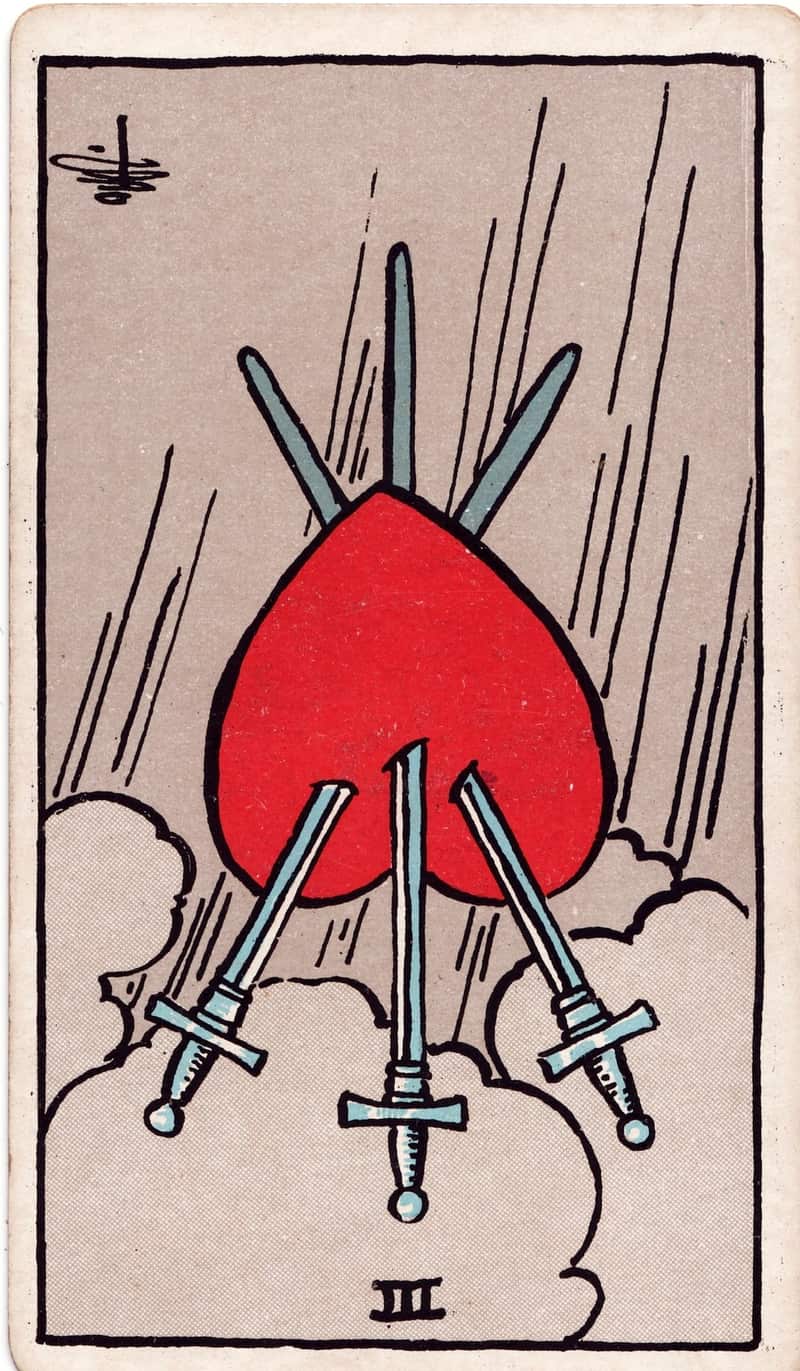
Reversed, the Three of Swords means the wound is changing, but it does not automatically mean happiness has replaced grief. In one expression, the old pain is finally draining: you are releasing sorrow, moving towards forgiveness and allowing a difficult experience to loosen its hold. In the other, the hurt has been pushed down or kept alive so long that the wound cannot close.
That difference matters more than a simple upright-bad, reversed-good reading. The same card can show recovery after heartbreak, or it can show someone insisting they are fine while replaying the injury underneath. Reconciliation may be possible in some readings, but only where the pain itself has been faced rather than covered over.
Look to the surrounding cards to decide which side of the reversal is active. If they support release, the rain has done its work and the grief is beginning to pass through. If they show fixation or avoidance, the reversal points to emotion that has not been given a clean way out.
Reversed: love, career and money
Love
In love, the reversed Three of Swords points either to healing after heartbreak or to a relationship wound that has never properly closed. After a breakup or betrayal, you may be ready to forgive, reopen communication or stop carrying the old pain into every new connection.
The other expression is quieter but harder to shift. You or your partner may say the issue is over while still returning to it in arguments, testing each other or holding back affection. For singles, the reversal can show genuine readiness to release an old rejection, but only if you are no longer using that history as the measure for every new person.
Career
For career, the reversed Three of Swords shows recovery from a professional setback, or a refusal to let an old rejection stop shaping your work. A difficult period with colleagues may be easing, harsh feedback may have become easier to use, or you may be ready to apply again after being turned down.
If the wound is not closing, however, resentment can keep you tied to the very role, team or criticism that hurt you. You may replay what was said instead of deciding what to do with it. The healthier side of this reversal is not pretending the setback was harmless; it is letting the experience become information rather than an identity.
Money
For money, the reversed Three of Swords shows the emotional pressure around a loss or debt beginning to ease, or the same financial hurt still directing every decision. You may be working through repayment, accepting a loss on an investment or making calmer spending choices after a stressful period.
The difficult expression is fixation. Fear of losing again can make you excessively cautious, while the urge to recover quickly can pull you back towards impulsive risk. This reversal asks whether the original financial pain is actually being processed or merely hidden beneath new behaviour. Small, clear decisions are stronger here than attempts to erase the whole loss at once.
Timing
This site associates Swords with winter; other timing systems differ. Some readers connect the Three symbolically with three days or weeks, but a card cannot date a painful event or set a timetable for grief. Focus instead on what support, conversation or practical change the situation needs now.
Three of Swords card combinations
The Three of Swords is an important card in the context of your emotional health and wellbeing. It represents grief and loss, but also the importance of listening to your inner thoughts to overcome this. When paired with other cards, the general meaning of each card changes slightly, which only makes tarot readings more fascinating. Some of the most interesting combinations with the Three of Swords are:
The Three of Swords and Ace of Swords
These are both Swords cards, which means they represent mental clarity and ability. But while the Ace of Swords focuses on mental strength, the Three of Swords brings grief or painful knowledge into the picture. Together, the cards can invite clear language for what hurts and consideration of the next available step; they do not diagnose a breakdown or guarantee recovery.
The Three of Swords and The High Priestess
The Three of Swords is a Minor Arcana card and The High Priestess is a Major Arcana card. The High Priestess is a very powerful card, and when it is paired with the Three of Swords it implies that it is time to have a difficult and painful conversation. This may have unwanted consequences, but a thoughtful conversation may help when it is appropriate and safe. Healing does not follow one required sequence.
The Three of Swords and The Hanged Man
The Three of Swords is the third card in the Swords suit, and when paired with The Hanged Man it represents keeping the faith no matter how difficult your emotional upheaval or how severe your pain. The pairing may invite a gentler pace or a different perspective while you work through what happened. There is no need to force a spiritual explanation or a deadline for feeling better.
Astrology
The zodiac sign most closely associated with the Three of Swords is Libra. All of the cards in the Suit of Swords are associated with the air signs, which are Gemini, Aquarius and Libra. These are the signs that control communication and intelligence, reminding us that even in a period of severe emotional upheaval, communication is key.
In the Golden Dawn’s Book T, §XXVIII, the Three of Swords is associated with Saturn and Libra. In that framework, Saturn’s limits and Libra’s concern with balance offer one way to explore the card’s sorrow and difficult clarity. This is a specific esoteric correspondence, rather than a planet assigned universally by every tarot tradition.
Conclusion
The Three of Swords asks you to face the painful fact before building a story around it: heartbreak, absence, delay or division may hurt, but acknowledged grief can begin to move. Upright or reversed, the card is less about predicting who will wound you than showing what happens when truth reaches the heart and whether you let the feeling pass through.
Continue with Two of Swords or Four of Swords to follow the suit’s story around this moment.
Reading approach: Use these Rider–Waite–Smith interpretations to explore the question and context. A card does not establish another person’s feelings or a future outcome; check practical decisions against observable facts.
Curious about what lies ahead?
Get a free AI tarot reading and explore guidance designed just for you. Discover the messages the cards have to share and gain insight into your path.
Get a free tarot reading


