



Seven of Swords Tarot Card Meaning: Deception, Strategy & Hidden Truths
Table of Contents
- Upright / Reversed keywords
- Seven of Swords description
- Symbolism: what’s in the Seven of Swords? (1–10)
- What does the Seven of Swords mean?
- What does the Seven of Swords mean in love?
- What does the Seven of Swords mean for career?
- What does the Seven of Swords mean for money?
- The Seven of Swords as feelings
- The Seven of Swords as actions
- Is the Seven of Swords a yes or no?
- What does the Seven of Swords reversed mean?
- Reversed: love, career and money
- Timing
- Seven of Swords card combinations
- Astrology
- Conclusion
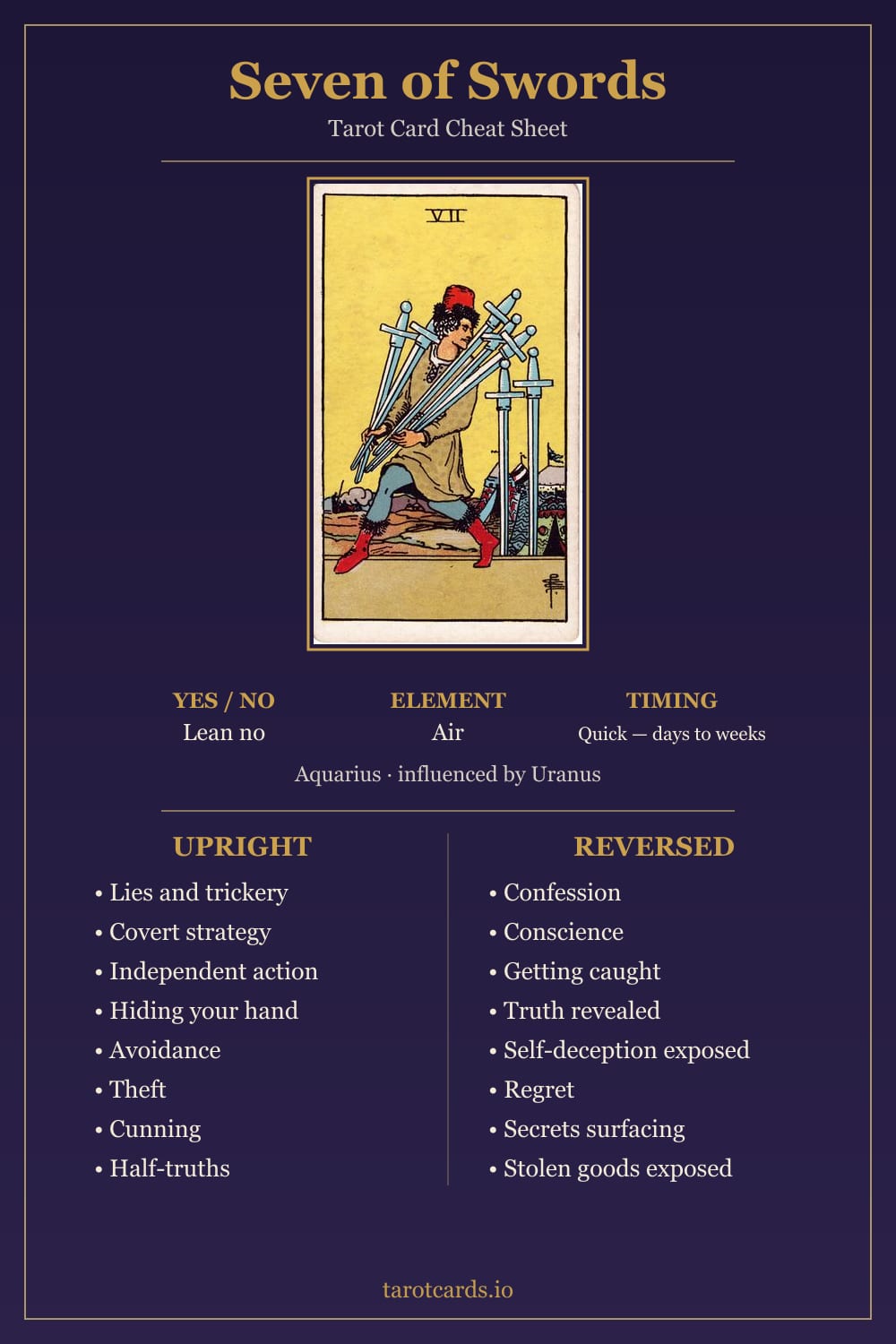
Meaning at a glance
Seven of Swords: upright and reversed
Upright
The Seven of Swords examines secrecy, avoidance and indirect strategy. Keeping a plan private can differ from withholding information someone needs. Look closely at the situation and your own approach; the card alone is not evidence that another person is deceiving you.
Keywords: Lies and trickery, covert strategy, independent action, hiding your hand, avoidance, theft, cunning, half-truths
Reversed
Reversed, the Seven of Swords can suggest concealment becoming harder to maintain, or an opportunity to admit what has been avoided. Consider what honest acknowledgement would change. Exposure does not automatically repair trust; responsible action still matters after the truth is spoken.
Keywords: Confession, conscience, getting caught, truth revealed, self-deception exposed, regret, secrets surfacing, stolen goods exposed
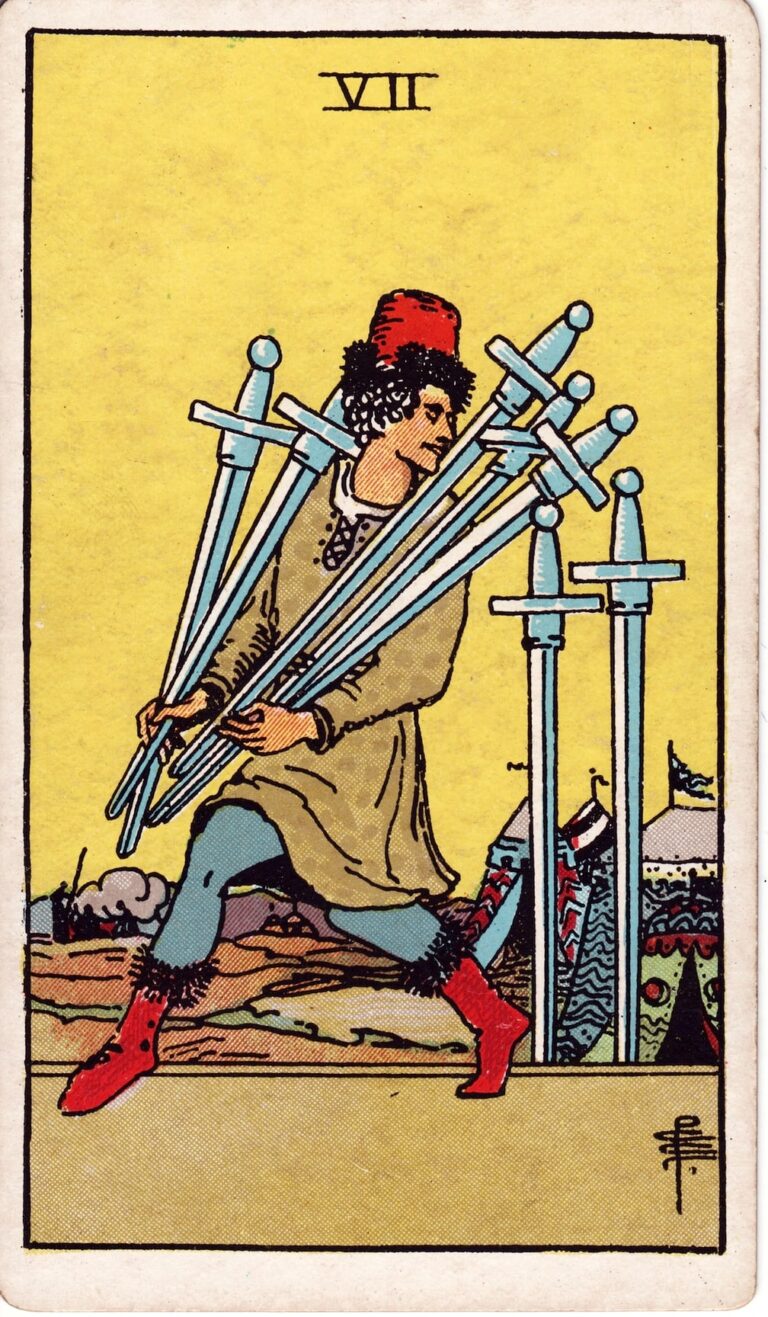
The Seven of Swords is the Suit of Swords’ trickster card: deception, secrecy, clever planning, avoidance, and the choice to act without showing your full hand. It does not automatically mean someone else is lying to you; the card can point to your own evasions or scheming, and in some situations it is legitimate strategy, discretion, or independent action rather than wrongdoing. In readings, the real issue is what is being done out of sight, why it cannot be handled openly, and what the plan is leaving behind.
Seven of Swords description
In the Rider-Waite-Smith Seven of Swords, the Roman numeral VII sits above a flat yellow sky. A group of patterned camp tents stands low on the right side of the card, while a tiny group of soldiers stands farther away, one of them holding a sword aloft. The foreground is much more open, with smooth ground and little between the central figure and the camp behind. The seven swords are visibly split into two groups: five travel with the figure and two remain behind.
That figure moves sideways on tiptoe, dressed in a red fez and red boots. Five swords are gathered awkwardly in the figure’s arms, held by the blades rather than the handles, while two more remain standing behind. The figure’s head turns back towards the camp as the body continues away from it. The scene is bright and exposed rather than shadowy, with the figure, the seven swords, and the distant camp all clearly visible against the open setting.
Also known as: the Seven of Épées in the Tarot de Marseille, with some modern decks using Blades. The Thoth deck keeps the name Swords, and in playing-card decks the suit maps to Spades; this guide focuses on Rider–Waite–Smith imagery and interpretation, which may differ from those traditions.
Symbolism: what’s in the Seven of Swords? (1–10)
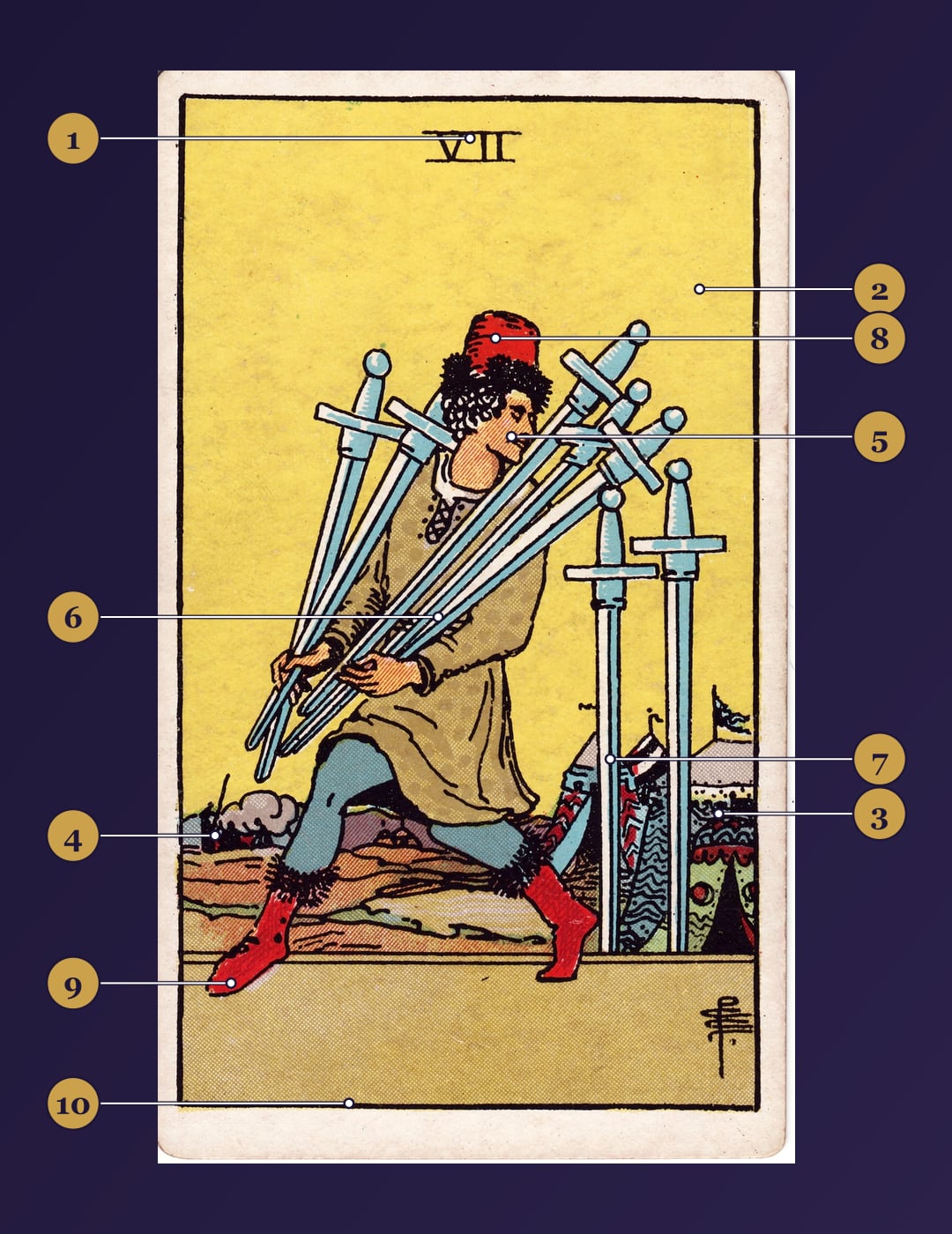
Choose a labelled symbol to highlight its number.
Read the numbered explanationsThe Seven of Swords contains ten visual details that build its meaning from strategy and audacity to incomplete escape and chosen exposure.
- Roman numeral VII: The VII frames the card around strategy and lone assessment. It points towards a plan judged from one person’s position: what can be gained independently, what must be decided alone, and what may be missed when nobody else is checking the thinking.
- Flat yellow sky: Nothing here happens under cover of darkness. The flat yellow sky puts the act in broad daylight, giving the scene an almost comic audacity. Whatever the figure thinks they are concealing, they are taking a striking risk by treating openness around them as safety.
- Striped camp tents: The line of tents represents the collective or establishment the figure is slipping away from. The figure moves outside the group rather than through it, which can describe betrayal and theft, but also independent action when a plan needs to stay outside the larger structure.
- Distant soldiers: The tiny soldier group matters because one sword is already raised. That detail can suggest the risk of discovery, rather than confirming what happens next. The scheme has not yet become a clean escape, and the card keeps danger in the background: being ahead of other people is not the same as being beyond their reach.
- Sly backward glance: The backward look carries two impulses at once. There is self-congratulation in checking the distance already gained, but also a guilt-check: has anyone noticed? That mixture makes the figure look clever and uneasy at the same time, with the plan still open to discovery.
- Five swords held by the blades: The five swords are hugged awkwardly by their blades, turning cleverness into its own hazard. The plan may be cunning, but it is being carried badly. In readings, this detail warns that evasion can start cutting the person who thought they controlled it.
- Two swords left behind: Two swords remain standing, making the getaway incomplete. This is one of the card’s sharpest details: cunning rarely gets everything. Something is left behind, missed, or cannot be carried, so even a successful scheme may create unfinished business that refuses to close neatly.
- Red fez and boots: The bright red fez and boots give the figure a trickster’s costume. They are flamboyant choices for someone trying to get away unnoticed, undercutting the theft with comedy. Stealth and self-display sit awkwardly together, just like the swords gathered in the figure’s arms.
- Tiptoeing stride: The figure does not charge forward. The figure steps sideways while looking back. The body language favours evasion over confrontation: getting around the problem or person instead of meeting it directly and accepting the consequences of an open clash.
- Smooth open ground: There is no meaningful cover on the smooth ground around the figure. Exposure is a risk the figure chooses to ignore. The image suggests that confidence in a clever plan can become a blind spot when there is nowhere obvious to hide if someone turns around.
What does the Seven of Swords mean?
The Seven of Swords means deception, secrecy, avoidance, or a strategy that depends on not showing your full hand. In readings, it usually lands as a warning about something being handled indirectly. That may be theft, lying, betrayal, or a private scheme, but it is not automatically proof that another person is deceiving you. Sometimes you are the one sidestepping the truth, keeping a plan quiet, or trying to get what you want without facing the issue openly.
There is also a legitimate side to this card. Waite includes design, attempt, and wish among its meanings, which leaves room for planning, discretion, independent action, and keeping an idea private until the right moment. The question is what the secrecy is for. Sound tactics protect something that needs room to develop; dishonest tactics avoid responsibility and make other people carry the cost.
The artwork keeps that distinction from becoming too flattering. Two swords are left behind, so the clever move is incomplete, and five are carried by their blades, so the plan is already capable of hurting its owner. When this card appears, check both directions: what someone else may be withholding, and what you are choosing not to say, face, or finish.
What does the Seven of Swords mean in love?
In love, the Seven of Swords means secrets, half-truths, or feelings and intentions that are being kept off the table. If you are in a relationship, this can point to dishonesty or infidelity, but it can also be quieter: avoiding a difficult conversation, hiding what you really feel, or trying to manage your partner’s reaction by giving them only part of the story. The card asks you to look at what is not being said, including the part you may be withholding yourself.
If you are single, the Seven of Swords warns against games on either side. A potential partner may be evasive, selective with the truth, or unwilling to show their full hand. You can also draw this card when you are protecting yourself so carefully that genuine openness never gets a chance. Take things slowly, watch actions as closely as words, and do not confuse mystery with honesty.
What does the Seven of Swords mean for career?
For career, the Seven of Swords points to office politics, hidden agendas, credit-theft, or a work strategy that succeeds by staying quiet until the right moment. In a difficult workplace, watch what is left unattended. Gossip, selective information, or a colleague taking credit for your work can make a capable person look careless if there is no record of what they actually contributed.
The card does not say every private plan is unethical. Sometimes the wiser move is to work independently, keep an idea to yourself while it is still forming, or avoid announcing an ambition before you are ready to act on it. The line is the same one this card draws everywhere: discretion protects the work; deception takes from someone else or shifts responsibility onto them.
Keep track of your own loose ends as well. The two swords left behind suggest that a clever professional move can fail because one task, detail, or obligation was treated as unimportant.
What does the Seven of Swords mean for money?
For money, the Seven of Swords warns against financial choices built on secrecy, wishful thinking, or the hope that a risky shortcut will somehow stay hidden. This can describe lying about personal information to secure borrowing you cannot afford, falling for a get-rich-quick scheme, or taking an investment risk because the promised reward sounds easier than the real numbers support.
It can also point to self-deception. You may know what you spend, owe, or risk, but prefer not to look at the full picture because doing so would force a change. Strategic thinking is useful here when it means making a realistic repayment or spending plan. It becomes a problem when strategy turns into rationalising behaviour you already know is unstable. If an offer seems too good to be true, the Seven of Swords gives you a strong reason to examine it carefully.
The Seven of Swords as feelings
As feelings, the Seven of Swords can symbolise privacy, guardedness or reluctance to speak openly. It does not establish that someone is hiding affection or manipulating you. The useful distinction is between respecting a person’s privacy and noticing an actual pattern of misleading communication.
This is not a card of easy emotional transparency. The person may be calculating what to reveal, avoiding a direct admission, or trying to stay one step ahead of your response. Pay attention to the gap between what they seem to feel and what they are prepared to say plainly.
The Seven of Swords as actions
As actions, the Seven of Swords can frame a question about acting independently, keeping plans private or avoiding a direct discussion. Dishonesty is one possible theme, but the card itself is not evidence of theft or a secret move against you. Consider what is known about the situation before deciding which interpretation fits.
The image invites attention to indirect approaches. They may act first and explain later, avoid the conversation that would expose their motives, or leave part of the matter unfinished. The two swords left behind suggest that even a carefully planned move may not tie up every loose end.
Is the Seven of Swords a yes or no?
In a yes-or-no reading, the Seven of Swords is often interpreted as no, or as a reason to reconsider the proposed route. Something about the plan, the information, or the people involved is not clean enough for a confident yes, and an important piece may be hidden or left behind.
If your question is specifically about using discretion or making a quiet strategic move, the answer is less absolute. The card can support acting without announcing every step, but it still warns that an incomplete plan or concealed motive can be exposed.
What does the Seven of Swords reversed mean?
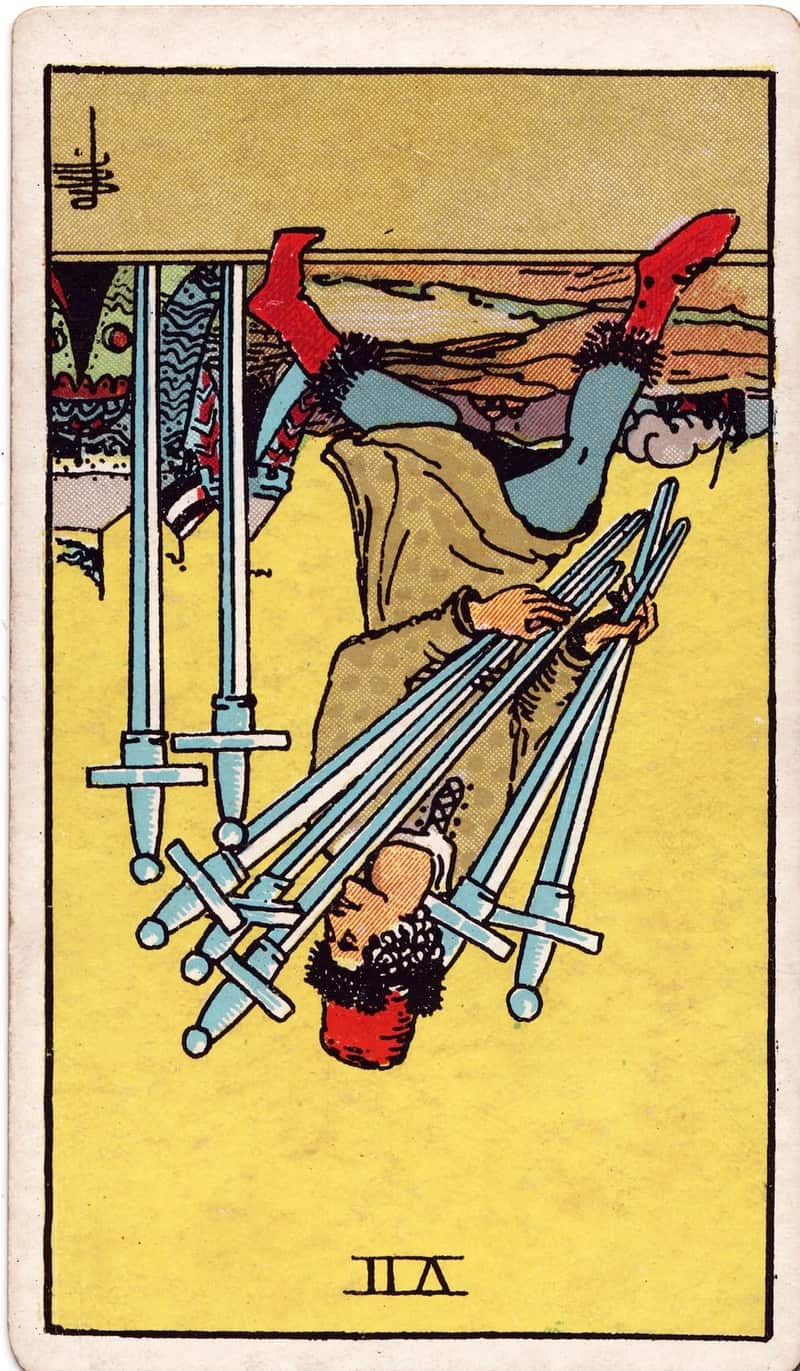
The Seven of Swords reversed means that secrecy is starting to fail: conscience surfaces, a confession comes, someone gets caught, or you finally recognise the story you have been telling yourself. The shift is not simply from bad to good. It is from concealment towards exposure, and that can be uncomfortable even when the truth is necessary.
In readings, the reversal often feels like the stolen goods coming back into the light. A lie may be admitted before it is discovered, evidence may make denial impossible, or regret may become strong enough that the person can no longer carry what they took or hid. Sometimes the exposure is internal rather than public. You see your own avoidance clearly and realise that the clever explanation you used to protect yourself has stopped making sense.
The useful part of this reversal is the return of conscience and the chance to deal with what was concealed. That does not erase consequences. It does mean the situation can no longer rely on everyone pretending not to see the two swords left behind.
Reversed: love, career and money
Love
In love, the reversed Seven of Swords brings hidden behaviour into the open. Dishonesty or infidelity may be confessed or discovered, and the weight of keeping the secret starts to lift even if the relationship now has difficult decisions to make. If you were the one withholding your true feelings, this reversal can show the point where you finally say what has been avoided.
If you are single, it asks for a clearer look at evasive patterns. You may be recognising that you are repeatedly drawn to people who lie or cheat, or that you excuse signs you would normally question. Slowing down gives you room to notice what does not add up before attachment makes those excuses easier.
Career
In career readings, the reversed Seven of Swords points to workplace deception being exposed. A colleague who took credit, interfered with a client, or worked against you may be called out once the missing pieces become visible. If you were responsible for the hidden move, the card turns the pressure towards confession before someone else produces the proof.
This reversal can also show the end of a private professional strategy. A plan that depended on secrecy may have reached the point where it must be explained, owned, or abandoned. The advantage now comes from dealing with what is known rather than trying to preserve a cover story that is already failing.
Money
For money, the reversed Seven of Swords asks for honesty about what you owe, spend, borrow, or risk. Financial deception is harder to maintain under this card. That can mean correcting false information, paying taxes properly, repaying money borrowed from friends or family, or admitting that a tempting scheme was not as safe as you wanted it to be.
It can also expose self-deception around spending or investments. Numbers you avoided looking at become harder to ignore, which gives you a chance to make a realistic plan. The reversal favours bringing the full financial picture into view and dealing with it directly rather than building another explanation around the missing pieces.
Timing
This site associates Swords with winter. Some readers use seven days or weeks in number-based timing, but there is no agreed method for dating an event from this card. Focus on whether a plan is ready, which information is missing and what would make an action responsible.
Seven of Swords card combinations
When other cards appear alongside the Seven of Swords, its meaning can change slightly. Each card offers general guidance, while combinations make that guidance more specific. Some of the most interesting pairings with the Seven of Swords are:
Seven of Swords and Ace of Swords
When the Seven of Swords appears alongside the Ace of Swords, the pairing can contrast unclear information with the wish for a direct answer. It may invite honest discussion or careful fact-checking, but it does not establish that a partner is cheating or that a revelation is imminent.
Seven of Swords and The High Priestess
The Seven of Swords is a Minor Arcana card and The High Priestess is a Major Arcana card. When these two cards appear together, the pairing can invite reflection on what is known, what is private and what you are merely assuming. Intuition can prompt a question, but it is not proof of betrayal or a required route to healing.
Seven of Swords and Seven of Wands
The Seven of Swords and the Seven of Wands are an interesting combination. The Seven of Wands signifies a desire for success and a need to achieve. Paired with the deceptive Seven of Swords, the pairing can raise questions about how someone defends a goal and whether their methods are open and fair. It does not establish another person’s priorities or moral character.
Astrology
The zodiac signs most closely connected to the Suit of Swords are Gemini, Libra, and Aquarius. These are air signs and, in a spiritual context, they represent intellect and power, which are also represented by the Suit of Swords.
The Golden Dawn’s Book T pairs the Seven of Swords with the Moon in Aquarius. Uranus is a modern ruler of Aquarius, but that is a separate astrological association and does not replace this card’s Moon correspondence. Neither system makes people dishonest because of a planetary influence.
Conclusion
The Seven of Swords asks you to look at secrecy without assuming the villain is always someone else: deception, avoidance, and clever tactics can all belong to you, while discretion can sometimes be the sounder choice. Its warning is in the unfinished escape, where something is left behind and the method may already be hurting the person using it.
Continue with Six of Swords or Eight of Swords, carrying this card’s eye for what is missing into the next reading.
Reading approach: Use these Rider–Waite–Smith interpretations to explore the question and context. A card does not establish another person’s feelings or a future outcome; check practical decisions against observable facts.
Curious about what lies ahead?
Get a free AI tarot reading and explore guidance designed just for you. Discover the messages the cards have to share and gain insight into your path.
Get a free tarot reading


