



The Ten of Swords Tarot Card Meaning: The Card of Endings and Transformation
Table of Contents
- Upright / Reversed keywords
- Ten of Swords description
- Symbolism: what’s in the Ten of Swords? (1–10)
- What does the Ten of Swords mean?
- What does the Ten of Swords mean in love?
- What does the Ten of Swords mean for career?
- What does the Ten of Swords mean for money?
- The Ten of Swords as feelings
- The Ten of Swords as actions
- Is the Ten of Swords a yes or no?
- What does the Ten of Swords reversed mean?
- Reversed: love, career and money
- Timing
- Ten of Swords card combinations
- Astrology
- Conclusion
Meaning at a glance
Ten of Swords: upright and reversed
Upright
The Ten of Swords represents a painful ending or the exhaustion of an approach that cannot continue as it is. Its place in a spread matters: the ending may be experienced, remembered or feared. The dramatic image does not establish that catastrophe has occurred.
Keywords: Ruin, painful ending, total collapse, deep exhaustion, rock bottom, dead end, secondary betrayal, final acceptance
Reversed
Reversed, the Ten of Swords can describe recovery after an ending or difficulty accepting that something has finished. Identify what can be rebuilt and what remains beyond repair. Small steps forward need not deny the pain or revive the same exhausted pattern.
Keywords: Recovery, hard-won survival, gradual healing, resistance to endings, lingering pain, lessons learned, relapse into despair, final release
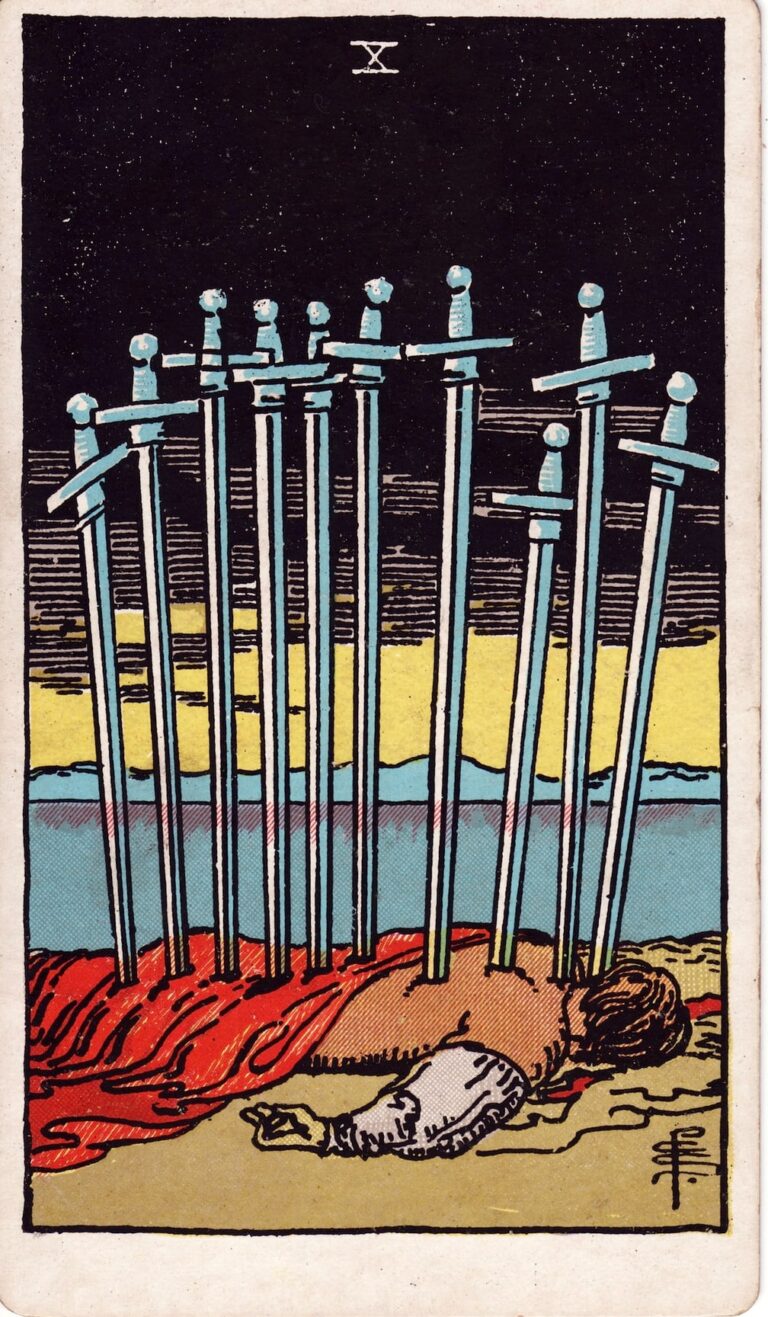
The Ten of Swords is the card of a painful ending pushed all the way to its limit: ruin, collapse, exhaustion and the point where there is nothing left to keep fighting.
Ten swords make the scene stark and excessive, while light at the horizon leaves room for an interpretation about what comes after an ending. Betrayal is one possible theme rather than the whole meaning. The image can prompt reflection on closure and rebuilding, but it does not establish that the worst is already over.
Ten of Swords description
In the Rider-Waite-Smith Ten of Swords, the Roman numeral X sits above a black sky. Below it, ten swords stand in the back of a prone figure lying face-down across the foreground. A red drape covers part of the body, while the figure’s right hand remains visible, curled into a sign of benediction that echoes The Hierophant.
Behind the figure, the sea is completely still, its surface mirror-calm beneath the dark sky. Distant mountains sit low along the far edge of the scene. At the horizon, a band of gold breaks through beneath the black, creating a sharp line between darkness above and the warmer light below.
The whole card is unusually still for such a violent image. Nothing in the scene appears to be moving: the figure is down, the water is flat, and the sky has settled into heavy darkness while the first light arrives at the horizon.
Also known as: the Ten of Épées in the Tarot de Marseille, with some modern decks using Blades. The Thoth deck keeps the name Swords, and in playing-card decks the suit maps to Spades; this guide focuses on Rider–Waite–Smith imagery and interpretation, which may differ from those traditions.
Symbolism: what’s in the Ten of Swords? (1–10)
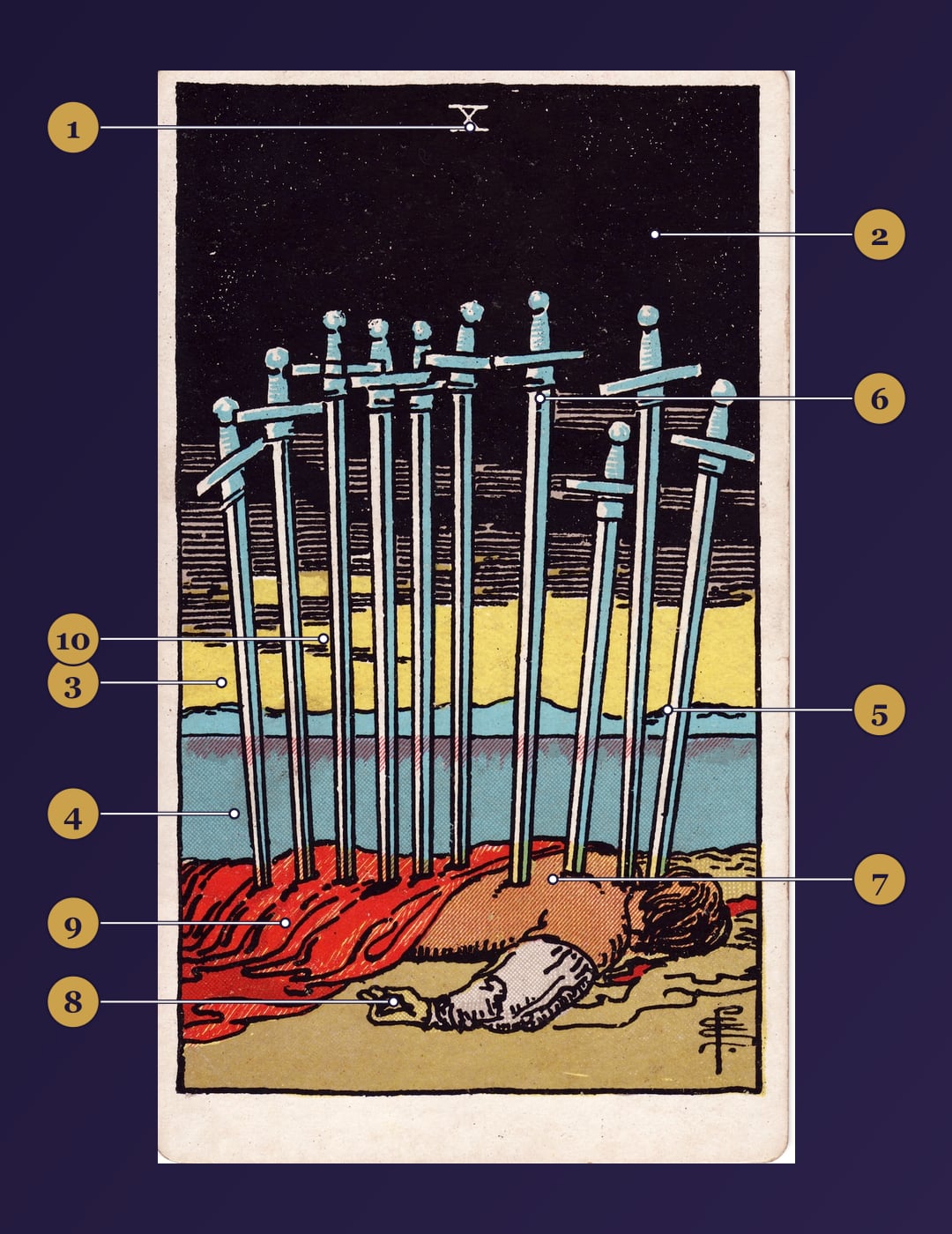
Choose a labelled symbol to highlight its number.
Read the numbered explanationsAcross the Ten of Swords, ten marked details turn its violent scene into a picture of completion, rock bottom and the first edge of aftermath.
- Roman numeral X: The Roman numeral X crowns the card. Ten closes the numbered run of the Swords, so this marker points to completion: the suit’s logic has been followed as far as it can go. There is no eleventh sword waiting above it. The sequence has reached its endpoint.
- Black sky: The black sky carries the full weight of the card’s lowest point. This is night with almost nothing softened or hidden, a visual statement that the situation has reached its floor. The light at the horizon creates a contrast with that darkness, leaving room to consider what could follow an ending.
- Gold dawn: Along the horizon, gold light is already breaking beneath the black. This is the reversal built into the image: because the ending has happened, something else can begin. The dawn does not erase the loss. It shows that the scene has already started to move beyond it.
- Still, mirror-calm sea: The sea has no visible wind left in it. After the Suit of Swords has spent so much energy on conflict and mental strain, this flat water reads as the silence after those storms. The card is painful, but the struggle itself has stopped.
- Distant mountains: The mountains sit at the far edge of the loss rather than pressing into the foreground. They suggest perspective beginning to return, even if it is still distant. What feels absolute at rock bottom can eventually be seen from farther away, with more space around it.
- Ten swords in the back: Ten swords make the card’s dark comedy unmistakable. One sword would have done the job; the other nine turn the image into theatrical overkill. This is the mind continuing to stab a finished thing, repeating the thought of defeat after the ending is already complete.
- Prone, face-down figure: The figure has no fight left to give. Lying face-down, the body shows total surrender rather than another round of struggle. The image can symbolise exhaustion or the end of a struggle without establishing that a real situation has reached its lowest possible point.
- Right hand in benediction: Visible beside the body, the right hand curls into a sign of benediction that echoes The Hierophant. At the bottom of the card, that small gesture brings in grace and acceptance. The ending is still painful, but acceptance can bless what cannot be fought or undone any longer.
- Red drape: The red drape lies across the defeated body, placing a note of dignity over an otherwise brutal scene. It does not change what has happened or disguise the loss. Instead, it suggests that defeat does not strip the figure of all worth or human dignity.
- Horizon line: Across the horizon, a precise seam divides black and gold, ending and aftermath. It is the card’s clearest dividing line: above it is the full weight of what has finished; below it is the first visible sign of what comes after the ending has been accepted.
What does the Ten of Swords mean?
In an upright reading, the Ten of Swords can describe a painful ending, exhaustion or the feeling that a particular approach has run its course. Whether that ending is past, present or feared depends on the question and the spread position. The card does not establish that catastrophe has happened or that the worst is behind you.
The image is melodramatic on purpose. One sword would have been enough; ten shows what the mind can do after something is already finished, replaying the hurt, adding another thought to the wound and treating a completed ending as if it still needs to be fought. The blow has landed; what remains is your response to it. Betrayal can be part of the reading, but it is secondary to ruin, exhaustion and finality.
That makes the Ten of Swords different from Death, where an ending belongs to a natural process of change, and The Tower, where demolition arrives suddenly. Here, the key is exhaustion of the cycle. It may invite you to ask which part of a situation can be repaired and which part needs to end. Acceptance may feel bleak at first, but the dawn in the card matters: it leaves room for the possibility of rebuilding without promising an outcome. The next task is not to deny what happened, but to stop giving a finished thing fresh swords.
What does the Ten of Swords mean in love?
In love, the Ten of Swords can bring attention to an ending, exhaustion or a pattern that feels unsustainable. It does not establish that a relationship must end. Consider what is actually happening, what each person wants and whether repair or separation is appropriate.
If you are single, the card may help you reflect on the impact of an earlier heartbreak or a pattern you want to change. The light on the horizon can symbolise the possibility of a different chapter, but it does not decide when grief is finished or when you should be ready to move on.
If you’re attached, the Ten of Swords can mark the end of the relationship itself, or the rock bottom of a damaging pattern within it. Either way, the old form cannot simply continue unchanged. The useful question is not how to restore what has already collapsed, but what must be admitted as finished before any real recovery is possible.
What does the Ten of Swords mean for career?
For career readings, the Ten of Swords means a work cycle has ended hard, often through redundancy, a project collapse or a door closing with little room to reopen it. This is the point where rebuilding makes more sense than trying to resuscitate the exact situation that has already failed.
You may feel professionally defeated, overworked or hurt by how an ending happened. The card can also carry a note of betrayal, especially when a role is cut or a project falls apart in a way you did not expect. Still, its main message is finality rather than punishment.
In readings, I would treat this as a completed chapter. Name what has ended, stop spending energy on making the old structure stand again, and look towards the opportunities that only become visible once you accept the closure. The dawn in the image does not promise an instant replacement, but it does show that your working life continues after this particular ending.
What does the Ten of Swords mean for money?
Financially, the Ten of Swords means your behaviour needs to become much more cautious after a damaging or final turn. Its upright message is not to keep spending or investing as though nothing has happened.
Lower your risk appetite, pay close attention to where your money is going, and be especially careful with investments that tempt you to ignore a clear ending. If debts have caught up with you, avoidance has reached its limit, so the useful move is to face what is owed rather than add more pressure through careless spending.
In a severe reading, the card can point towards bankruptcy or financial ruin, but it does not insist on either. The dawn matters here too. Recovery is possible, but it begins with cautious choices and a willingness to deal with the position you are already in.
The Ten of Swords as feelings
As feelings, the Ten of Swords can symbolise exhaustion, disappointment or a sense of closure within the question. It cannot establish that another person is finished with you or has decided the relationship is over.
If an ending has been communicated, the card may offer a way to reflect on its impact. If it has not, seek clarity through the person’s words and behaviour rather than treating the image as a final answer on their behalf.
The Ten of Swords as actions
In an actions position, the Ten of Swords can invite reflection on stopping an unsustainable pattern, acknowledging an ending or deciding what no longer merits further effort. It does not establish that someone will betray you or deliver a final blow.
As advice, the image may ask for a realistic assessment of what has ended and what remains possible. That can include accepting a loss, seeking support or deciding whether a repair is workable. The dramatic imagery does not require a dramatic response.
Is the Ten of Swords a yes or no?
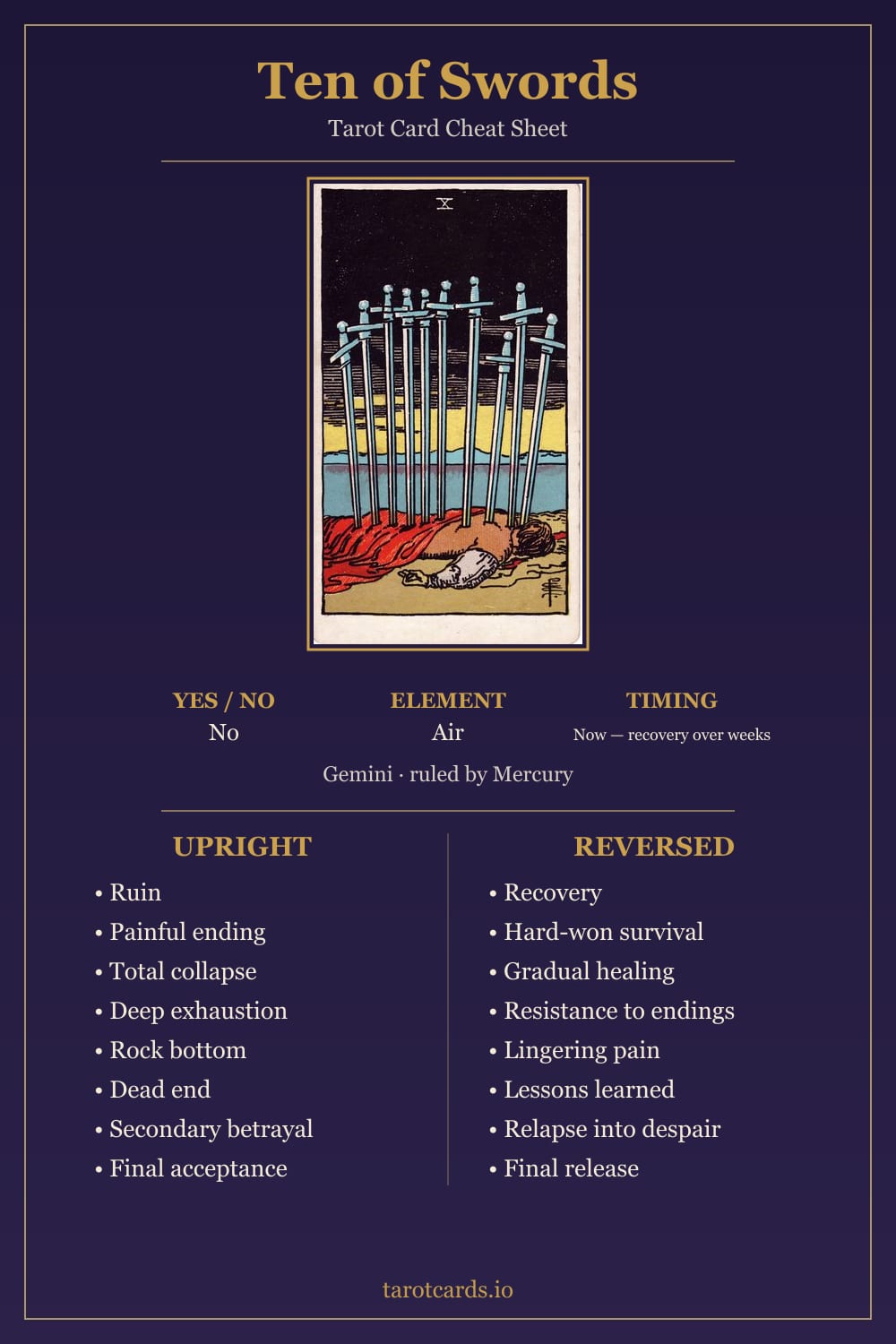
In a yes-or-no reading, the Ten of Swords is commonly treated as no or as a reason to reconsider continuing unchanged. That reading comes from its ending symbolism, rather than knowledge of a fixed outcome.
That no is not the same as permanent hopelessness. The gold dawn changes the tone: no to this path, this version or this cycle can clear the space for what comes next. If you are asking whether the old situation can carry on unchanged, the card’s answer is especially firm.
What does the Ten of Swords reversed mean?
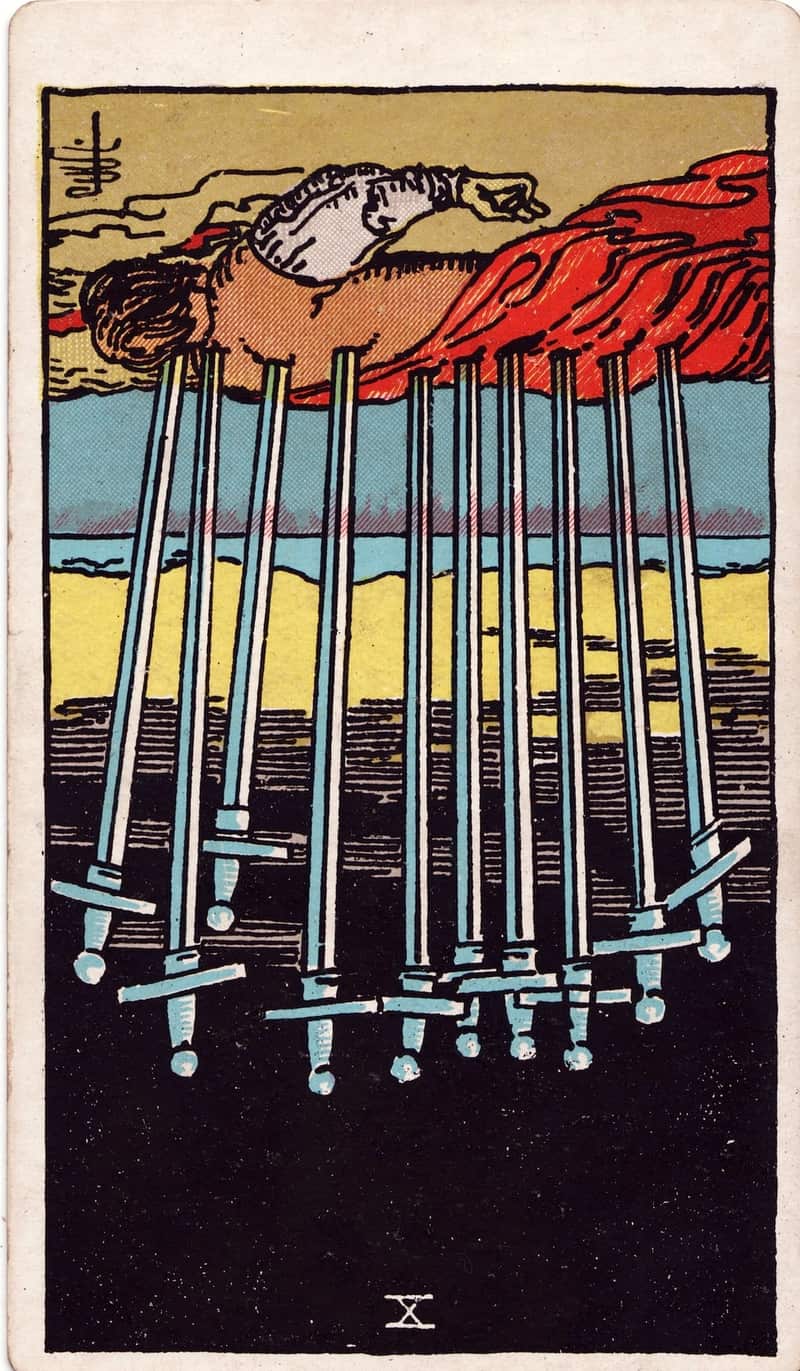
Reversed, the Ten of Swords means either an ending is being resisted long after it is over, or recovery has finally begun. The key shift is not a simple mirror of the upright card; it is about what happens when the ending refuses to stay neatly finished.
On the harder side, you may be dragging out a situation that has already reached its natural stopping point. Old wounds are being argued again, the same hurt is replayed, or you keep returning to the scene of defeat because acceptance feels too final. In that reading, the reversal is the refusal to let the cycle die.
On the more hopeful side, the reversal can symbolise beginning to rebuild, applying a difficult lesson or accepting support. Those possibilities should be checked against what is actually changing. The card does not establish that the worst has passed, and recovery need not follow a smooth or immediate course.
Reversed: love, career and money
Love
Reversed in love, the Ten of Swords can show recovery after heartbreak, reconciliation, or the harder pattern of refusing to accept that a connection has ended. The difference lies in what you are doing with the wound now.
If healing is underway, you may be letting go of past pain and becoming more open to a new romantic connection, or trying to rebuild an existing relationship after its lowest point. When resistance is stronger, the same arguments and injuries keep being brought back into the present. The card asks for honesty about which process is happening: repair requires the old wound to stop being reopened simply to prove that it still hurts.
Career
Professionally, the reversed Ten of Swords can show recovery after conflict, rejection or a hard ending, but it can also show you trying to revive a role or project whose cycle is already complete. The reversal makes that distinction important.
On the recovery side, rebuilding professional relationships and making new connections can help you find opportunities after a difficult period. By contrast, returning to the same failed structure keeps the ending alive without changing its result. Treat the loss as information. Rebuild from what remains useful rather than asking the old role, project or workplace to become exactly what it was before.
Money
For money, the reversed Ten of Swords can show financial recovery beginning after overspending, debt pressure or a period of serious strain. Improvement is gradual, and it depends on applying what the difficult period has already taught you.
The resistant version looks different: spending continues as before, risky choices are defended, or the seriousness of the position is pushed aside because accepting it feels too painful. If the damage is not fully resolved, that does not cancel the recovery. Regaining control, reducing unnecessary spending and becoming more careful with investments are the practical signs that the swords are finally starting to come out.
Timing
This site associates Swords with winter, while other timing systems differ. The Ten can symbolise completion, but it cannot establish that an ending has just happened or that recovery will take only a few weeks. Read its timing through the known circumstances and the position it occupies in the spread.
Ten of Swords card combinations
The general meaning of the Ten of Swords card isn’t set in stone and depends on the reading and the person. But when paired with other cards, even more nuance is needed from the tarot reader as the messages run deeper.
The Ten of Swords and The Tower
When paired with The Tower, these cards can indicate a sudden dramatic ending. These cards are perhaps the most challenging combination, with The Tower signifying unexpected change. Projects and plans may be falling through, such as an abrupt redundancy in your current job. But the pairing can spur on the destruction of old belief systems and structures, where despite the negativity or tragic loss, there’s an opportunity for growth after a violent end.
The Ten of Swords and The Star
This is a slightly more upbeat pairing, as The Star softens the brutality of the ten swords and presents light in our darkest hour. The Star has energy for renewal, inspiring us to garner a new sense of purpose that can often emerge after a difficult period. Together, you’re encouraged to release old thought patterns and embrace a brighter outlook.
The Ten of Swords and Death
With Death, both cards symbolize endings individually, yet together they combine into a message of major change. Death is read here symbolically as transition; neither card provides evidence that someone will die. Together they may invite reflection on what is ending and what a workable next step could be. The takeaway message here is to make way for new beginnings and lean into the change.
The Ten of Swords and Three of Swords
Within tarot card readings, eyebrows are often raised when two Suit of Swords cards are paired together. These Minor Arcana cards reinforce the themes of heartbreak and emotional pain, be that general anxieties or past relationships. The Three of Swords pairing encourages acceptance and the release of internal pain that may have stuck around for a long time. New ways of thinking are now needed.
The Ten of Swords and The Fool
This pairing is a great way to hammer home the ending-and-change message of the Ten of Swords card. The Fool represents a leap of faith towards new opportunities, but courage is required. Courage can be difficult to muster after the crisis of the Ten of Swords, and the combination also advises caution, as some circumstances may not have gone to plan.
Astrology
In the Golden Dawn’s Book T, the Ten of Swords is associated with the Sun in Gemini. Gemini is a zodiac sign, not a star, and this is an astrological correspondence rather than astral projection. The Sun’s symbolism of visibility offers one way to consider an ending brought fully into view.
Mercury is Gemini’s sign ruler, but it does not replace the Sun as this card’s planetary attribution in that system. These symbols can enrich a reading without claiming that a person’s sign determines how they handle difficulty.
Conclusion
Difficult as it looks, the Ten of Swords can invite a realistic look at an ending or an exhausted pattern. The black sky and light horizon offer a contrast between loss and the possibility of what comes next. Rebuilding depends on the real situation; the card does not guarantee that a low point has passed or that recovery is already under way.
For the next step, use a focused reading on the ending in front of you, or continue through the suit with Nine of Swords and Page of Swords.
Reading approach: Use these Rider–Waite–Smith interpretations to explore the question and context. A card does not establish another person’s feelings or a future outcome; check practical decisions against observable facts.
Curious about what lies ahead?
Get a free AI tarot reading and explore guidance designed just for you. Discover the messages the cards have to share and gain insight into your path.
Get a free tarot reading


