



Five of Swords Tarot Card Meaning: Conflict, Communication & Hard Lessons
Table of Contents
- Upright / Reversed keywords
- Five of Swords description
- Symbolism: what’s in the Five of Swords? (1–10)
- What does the Five of Swords mean?
- What does the Five of Swords mean in love?
- What does the Five of Swords mean for career?
- What does the Five of Swords mean for money?
- The Five of Swords as feelings
- The Five of Swords as actions
- Is the Five of Swords a yes or no?
- What does the Five of Swords reversed mean?
- Reversed: love, career and money
- Timing
- Five of Swords card combinations
- Astrology
- Conclusion
The Five of Swords is a card of conflict, hostility and the uneasy moment when somebody can win the argument yet lose far more than they gained. It can describe defeat, bullying or a victory with an ugly price, but it can also tell you that leaving the fight is the wiser move.
What makes this card unusual is that the Rider-Waite-Smith image gives you three possible places to stand: you may be the smirking winner, the person walking away, or the person left grieving. The reading changes with your position, but the measure stays the same: what this conflict has cost.
Upright / Reversed keywords
Upright
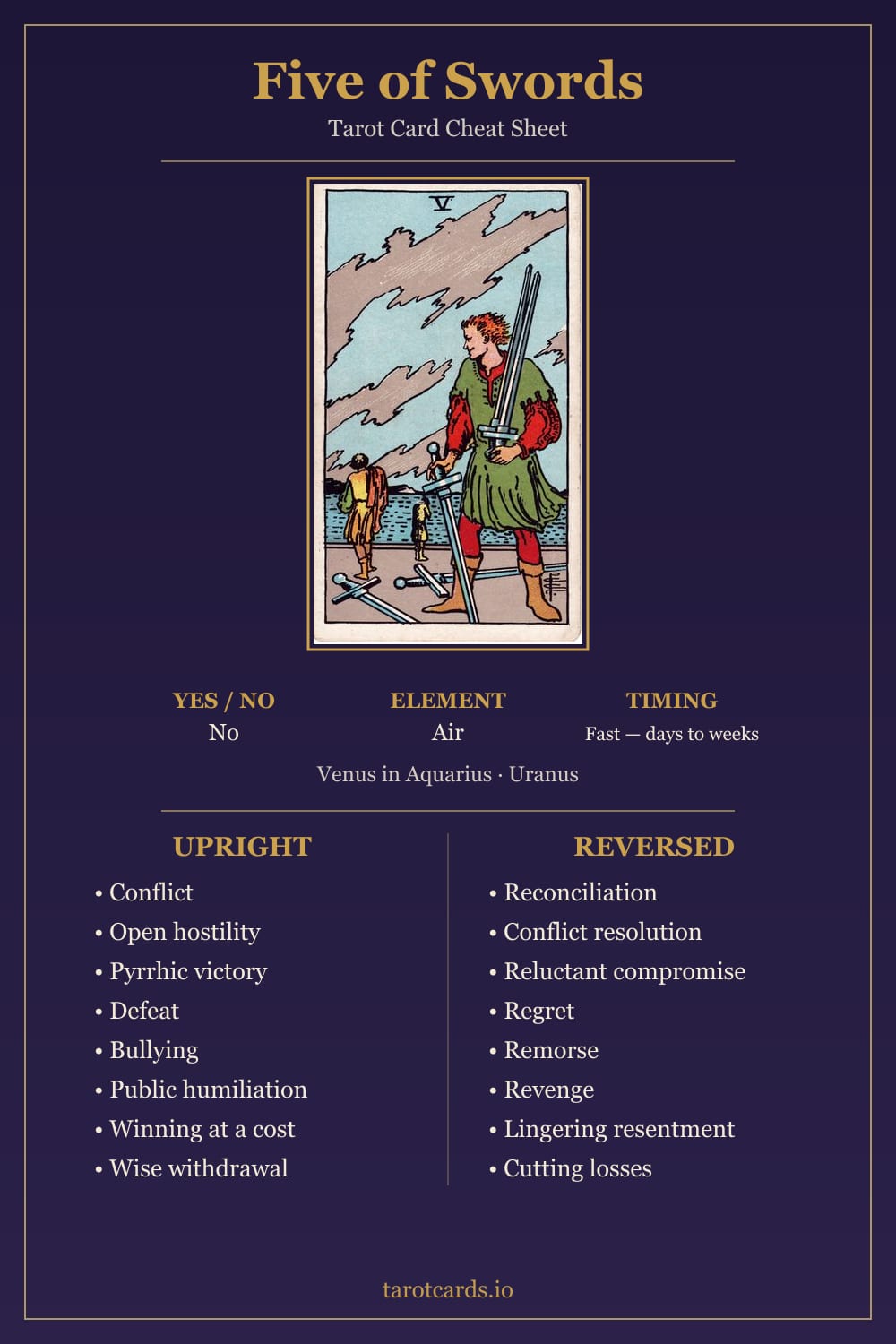
Conflict, open hostility, pyrrhic victory, defeat, bullying, public humiliation, winning at a cost, wise withdrawal
Reversed
Reconciliation, conflict resolution, reluctant compromise, regret, remorse, revenge, lingering resentment, cutting losses
Five of Swords description
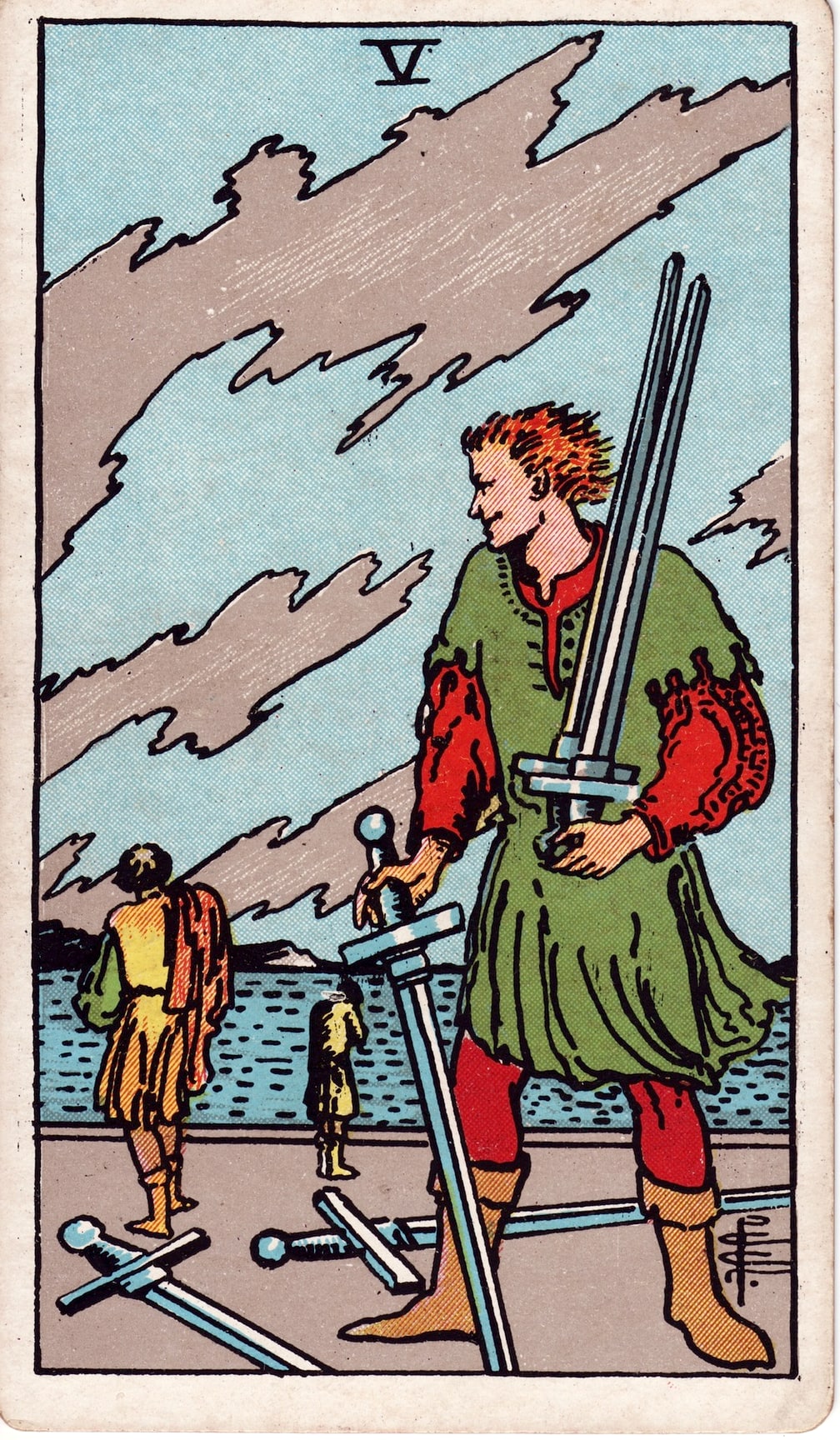
In the Rider-Waite-Smith Five of Swords, three figures occupy a bare, trampled foreground beneath jagged clouds. The Roman numeral V sits at the top of the card. Closest to us, a figure in a green tunic looks back with a smirk. Two swords rest over his shoulder while he holds a third in his hand.
On the ground in front of him lie two more swords. Farther back, another figure trudges away across the open field. Beyond that person, a third figure stands near the water with their head in their hands. The water itself is choppy rather than calm, and the clouds above look stretched and torn by wind.
Nothing in the scene brings the three figures together. One remains with the swords, one is leaving, and one is visibly distressed near the water. The two discarded swords sit between the viewer and the departing figures, while the choppy water and torn clouds keep the background visually unsettled.
Also known as: the Five of Épées in the Tarot de Marseille, with some modern decks using Blades. The Thoth deck keeps the name Swords, and in playing-card decks the suit maps to Spades; whichever your deck uses, this is the same air-suit card and the meanings on this page apply.
Symbolism: what’s in the Five of Swords? (1–10)
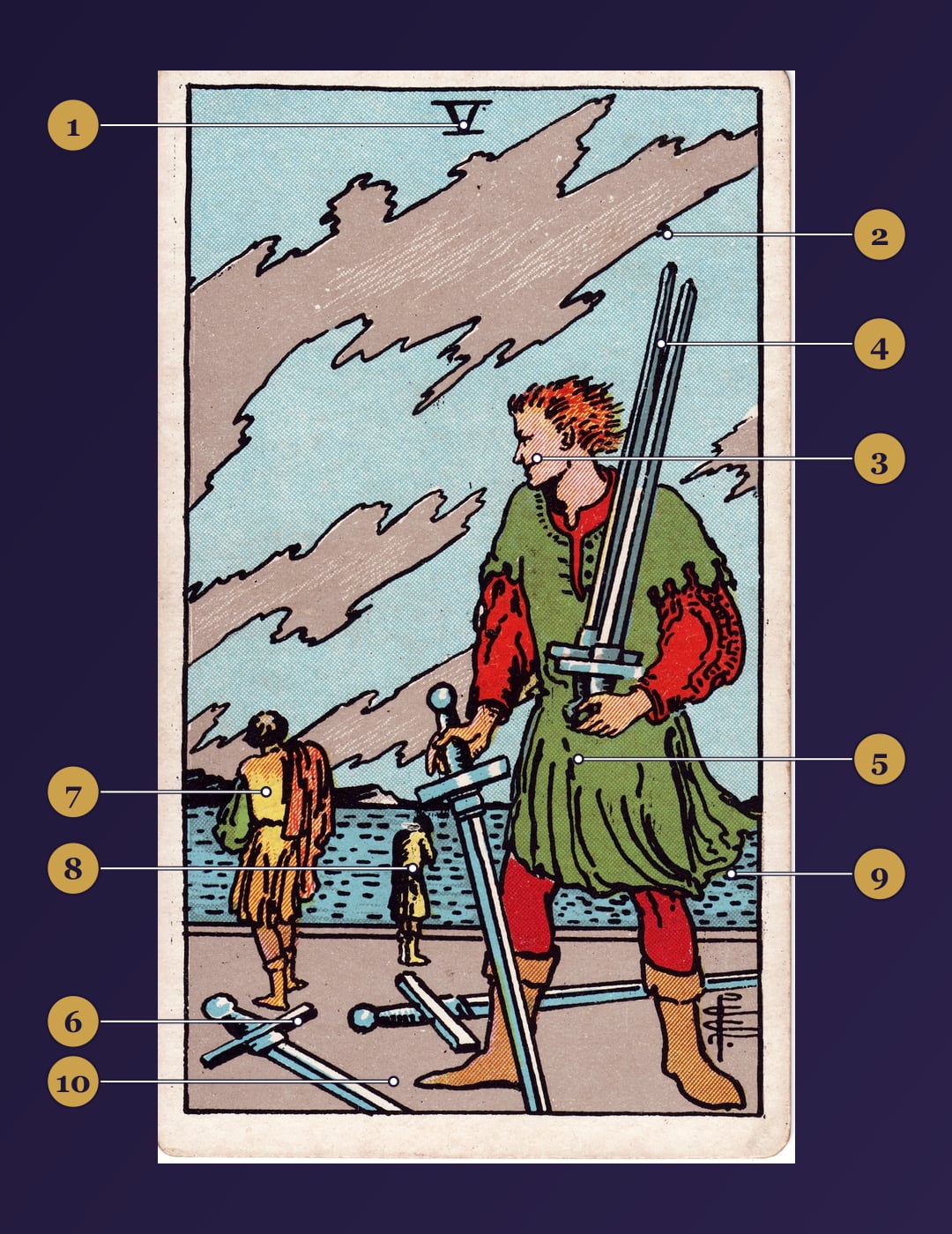
Across the Five of Swords, ten marked details build its picture of conflict, costly victory and withdrawal.
- Roman numeral V: The V at the top marks the Five, a number tied here to conflict and instability within the suit. It sets the tone before you reach the figures below: this is not a settled scene, and the balance between people has already been disturbed.
- Jagged, wind-torn clouds: The clouds look ripped across the sky, as though the atmosphere itself has been pulled out of shape. They carry the hostility of the scene upward. Even after the confrontation, the argument still seems to hang in the air rather than clearing cleanly.
- The victor’s backward glance: The foreground figure does not simply gather the swords and leave. He looks back with a smirk, checking the effect of his win. That glance turns the triumph into a display, with satisfaction depending partly on the defeated people knowing they have lost.
- Three swords collected: Two swords sit over the victor’s shoulder and a third remains in his hand. He has taken three of the five, which makes the win visibly incomplete. Yet the spoils are not the whole prize, and everyone else has gone.
- Green tunic: His green clothing points to self-interest that is still green itself: immature, underdeveloped and too pleased with immediate advantage. Nothing here denies that he has won something. It asks whether the way he has handled that win shows enough maturity to keep it.
- Two abandoned swords: Both remaining swords lie on the ground rather than in anyone’s hands. They show what the conflict has cost and what the others no longer want to keep fighting over. A victory can look less impressive when part of the field has simply stopped participating.
- The nearer figure walking away: One person trudges away from the victor rather than turning back for another round. That can read as resignation, but it can also be self-preservation. In some readings, this is the card’s advice: leaving a pointless fight can be wiser than proving you can continue it.
- The distant grieving figure: Near the water, the farthest figure has their head in their hands. This is the human price of the clash made visible. Whatever the victor believes he gained, someone else is carrying genuine hurt, humiliation or defeat away from the same encounter.
- Choppy water: The water behind the figures is unsettled, matching emotions stirred up by the conflict. Physically, the scene may be quiet now, but the feeling underneath it is not. Anger, hurt and agitation continue after the swords have stopped being used.
- Bare, trampled foreground: The ground is stripped back, with little on it worth holding once the fight is over. That emptiness sharpens the card’s central problem: everyone has paid for the conflict, yet the field itself offers almost nothing that makes the struggle look worthwhile.
What does the Five of Swords mean?
The Five of Swords means conflict in which winning, losing and walking away can all carry a cost. In readings, I do not treat it as a simple prediction that you will be defeated, because Pamela Colman Smith gives us three figures and never tells us which one is you.
You may be the person holding three swords, technically ahead but left alone on the field. The image makes the equation plain: he has collected most of the swords and lost everyone around him. If so, the card asks you to audit the victory: did you get the last word, prove your point or overpower someone only to damage the relationship around it? You may instead be the grieving figure, dealing with a real loss or humiliation. In that position, the card acknowledges the sting rather than pretending every conflict can be turned into an immediate lesson.
Then there is the person walking away. That figure changes the whole card. Withdrawal is not always surrender; sometimes refusing another round is the most self-protective choice available. The Five of Swords can therefore point to bullying, defeat or a pyrrhic win, but it can also advise you to stop feeding a contest that has nothing left worth winning.
What does the Five of Swords mean in love?
In love, the Five of Swords means that being right and being close are pulling in opposite directions. For an attached couple, poor communication, betrayal or repeated scorekeeping can turn ordinary disagreement into a contest where somebody has to lose. You may win the argument and still damage trust, affection or the willingness to keep talking. If the hostility has become abusive, the figure walking away matters most: leaving can be self-protection rather than defeat.
For a single reader, the card can point to self-sabotage or to people who treat dating as a competition instead of a connection. Be wary of aggressive behaviour and of your own urge to reject first so that you cannot be rejected. The useful question is not who has the upper hand, but whether the interaction leaves room for mutual respect once nobody is trying to score the final point.
What does the Five of Swords mean for career?
For career, the Five of Swords points to workplace conflict, a toxic competitor or a professional win that costs more than it appears to. You could get your way on a project, win a power struggle or come out ahead in an argument, then find that cooperation has collapsed around you. Before claiming victory, look at what you are giving up to secure it.
The card can also place you on the other side of the clash. A colleague may be playing unfairly, communication may have broken down, or the atmosphere may feel hostile enough that disengaging is the sensible choice. Keep your professional composure rather than matching cruelty with cruelty. Where the conflict is becoming unmanageable, seek workplace support rather than treating escalation as proof of strength. You do not have to keep proving yourself inside a fight that is damaging the work itself.
What does the Five of Swords mean for money?
In money readings, the Five of Swords warns that pride, conflict or the need to prove a point can distort your financial judgement. Watch your risk appetite, especially if you are tempted to make an investment simply because you want to be right after someone has challenged you. A costly decision can still feel like a win in the moment if ego is doing the accounting.
The card also asks you to look hard at spending and debt. If borrowed money is creating tension with family, or reduced income has left you trying to keep up appearances, cut expenses before the situation becomes another contest. The useful move is to protect what remains rather than throw more money at an argument, a regret or a decision you no longer need to defend.
The Five of Swords as feelings
As feelings, the Five of Swords shows someone who is still carrying the residue of conflict and cares more about winning the argument or saving face than restoring harmony right now. They may still care about you, but pride is sitting between that feeling and any easy expression of it.
This can look like defensiveness, resentment or a need to make sure you understand how hurt or angry they are. If they feel they lost, they may be replaying the humiliation; if they feel they won, the satisfaction is likely to be hollow rather than warm.
The Five of Swords as actions
When read as actions, the Five of Swords points to someone fighting to win at almost any cost. They are likely to push an argument past the point of resolution, use cruel words, or try to humiliate the other person so there is no doubt about who came out on top.
The problem is what happens next. They may collect the symbolic swords and walk away feeling victorious, but the bond is damaged behind them. In some cases, the action belongs to the other figure instead: refusing to keep engaging and leaving the conflict before it takes anything else.
Is the Five of Swords a yes or no?
No — the Five of Swords says that any available win is likely to carry a price that turns it into a loss. If your question is about pushing ahead, proving a point or beating someone else, the card warns against confusing victory with a good outcome.
There is one useful nuance: the “no” can support walking away. Declining the contest, cutting your losses or refusing another round may be the cleanest result this card can offer.
What does the Five of Swords reversed mean?
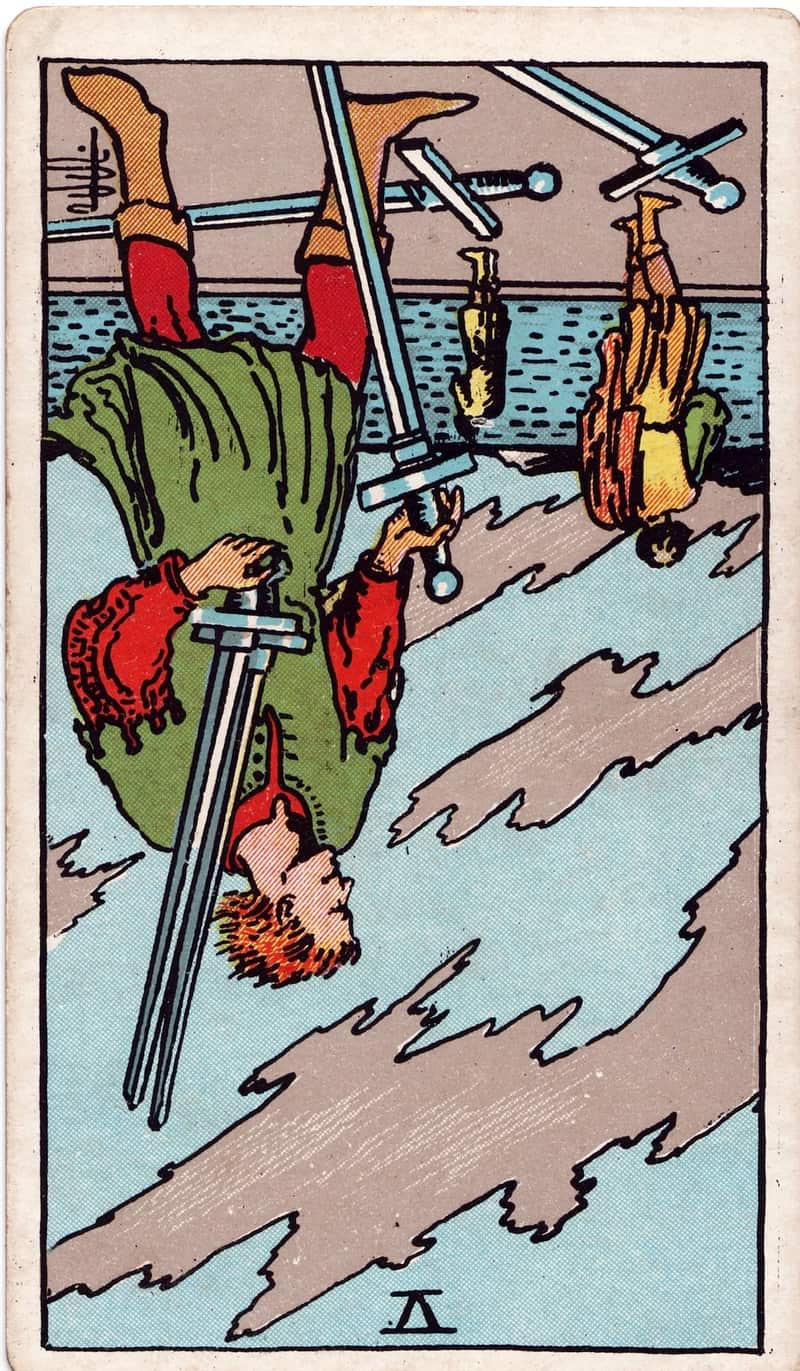
The Five of Swords reversed means you are in the aftermath of conflict, where the next move is either reconciliation or a grudge that keeps the fight alive. This reversal does not guarantee peace. It shows the moment when people decide what they are going to do with the damage already done.
On one side, there is regret, remorse and a willingness to cut losses. Nobody needs to keep proving who had the upper hand, so compromise becomes possible and communication can reopen. You may apologise, accept that the argument cost too much, or decide that continuing it would only deepen the harm.
On the other side, the conflict can harden into resentment or revenge. The words have stopped, but the score is still being kept. Someone may replay a humiliation, refuse to forgive, or wait for another chance to win. That is why I would not flatten the reversed Five of Swords into “reconciliation” in a reading: it can show de-escalation, but it can just as clearly show a fight fermenting into a long grudge.
Reversed: love, career and money
Love
In love, the reversed Five of Swords can show a couple finally deciding that the argument matters less than the relationship. Forgiveness, clearer communication or reconciliation with a former partner can follow when both people are willing to stop keeping score. After deceit or public humiliation, however, cutting your losses may still be the healthier form of resolution.
The other possibility is resentment that has gone quiet rather than disappeared. A partner may say the fight is over while continuing to punish, withdraw or keep the old grievance alive. If you are single, the same card can ask whether an old conflict is still shaping how quickly you reject or distrust new people.
Career
At work, the reversed Five of Swords points to conflict beginning to de-escalate, or to hostility that has simply moved underground. Communication with colleagues may reopen, and a workplace bully or unfair tactic may be exposed, giving everyone a chance to reset the terms of the situation.
Yet a surface truce is not the same as restored trust. Someone may remain resentful after losing status or being challenged, so watch what happens after the meeting ends. If you are considering leaving a hostile role, the reversal can support cutting your losses rather than spending more energy trying to win a workplace battle that has already taken enough.
Money
For money, the reversed Five of Swords is about dealing with the consequences of earlier financial choices instead of defending them. Regret can become useful if it leads you to reduce debt, increase repayments or rethink spending that has been keeping you in conflict with yourself or other people.
It can also show a money grudge that refuses to settle: resentment over a loss, a loan or an investment decision may keep influencing what you do next. The better expression of the reversal is to stop trying to recover pride through another risky move. Correct what you can, accept what has already been spent, and let the argument end there.
Timing
Readers traditionally associate the Five of Swords with fast, messy timing: around five days to five weeks is a reasonable reading rather than a rigid suit formula, air moves quickly, conflict-driven events can unfold at argument speed, and the Suit of Swords carries a Winter association.
Five of Swords card combinations
The Five of Swords represents both conflict and the importance of communication when seeking a resolution. When the Five of Swords appears alongside other cards in a reading, its meaning can be sharpened. Some of the most interesting combinations include The High Priestess and Six of Wands.
Five of Swords and The High Priestess
The High Priestess is a Major Arcana card that represents the importance of intuition. The Five of Swords appears in the Suit of Swords, which represents communication and intellect. When these cards combine, you are advised to take a period of introspection, reflecting on the decisions you’ve made as you seek a resolution.
Five of Swords and Six of Wands
The Five of Swords and Six of Wands are both Minor Arcana tarot cards, bringing together the Suit of Swords and the Suit of Wands. When these cards appear together, they warn of deception and treachery. Be careful of those around you, because not everyone is what they seem.
Astrology
Astrologically, the Five of Swords is most closely associated with Venus in Aquarius. This is because the Suit of Swords is attached to the element of air, with both symbolising intelligence, communication and action.
Uranus is the planet most closely linked to the Five of Swords, thanks to its messages of rebellion and expecting the unexpected. You may need some of that rebellious streak when this card is in your corner. The card is sometimes called a bad omen or the defeat card. But even when you feel powerless or defeated, you still have tools of intellect and communication available, and the card asks how you choose to use them once conflict has begun.
Conclusion
Look past the scoreboard when the Five of Swords appears and judge the conflict by what it has cost: you may be holding the swords, leaving the field or grieving beside the water, and none of those positions can be read well without the others. The card’s hardest lesson is that a clean-looking victory can leave everyone poorer.
Continue exploring with Four of Swords or Six of Swords.
Curious about what lies ahead?
Get a free AI tarot reading and explore guidance designed just for you. Discover the messages the cards have to share and gain insight into your path.
Learn More


