



The Emperor Tarot Card Meaning: What This Card Might Be Telling You
Table of Contents
- Upright / Reversed keywords
- The Emperor description
- Symbolism: what’s in The Emperor? (1–9)
- What does The Emperor mean?
- What does The Emperor mean in love?
- What does The Emperor mean for career?
- What does The Emperor mean for money?
- The Emperor as feelings
- The Emperor as actions
- Is The Emperor a yes or no?
- What does The Emperor reversed mean?
- Reversed: love, career and money
- Timing
- The Emperor card combinations
- Astrology
- Conclusion
Meaning at a glance
The Emperor: upright and reversed
Upright
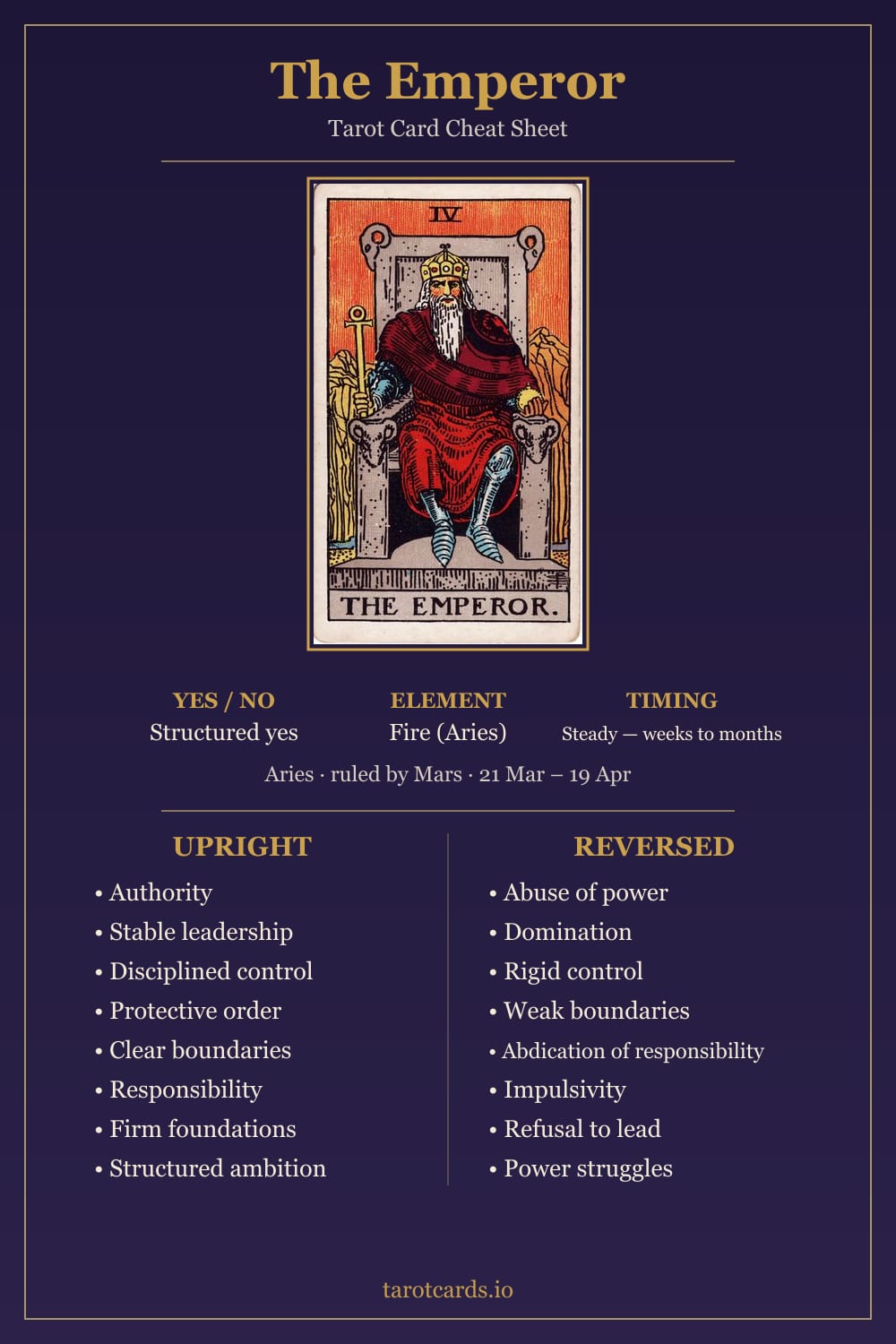
The Emperor represents dependable structure: clear boundaries, practical rules and responsibility for what you lead. His authority is useful when it protects people and gives plans a firm foundation. Consider where a consistent decision or an agreed framework would help.
Keywords: Authority, stable leadership, disciplined control, protective order, clear boundaries, responsibility, firm foundations, structured ambition
Reversed
Reversed, The Emperor explores authority out of balance. Control can become rigid or domineering, while avoiding responsibility can leave needed boundaries absent. Identify which pattern is present and what accountable leadership would require, rather than equating strength with getting your own way.
Keywords: Abuse of power, domination, rigid control, weak boundaries, abdication of responsibility, impulsivity, refusal to lead, power struggles
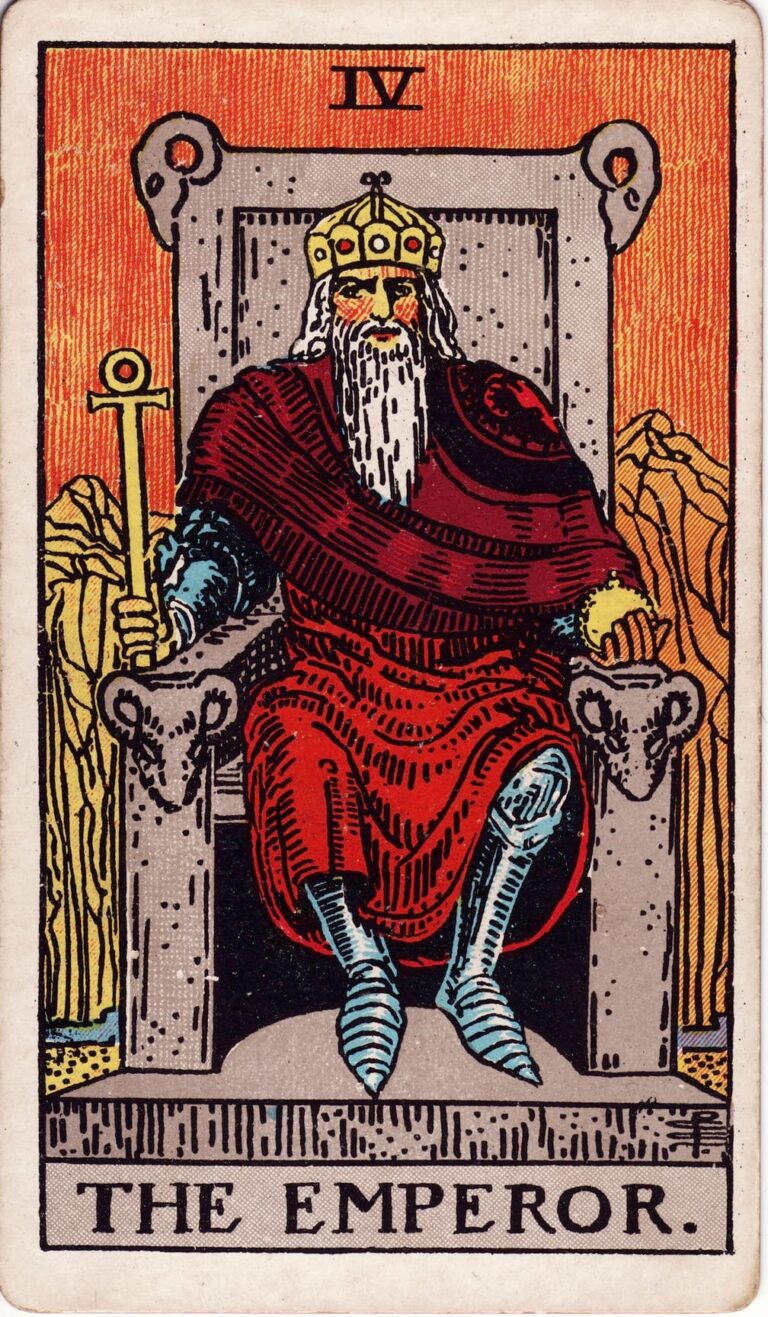
The Emperor represents authority, stability and disciplined control: the kind of structure that protects what has been built, sets workable boundaries and gives ambition somewhere solid to stand. The tyrant belongs to the reversal; upright, he represents competent, protective order and, like The Empress in a world of rock instead of a garden, he is far more often your own need to build structure than a prediction that an older man is coming into your life.
The Emperor description
In the Rider-Waite-Smith deck, The Emperor appears as a crowned, white-bearded ruler seated on a massive stone throne. His red robe covers most of his body, though pieces of armour are still visible beneath it, including the greaves over his lower legs. Four carved ram’s heads decorate the throne around him.
He holds an ankh-shaped sceptre in his right hand and a golden orb in his left. A bright golden crown sits above his long white beard, while the hard stone of the throne fills much of the lower half of the card. Both hands are occupied, with the sceptre and orb held close to the red robe and stone throne.
Behind him, barren orange mountains rise across the background. At their base, a thin stream runs through the otherwise dry scene. The stone throne, the four ram carvings, the mountains and the narrow line of water make up the card’s main setting, with the stream tucked low behind the seated figure.
Symbolism: what’s in The Emperor? (1–9)
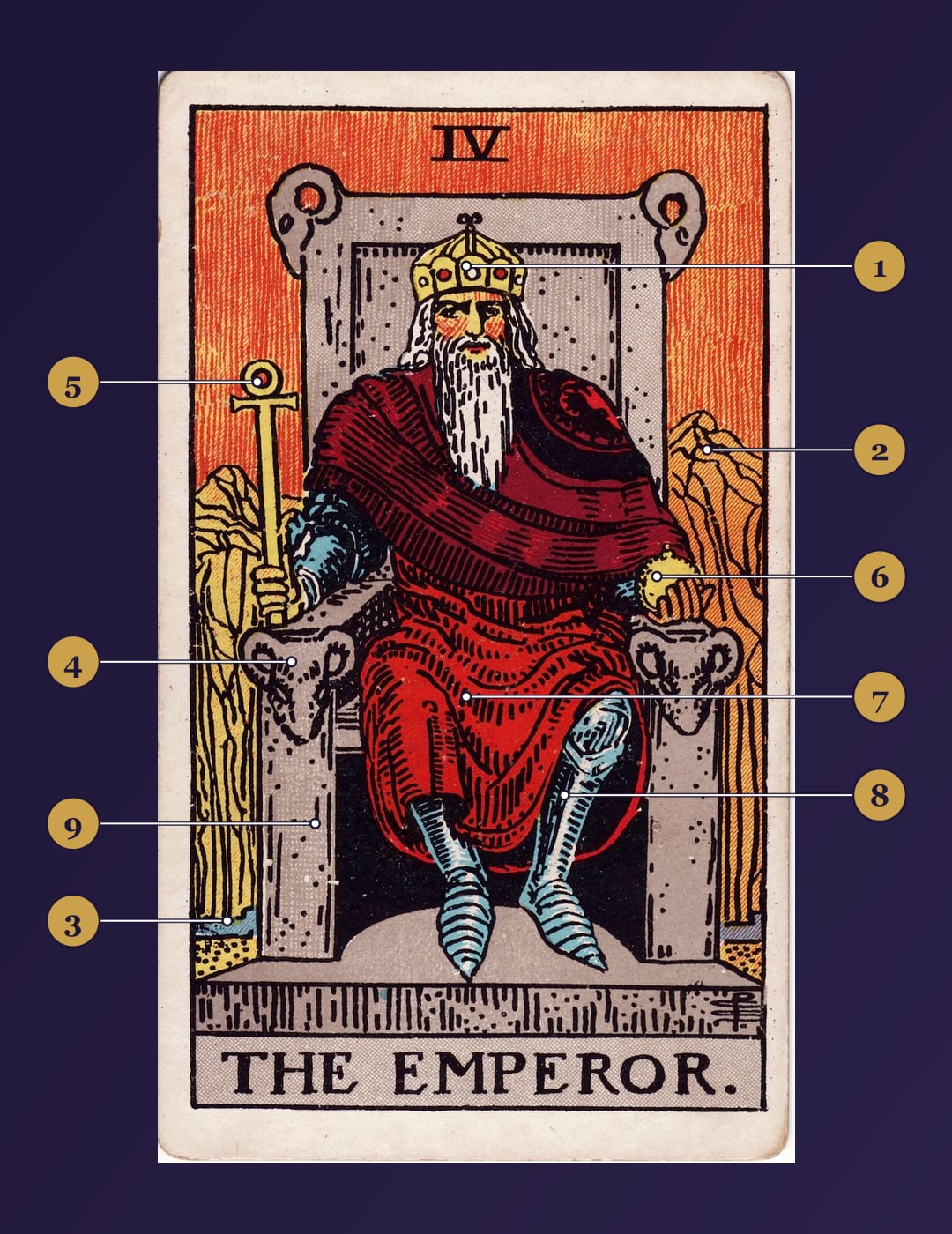
The Emperor’s artwork contains nine marked details, running from his crown and beard to the stone throne beneath him.
- Crown and long white beard: The crown establishes rank, while the long white beard points to seasoned authority. His power is presented as something earned through experience rather than seized in a rush. This is leadership shaped by time and responsibility rather than a rush to claim power.
- Barren orange mountains: The mountains place The Emperor in a world of rock rather than cultivation. They show rule through structure, endurance and firm limits, deliberately contrasting the garden around The Empress. Both figures are sovereign; the difference is the ground their authority grows from.
- Thin stream: At the mountains’ base, the stream is easy to miss, but it matters. Feeling has not disappeared beneath The Emperor’s discipline. The abundant waters associated with The Empress have been reduced to a trickle here, suggesting emotion survives even when it is tightly contained.
- Four ram’s heads: The four carved rams connect The Emperor with Aries and Mars. They bring leadership, initiative and force into the throne itself, but the animals are carved rather than charging forward. The energy is present and ready, held in reserve rather than spent without direction.
- Ankh sceptre: In his right hand, The Emperor holds the Egyptian key of life. The symbol widens the reach of his authority: he is not simply guarding land or status. His responsibility extends to the living world under his rule and the order that sustains it.
- Golden orb: The orb in his left hand presents the world as something held, ordered and accounted for. It suits a ruler who wants to know what belongs where and what must be maintained. Nothing about this symbol is casual; possession comes with oversight and responsibility.
- Red robe: The red robe carries the Mars energy attached to The Emperor. Its colour brings vitality and command into an otherwise hard, still image. The force beneath his authority is active, even when he remains seated, making the robe a visible sign of power under control.
- Armour beneath the robe: The visible greaves show that the warrior has never fully retired. Peace does not make him unprepared. His stability rests on readiness: he can remain seated because the capacity to defend what he has built is still present beneath the robe.
- Massive stone cube throne: The throne turns The Emperor’s central number into a physical object. Its heavy, cubic form suggests foundations, permanence and four-square stability. Number four appears again in the four ram’s heads, making order part of both the card’s structure and its seat of power.
What does The Emperor mean?
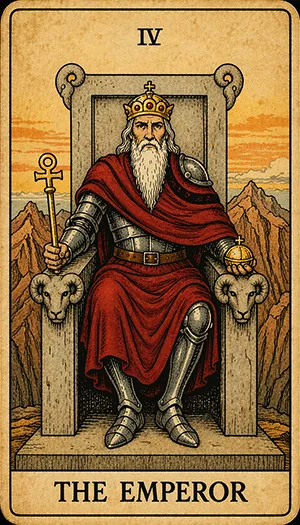
The Emperor upright means competent, protective order: build the structure, take responsibility for it and keep it standing. In readings, this card usually lands around authority, discipline, stability, control and the rules that make a situation workable. Sometimes that authority is external, such as a fatherly figure, a leader or the law. Just as often, it is asking you to become the steady point yourself.
That distinction matters because The Emperor is easily caricatured as domination. Upright, his control has a job to do. It sets boundaries, creates a solid foundation and protects what falls within them. The four ram’s heads and cubic throne repeat the logic of four: things are measured, placed and made dependable.
He also makes more sense beside The Empress than against her. She is surrounded by growth and water; he sits among rock, with only a thin stream behind him. The feeling is still there, but it has been put inside a framework. When The Emperor appears, the question is often less about finding a powerful person and more about where your own life needs firmer standards, clearer responsibility or a system you can actually maintain.
Order becomes a problem only when it hardens past usefulness. That is where the reversed card begins.
What does The Emperor mean in love?
In love, The Emperor means stability, commitment and protection matter more than immediate spark. This is serious relationship energy: reliability, a clear sense of where things are going and a willingness to build something that can last.
If you’re single, the card can point to someone mature, established or older who approaches romance with intention rather than flourish. It can also describe your own need to set clearer standards before choosing a partner. The older-person reading is possible, but it should not replace the card’s wider message about structure and commitment.
If you’re attached, The Emperor can describe a partner who provides consistency, keeps promises and thinks about the future. The strain comes when provision replaces tenderness. Someone may believe that being dependable is enough while forgetting to show warmth. A reliable partner may need reminding that affection cannot be replaced by planning everything correctly.
What does The Emperor mean for career?
The Emperor is one of the clearest career signs of leadership, authority and advancement through disciplined work. It can point to a promotion into management, greater responsibility, or dealings with institutions and people who hold formal power. If you want the next level, show that you can organise people, projects and decisions without losing control of the details.
This card rewards systems. Set a process, define responsibilities and make expectations clear before a project becomes chaotic. When you negotiate, do it from preparation rather than force; know your position, keep to the facts and stay consistent. The Emperor also favours records, so document decisions, agreements, deadlines and changes instead of relying on memory or informal promises.
If you’re already in charge, the card asks you to lead rather than merely hold a title. Be firm enough to create order and steady enough that other people know where they stand. A promotion or leadership role is more convincing under this card when your authority is backed by a system that other people can actually follow.
What does The Emperor mean for money?
With money, The Emperor means discipline should lead your spending and investment decisions. This is not a card of chasing excitement with cash. It prefers a plan you can follow, clear limits and enough self-control to avoid purchases or risks that do not fit your wider financial structure.
Track what comes in and what goes out. A defined budget suits this card because it turns vague intentions into rules you can actually keep. Before an investment, decide what level of risk you are prepared to accept and do not change that standard simply because an opportunity feels urgent.
The Emperor can be strict, but the aim is not deprivation. It is control with a purpose: knowing where your money is going and making responsible purchases. A purchase, budget or investment should still make sense when the urgency has passed.
The Emperor as feelings
The Emperor as feelings can represent a protective, serious approach to commitment, where care is expressed through practical plans. It does not establish that another person feels this way; look for consistency between their words and actions. They may be thinking in terms of what they can provide, how they can make the connection secure, or what a stable future would require.
Do not expect this card to be especially flowery. The feeling can be real while the expression stays stiff, guarded or practical. This person may show care by being reliable, taking responsibility and trying to create certainty around you. The difficulty is that their wish to protect can come with a strong preference for doing things their way.
The Emperor as actions
As actions, The Emperor represents taking charge, setting workable boundaries and putting a structure around the situation. Firm, methodical steps fit this symbolism better than improvisation. In your own choices, that could mean clarifying responsibilities, agreeing on terms or protecting what you have built without deciding for other people.
That can look reassuring when you need stability. They may organise practical details, make a commitment, provide support or step forward to lead. The harder edge is inflexibility: once this person has decided how something should be done, they may expect others to follow. If they believe their method is safest, they may keep pushing it even when you would prefer another approach.
Is The Emperor a yes or no?
In a yes-or-no reading, The Emperor is usually interpreted as a structured yes: a prompt for discipline, preparation and a workable plan. This is a reading convention, not a guarantee that a result will go in your favour. Consider whether you can respect the situation’s boundaries and follow the process consistently; a shortcut that depends on bending the rules works against the card’s emphasis.
What does The Emperor reversed mean?
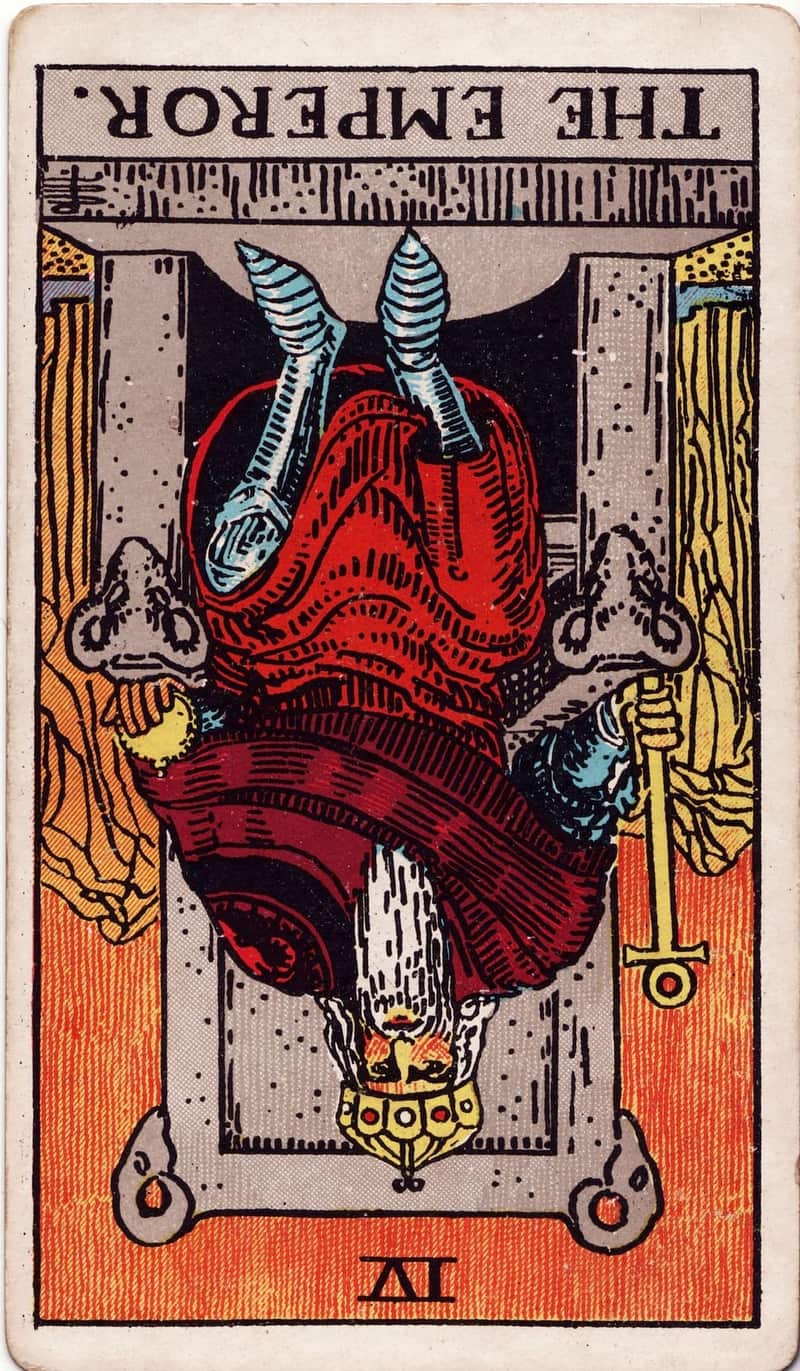
The Emperor reversed means authority has been miscalibrated: too much control at one pole, or too little willingness to lead at the other. One version is easier to recognise. Discipline hardens into rigidity, protection becomes domination, and a person who should create order starts using power to keep everyone else in line. The power-hungry or controlling Emperor belongs here, not in the upright card.
At the other pole, the card can look almost opposite while failing at the same task. Instead of over-controlling, you may avoid responsibility, let boundaries collapse or refuse to take charge when the situation needs direction. Lack of self-control and impulsivity can leave you reacting without a framework.
In readings, the useful distinction is whether the rules are so tight that nothing can move or so weak that nothing holds. The same applies to responsibility: authority may be abused, or the person who needs to carry it may refuse. If the problem is over-control, loosen the grip; if it is abdication, take responsibility and set the missing boundary.
Reversed: love, career and money
Love
In love, The Emperor reversed points to a problem with power, boundaries or responsibility inside the relationship. One partner may try to control the terms, use manipulation to get their way or treat protection as a reason to decide for both people. At the other pole, immaturity or weak boundaries can make it difficult to build the stable foundation the upright card promises.
If you’re attached, notice where personal power has become uneven and where commitment has turned into management. For singles, the card can warn against repeating patterns with controlling or emotionally immature people. In non-romantic relationship readings, the card can be used to reflect on authority or unresolved issues with a father or father figure, where those themes fit the actual situation.
Career
At work, The Emperor reversed can show a power struggle, abuse of authority or leadership that has become territorial. A superior may protect their position so tightly that your advancement is blocked, or you may be tempted to push ambition into domination if you gain more power.
The second possibility is under-leadership. You may be avoiding responsibility, failing to apply enough effort or waiting for someone else to impose the structure your work needs. If you’re managing a project or team, check whether expectations are either too rigid or too loose to function. This card asks for authority that is proportionate to the job: enough to make decisions and hold standards, without turning every disagreement into a contest of control.
Money
Financially, The Emperor reversed points to control that is either missing or badly applied. Impulsive spending, weak limits and inconsistent decisions can undo your plans because nothing is holding the budget together. If that is the problem, outside structure such as a clear budget or a financial adviser may help you regain control.
The opposite version is excessive rigidity. You may be so focused on keeping tight command of every expense that your rules stop responding to reality. Review spending and investment decisions against the plan you actually need, not against control for its own sake. A useful rule should still work when circumstances change; if it cannot, the rule needs adjusting.
Timing
The Emperor corresponds to Aries in the Golden Dawn system. Readers who use zodiac timing may associate it with roughly 21 March to 19 April; number-based methods may use four weeks or four months. These are different symbolic conventions rather than reliable deadlines. For practical timing, look at the planning, approvals and steady work the situation requires.
The Emperor card combinations
The exact meaning of The Emperor will depend on its interactions with other cards in your tarot spreads. On its own, The Emperor symbolises stability, power, authority and discipline, but its meaning evolves when paired with other cards. Below are some of the most interesting Emperor pairings.
The Emperor and The Empress
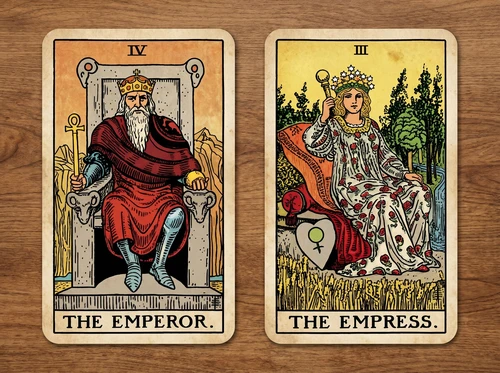
First, let’s see how The Emperor interacts with his female counterpart, The Empress. These two cards represent masculine and feminine energies; while The Emperor emphasises structure and protective authority, The Empress represents fertility, abundance and stability.
Both cards depict royal figures who rule over their dominions. Crowned and holding sceptres in their hands, The Emperor and The Empress are symbols of great powers and forces working in your life. Together, they can also symbolise harmony and the process of creating something new.
The Emperor and The High Priestess
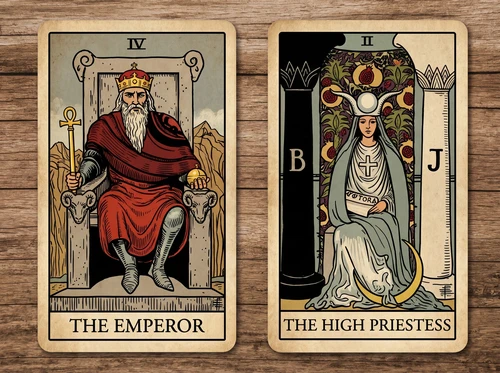
When paired with The High Priestess, The Emperor represents the rational and logical side of life, while The High Priestess represents intuition and the mysteries of the unknown. As such, these two cards might seem incompatible, but that’s not necessarily the case.
In practice, The Emperor and The High Priestess can complement each other. Together, they represent a logical and intuitive approach to life, and you could benefit from using both. Use logic to guide you, but listen to your intuition when it speaks to you.
The Emperor and The Hierophant
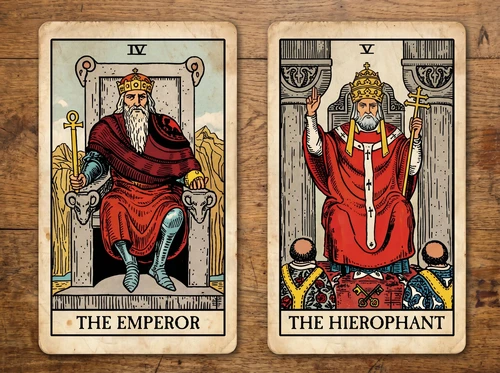
This is an interesting combination, as both cards represent tradition and authority. If your tarot spread contains both of these cards, it might represent a strong mentor figure in your life and your relationship with that figure. You might also be religious or prone to obeying rules and societal norms.
If this pairing reflects your situation, consider whether clear roles, reliable routines or an experienced mentor would help. An organised environment may support you, but the cards do not determine your personality or require unquestioning obedience to every authority.
The Emperor and The Devil
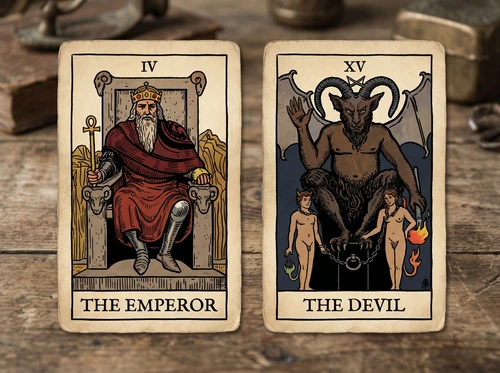
If you get these two cards in the same spread, you may find the pairing odd, as The Devil represents the corruption of everything The Emperor stands for. This combination can represent power abuse, unchecked control, manipulative practices and oppressive restrictions.
The Emperor and Wheel of Fortune
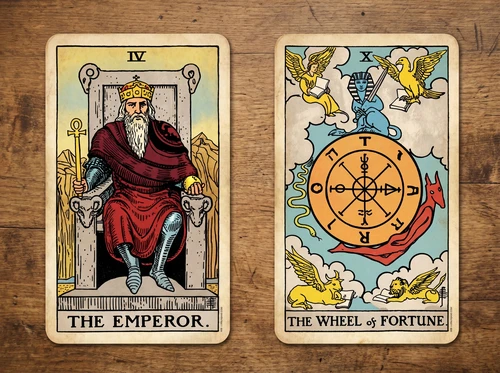
Nothing lasts forever, and everything changes. Wheel of Fortune is a card that reminds us how volatile life is. Even when we are in a position of power, feeling like we are on top of the world as represented by The Emperor, it can all change overnight.
Of course, that doesn’t mean you will necessarily lose your accomplishments, but it does remind you to stay humble and prepared for obstacles and circumstances that can set you back. If you have reached a low point, this pairing can prompt you to identify what support and structure would make recovery more possible.
The Emperor and The Tower
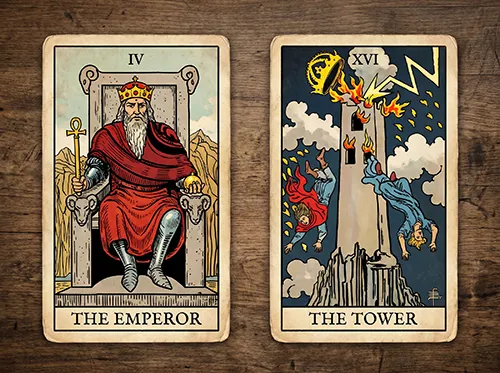
The Tower is always a card of disruption and change: the old structures are falling down so that new ones can be built. This card represents instability and uncertainty, unlike The Emperor, which symbolises stability and safety.
How you interpret these two cards together depends on your situation. If an existing structure is under strain, examine what needs reinforcement and what is no longer useful. After disruption, The Emperor can represent the practical work of rebuilding. Neither card guarantees a collapse or a better outcome; the pairing asks how you respond to instability.
The Emperor and King of Swords
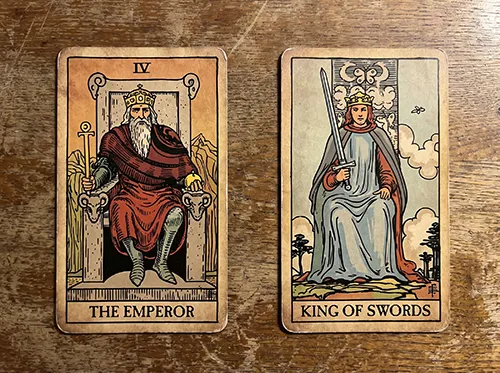
King of Swords is a card of power and authority, similar to The Emperor. When two similar cards appear together in your spread, it means that their message is very strong.
This pairing emphasises clear thinking, disciplined leadership and accountability. Use facts and a coherent strategy to support your decisions, then check whether your standards are fair to the people affected. It can invite you to develop leadership skills without declaring you a natural-born leader or making authority your destiny.
Astrology
The Emperor is the card of Aries, shown by the four ram heads on his throne. Aries is ruled by Mars, the planet of authority, domination, leadership, strength, passion and even aggression, all qualities associated with The Emperor. In other words, the Aries connection is built directly and clearly into the card.
This relationship emphasises how important it is for a leader to be bold and proactive. Authority also brings responsibility: a leader needs to be ready to protect the people under their rule.
Conclusion
The Emperor asks you to build order that protects rather than controls, using clear boundaries and steady responsibility so your plans can hold when pressure arrives without turning every decision into a test of power. Upright, that structure creates safety and dependable leadership; reversed, the same instinct can harden into domination or disappear into weak boundaries, impulsivity and avoided responsibility.
Continue exploring with The Empress or move on to The Hierophant.
Reading approach: Use these Rider–Waite–Smith interpretations to explore the question and context. A card does not establish another person’s feelings or a future outcome; check practical decisions against observable facts.
Curious about what lies ahead?
Get a free AI tarot reading and explore guidance designed just for you. Discover the messages the cards have to share and gain insight into your path.
Get a free tarot reading


