



Justice Tarot Card Meaning: Fairness and Accountability
Table of Contents
- Upright / Reversed keywords
- Justice description
- Symbolism: what’s in Justice? (1–10)
- What does Justice mean?
- What does Justice mean in love?
- What does Justice mean for career?
- What does Justice mean for money?
- Justice as feelings
- Justice as actions
- Is Justice a yes or no?
- What does Justice reversed mean?
- Reversed: love, career and money
- Timing
- Justice card combinations
- Astrology
- Conclusion
Meaning at a glance
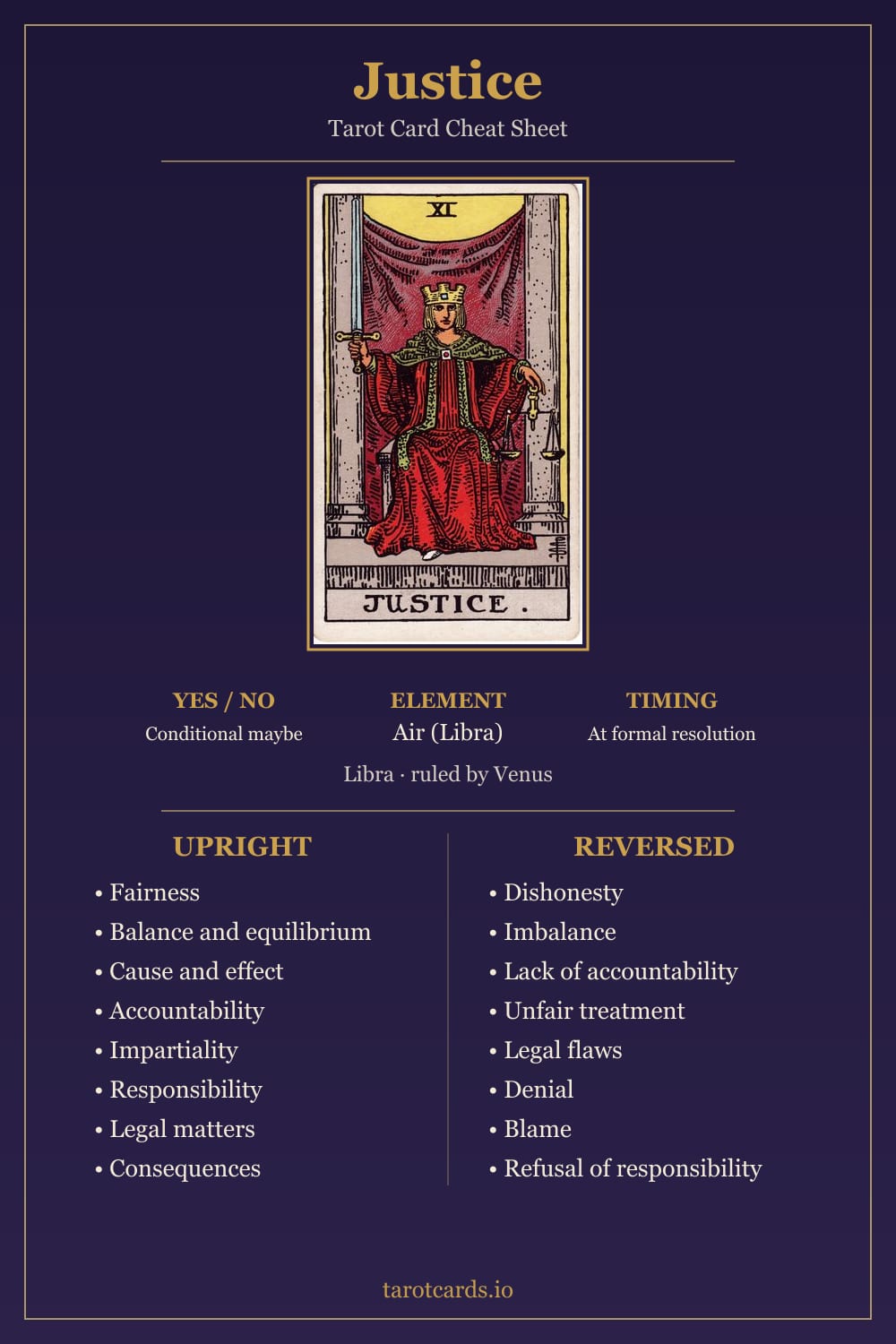
Justice: upright and reversed
Upright
Justice asks for an honest accounting of choices, evidence and consequences. Apply a fair standard to yourself as well as others, and make agreements clear. It can frame a formal decision or dispute, but does not guarantee a favourable verdict.
Keywords: Fairness, balance and equilibrium, cause and effect, accountability, impartiality, responsibility, legal matters, consequences
Reversed
Reversed, Justice raises questions about unfair treatment, dishonest reasoning or responsibility being avoided. Examine the facts before assigning blame. Taking ownership of your part is different from accepting responsibility for someone else's conduct or an unfair process.
Keywords: Dishonesty, imbalance, lack of accountability, unfair treatment, legal flaws, denial, blame, refusal of responsibility
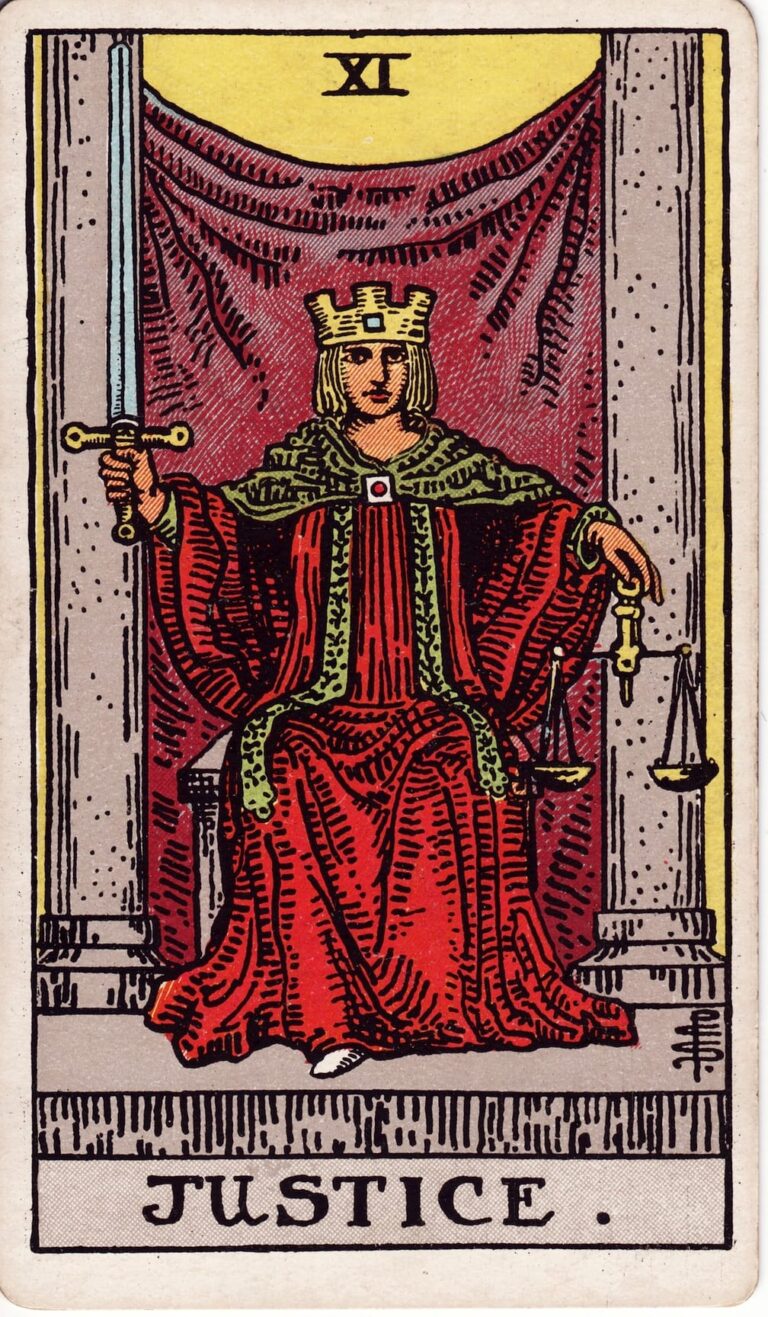
Justice is the card of fairness, cause and effect, responsibility, and decisions that have to stand up to scrutiny. Its scales do not promise that “the universe will punish them for you”; they weigh your conduct too, so this card is about accountability rather than revenge. In the Rider-Waite-Smith deck, Justice is XI, moved by Waite from its traditional position at VIII, and that places the card at the midpoint of the Major Arcana: an audit before the sequence turns towards The Hanged Man and Death.
Justice description
In the Rider-Waite-Smith deck, Justice shows a seated figure on a stone throne and dais between two grey pillars. A red curtain hangs between the pillars, while a flat yellow field fills the space behind the upper half of the figure. Roman numeral XI appears at the top of the card.
The figure wears a gold crown with a square jewel, a red robe, and a green mantle fastened at the chest by a square-and-circle clasp. A gold-tan slipper shows from beneath the robe. In the right hand, a double-edged sword is raised perfectly upright. In the left, the figure holds a set of golden scales.
The whole image is formal and contained. The throne anchors the figure at the centre, the pillars frame the seat, and the curtain closes off the space behind it. Nothing in the scene is busy or accidental; the card presents its figure, tools, clothing, seat, and background with clear separation.
Also known as: La Justice in the Tarot de Marseille, where the card is numbered VIII rather than XI. The Thoth deck reworks it as Adjustment. This guide uses Rider–Waite–Smith imagery; related cards in other decks can differ in imagery and interpretation.
Symbolism: what’s in Justice? (1–10)
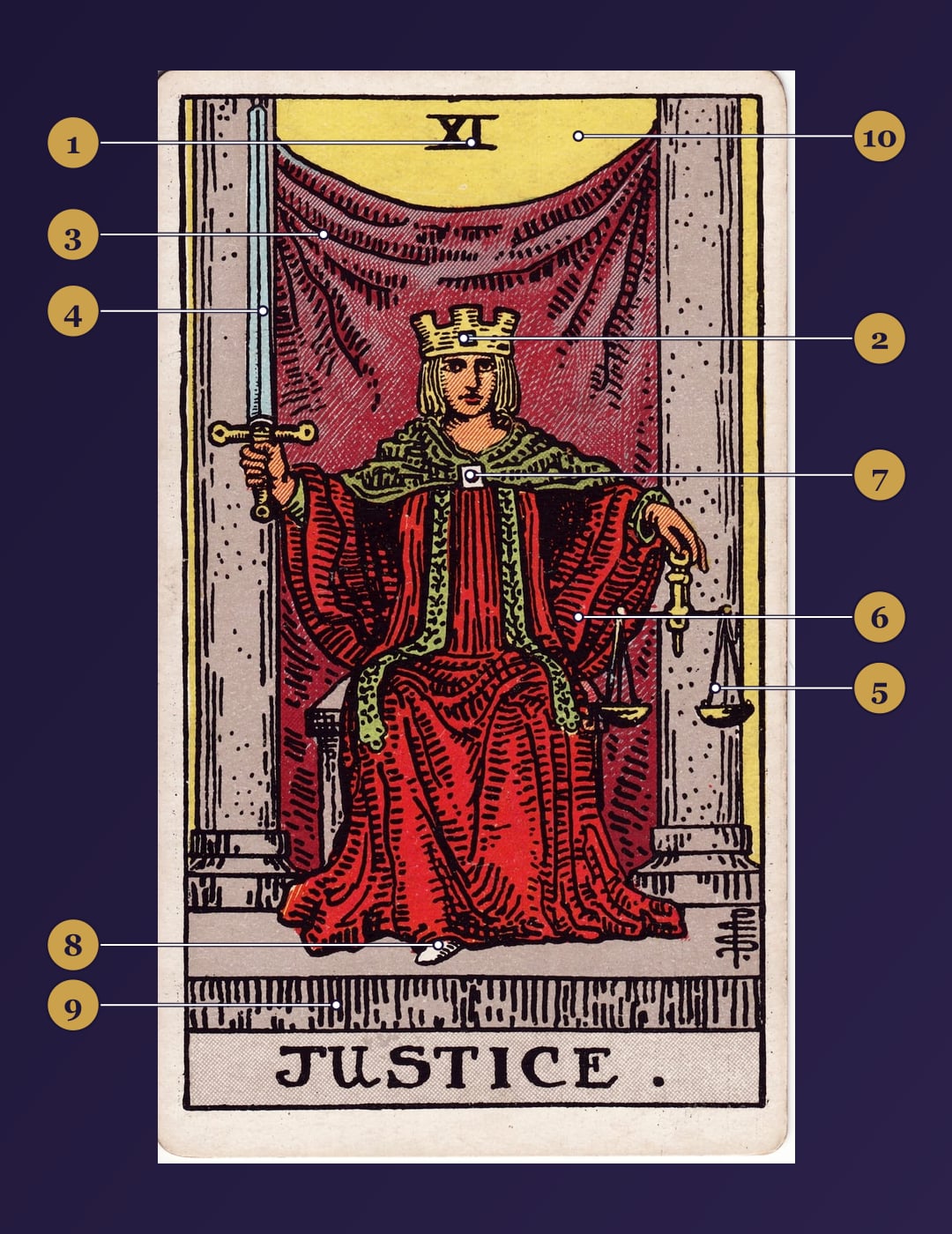
Choose a labelled symbol to highlight its number.
Read the numbered explanationsThe Rider-Waite-Smith Justice builds its symbolism through ten marked details, moving from the card’s number and crown down through the figure’s tools and clothing to the throne and background.
- Roman numeral XI: Waite moved Justice from its traditional VIII to XI, swapping places with Strength. That choice places Justice at the exact midpoint of the 21 numbered cards: an audit before the Major Arcana moves into The Hanged Man and Death.
- Gold crown with square jewel: The crown places ordered, well-bounded thought above the figure. Its square jewel reinforces the same idea: judgement is meant to come from a mind that has defined the issue clearly, rather than one scattered by preference or impulse.
- Red curtain between two grey pillars: The curtain suggests a hidden law behind visible order. Its two pillars repeat the gateway structure seen in The High Priestess and The Hierophant, placing Justice between boundaries where something unseen is given a formal shape.
- Upraised double-edged sword: Held in the right hand and perfectly vertical, the sword shows truth that cuts both ways. It is impartial, ready, and unswayed. Just as tellingly, it has not yet swung, so the image holds the moment before consequence becomes action.
- Golden scales: The scales in the receptive left hand weigh cause against effect. They bring intuition into balance with logic, asking what happened, what followed, and what each side carries. Justice is not weighing another person alone; your part belongs on the scales too.
- Red robe: The robe gives authority a visible, active form. Red here belongs to action, so Justice is not content to consider fairness in the abstract. Once the weighing is done, a consequence can be delivered and a decision can take effect.
- Green mantle with square-and-circle clasp: The green mantle adds compassion to the card’s formal structure. At its centre, the circle represents the soul held within the square of order. The image binds mercy to law rather than asking one to cancel the other.
- Gold-tan slipper: The slipper appearing from under the robe points to the spiritual consequence of action quietly stepping out from beneath formality. The card may look official and controlled, but what you do still leaves a consequence beyond the visible procedure.
- Stone throne and dais: The throne is the judgement seat between the pillars, raised on a firm dais. Its stone setting gives the verdict stability: this is a decision issued from a settled position, not from a passing mood or an emotional swing.
- Flat yellow background: The plain yellow field leaves little atmosphere to hide behind. It speaks to mental clarity and direct sight, keeping attention on what can be seen, weighed, and decided. Justice asks for a clear account rather than a story softened by distraction.
What does Justice mean?
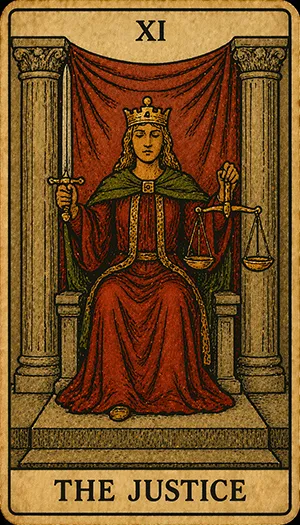
Upright Justice means accountability, fair judgement, and consequences that match what has actually been done. In readings, this card usually lands as an accounting: what happened, what can be weighed fairly, and what follows from it. It can point to a decision ahead, a legal matter, a formal agreement, or a situation where you need to be objective and impartial.
The part worth holding onto is that Justice is not a revenge card. Its scales do not belong only to the person who hurt you. Your choices, promises, omissions, and conduct are on them as well. If you have acted fairly, the card can invite you to present that clearly and seek a fair resolution; it does not guarantee vindication or a favourable verdict. If you have not, it asks you to own that before demanding a verdict from anyone else.
Justice also sits at a hinge in the Major Arcana. Waite placed it at XI, the audit before the sequence moves into The Hanged Man and Death. That gives it a different role from Judgment: Justice is the verdict now, based on conduct and evidence, while Judgment is the later spiritual summons. Social justice and the justice system also fit here when the question concerns how rules are applied. Here, fairness has to become a decision.
What does Justice mean in love?
In love, Justice means the relationship is being measured by fairness, reciprocity, and what each person has actually contributed. It can correct an imbalance, formalise a commitment, or make the consequences of poor conduct impossible to ignore.
If you are single: this card asks you to judge potential partners by what they do, not by promises alone. Your own behaviour matters just as much. Justice favours clear standards and honest choices, especially if old patterns have involved games, mixed signals, or unequal effort.
If you are attached: the relationship may be moving towards a more formal commitment, including marriage or another legal tie. If the bond has become uneven, Justice brings the imbalance into view so it can be corrected. In a breakup, the card is less interested in revenge than in a fair reckoning: each person meets the result of how they behaved, what they agreed to, and what they failed to honour.
What does Justice mean for career?
For career, Justice means your work is likely to be judged by clear standards, written agreements, and the record you can show. It is especially relevant to contracts, workplace legal matters, audits, and merit-based decisions.
This is a card that rewards a clean paper trail. Keep agreements in writing, record what was delivered, check the terms before you sign, and make sure your work can stand up to scrutiny. If a project or decision is being reviewed, Justice suggests that the outcome should match the evidence and the documented record.
The same standard applies to your own ambition. Do not ask to be credited for work you cannot support, and do not let someone else quietly claim what you did. When Justice appears around a professional decision, precision matters. Dates, terms, responsibilities, and completed work give the decision-maker something solid to weigh.
What does Justice mean for money?
For money, Justice invites a clear review of choices, obligations and the circumstances affecting your finances. Spending and risk decisions matter, but income, costs and events outside your control matter too. Use the accountability theme to identify what you can change without treating financial difficulty as a moral verdict.
If you have kept your spending proportionate and avoided risks you cannot absorb, the card supports staying consistent. If you have been buying first and accounting later, Justice asks you to look at the real cost without excuses. The same applies to investments: weigh the potential return against the downside instead of letting hope make the decision.
This card favours balance rather than extremes. You do not need to stop enjoying your money, but each purchase or investment should fit the financial limits you have actually set, not the ones you wish you had.
Justice as feelings
As feelings, Justice suggests someone is weighing you deliberately and asking themselves whether the connection is fair, right, and worth standing behind. Their emotions may look measured because they are filtering attraction through principle, reciprocity, and what has already happened between you.
That does not automatically make them cold. They may care deeply and still want the relationship to make sense on both sides. If they feel you have treated them fairly, that matters in your favour; if trust or balance has been broken, they are unlikely to ignore it simply because feelings are present.
Justice as actions
As actions, Justice points to someone behaving fairly, telling the truth, and taking responsibility for the choice they make. They are likely to weigh both sides before acting, check what was agreed, and choose the option they believe they can defend as right.
Once the decision is made, they will be expected to live with it rather than shift the blame. That can mean honouring an agreement, correcting something they handled badly, or stating a clear position without trying to escape its consequences. Under Justice, action follows the weighing.
Is Justice a yes or no?
In a yes-or-no reading, Justice is usually treated as conditional: examine the facts, terms and fairness of the choice. It does not award a yes for being good or a no for being at fault, and it cannot predict how a court or another decision-maker will rule.
If the question involves a dispute, decision, or agreement, look at what each side has actually done and what can be supported. Justice does not promise the answer you want; it points towards the answer your actions and circumstances can fairly carry.
What does Justice reversed mean?
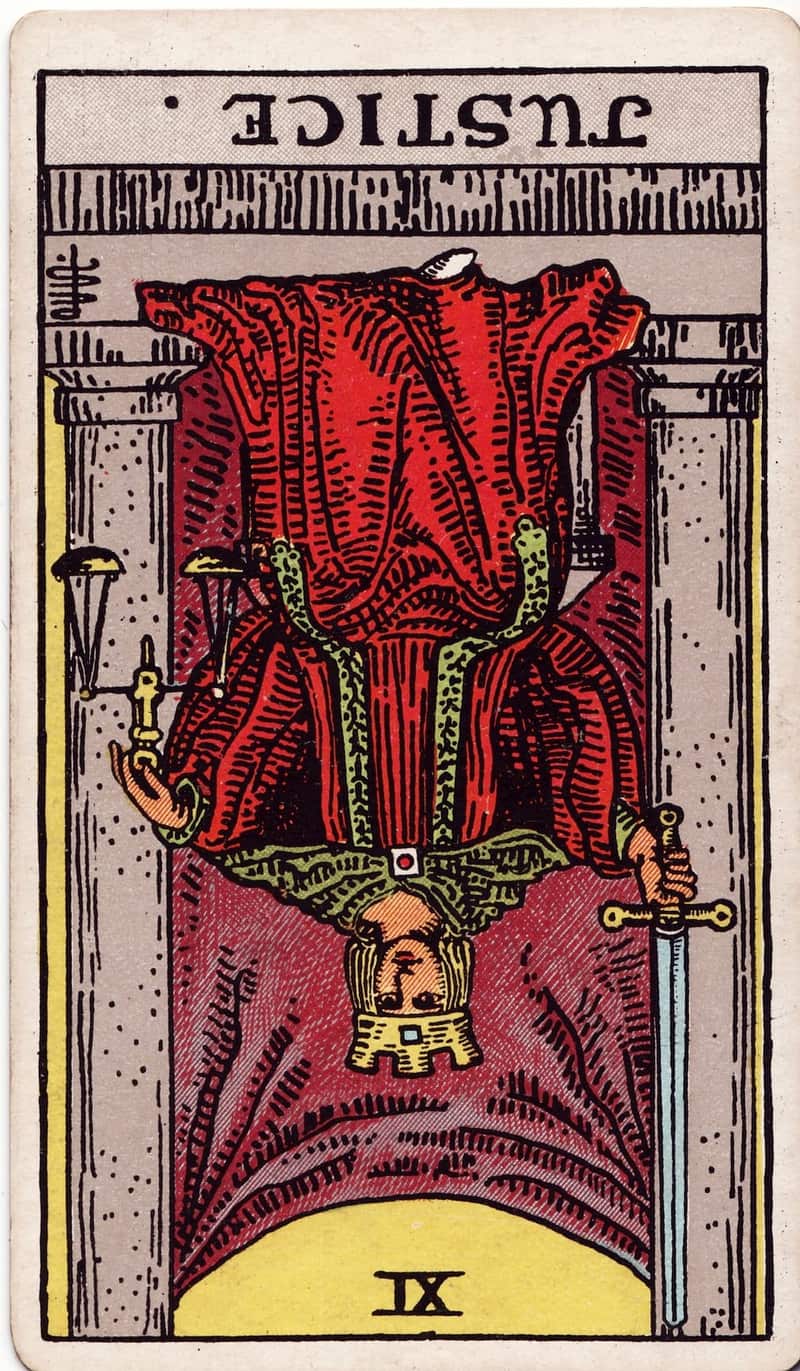
Justice reversed means accountability is being dodged, often through dishonesty with yourself, blame, or refusal to accept your part in what happened. The key shift is not simply “upright fairness becomes outside injustice.” It can also represent an unfair process or treatment by others. Examine the facts and the part each person actually controls before assigning responsibility.
You may be explaining away conduct that you would judge differently in someone else. Perhaps you know a decision was unbalanced but do not want to admit why, or you are focused on the consequences while avoiding the choice that produced them. Reversed Justice can also show legal flaws or unfair treatment, but a useful reading distinguishes your own responsibilities from unfairness you did not cause.
This is not a demand to accept blame for everything. It is a demand for an honest account. If you made a mistake, name it. If an agreement was broken, identify by whom and how. If the process itself is unfair, make that case clearly instead of letting anger replace evidence. The reversal becomes useful when excuses stop doing the weighing for you.
Reversed: love, career and money
Love
In love, reversed Justice points to a relationship where accountability has become uneven. One person may expect forgiveness while refusing to own their own behaviour, or the bond may contain a power imbalance that keeps the same person making the rules.
If you are attached, look for double standards, blame-shifting, and agreements that are only honoured when convenient. Fairness cannot be restored while one side edits the record. If you are single, the card can show a pattern of judging every past partner without examining your own choices. In either case, the work is to see the relationship as it is, then take responsibility for the part that is genuinely yours.
Career
For career, reversed Justice points to a work process that is unfair, poorly documented, or being handled without clear accountability. You may be facing inconsistent treatment, a flawed review, a contract problem, or a dispute where the facts are being presented selectively.
The card also asks you to check your own record before assuming the fault is entirely elsewhere. Check whether you kept the agreement, completed what you said you would, and documented the relevant work. If that record is clean, it matters. If not, correct what you can rather than covering the gap. Reversed Justice favours facts over grievance, especially when a formal decision is involved.
Money
For money, reversed Justice warns that your financial choices are becoming hard to justify to yourself. Expenses may be accumulating because spending has slipped out of balance, or you may be rationalising an investment risk that does not fit your real limits.
The reversal often shows the moment when cause and effect can no longer be separated. Ignoring repeated overspending or blaming every setback on bad luck will not rebalance the scales. Review what you are choosing, cut the expenses you know are unnecessary, and be stricter about the risks you accept. The point is not punishment; it is taking ownership before the consequences become harder to manage.
Timing
Some readers use Justice’s Libra correspondence as a symbolic reference to late September or October. In questions about contracts, decisions or disputes, actual paperwork and process deadlines give more dependable timing. The card itself cannot establish a verdict or completion date.
Justice card combinations
One thing that makes the tarot reading even more interesting and challenging is that the meaning of each tarot card depends on the other cards in the spread. Yes, Justice is obviously the card of justice, consequences, and balance, but its tarot meanings will be influenced by the meanings of other cards. Some examples of these interactions are discussed below.
Justice and The High Priestess
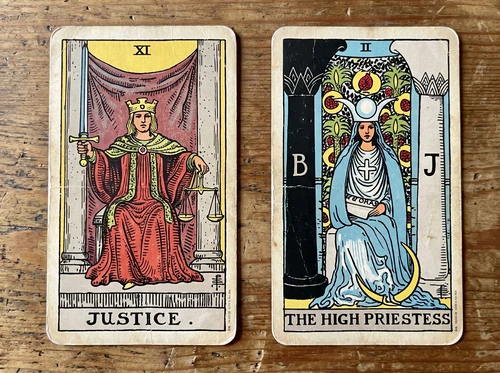
Tarot spreads with both Justice and The High Priestess are very interesting. On one side, The High Priestess represents intuition and inner knowledge, while Justice reminds you to stay balanced. Together, this combination is a message to find a balance between blindly listening to your intuition and trying to rationalise everything. That balance can help you make a more considered decision.
Justice and Wheel of Fortune
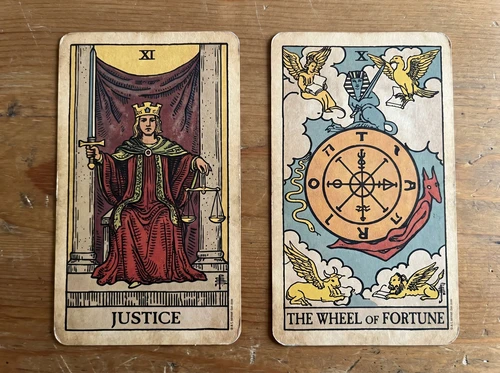
Wheel of Fortune is a card that reminds you that life is full of unexpected twists and changes. When you see Justice in the same spread, it means that the consequences of your actions will catch up to you, even when you do not expect them. However, this is not necessarily negative. Maybe you did something good in the past and will soon be rewarded for it.
Justice and The Hanged Man
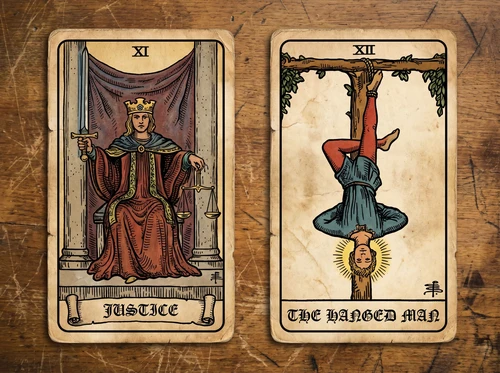
The Hanged Man is a really interesting card, as it represents a change of perspective. If paired with Justice, it is a gentle reminder to look at things from all perspectives before making your own judgement.
Justice and Ace of Swords
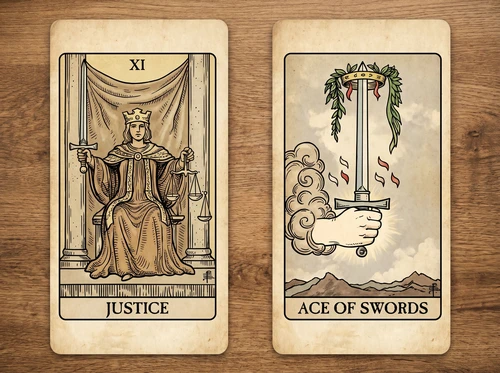
Ace of Swords is a Minor Arcana card, but it still has a powerful meaning. It is a symbol of swift and decisive action. Its combination with Justice can suggest making a clear decision after checking the relevant facts and deadlines. Stay unbiased and fair when making these decisions, and as soon as you make them, do not hesitate to take the necessary actions to follow through on them.
Astrology
As you probably already guessed, the Justice card is connected to the Libra zodiac sign and its ruling planet, Venus. Both Libra and Justice represent balance and fairness, necessary character traits for reaching your Higher Self.
In the Rider-Waite-Smith deck, Justice is numbered XI. It previously held VIII, but Waite switched it with Strength. That swap gives Justice the midpoint position used in this deck, rather than the traditional numbering found elsewhere.
Conclusion
Justice asks you to weigh conduct before demanding an outcome: fairness applies to you, the other person, and the decision itself. Upright, it brings accountability into the open; reversed, it presses hardest where responsibility is being avoided, so the useful question is not who deserves punishment but what each choice has placed on the scales.
Continue exploring with Wheel of Fortune, or move on to The Hanged Man.
Reading approach: Use these Rider–Waite–Smith interpretations to explore the question and context. A card does not establish another person’s feelings or a future outcome; check practical decisions against observable facts.
Curious about what lies ahead?
Get a free AI tarot reading and explore guidance designed just for you. Discover the messages the cards have to share and gain insight into your path.
Get a free tarot reading


