
Best Places to Stargaze in Every US State [2025 Survey]
Table of Contents
stargazers told us the best place to see the night sky in every US state.
TarotCards.io survey, July 2025
When it comes to travel, most people can rattle off the must-see landmarks in their state – the best hikes, the famous viewpoints, the iconic photo ops. But what about the best places to simply look up?
We surveyed over 3,000 avid campers and outdoor lovers across the U.S. to find the most beloved local spots for stargazing – the quiet corners where the night sky truly comes alive.
Beyond just naming locations, the results revealed patterns in how and where Americans connect with the cosmos.
The best stargazing spot in every US state
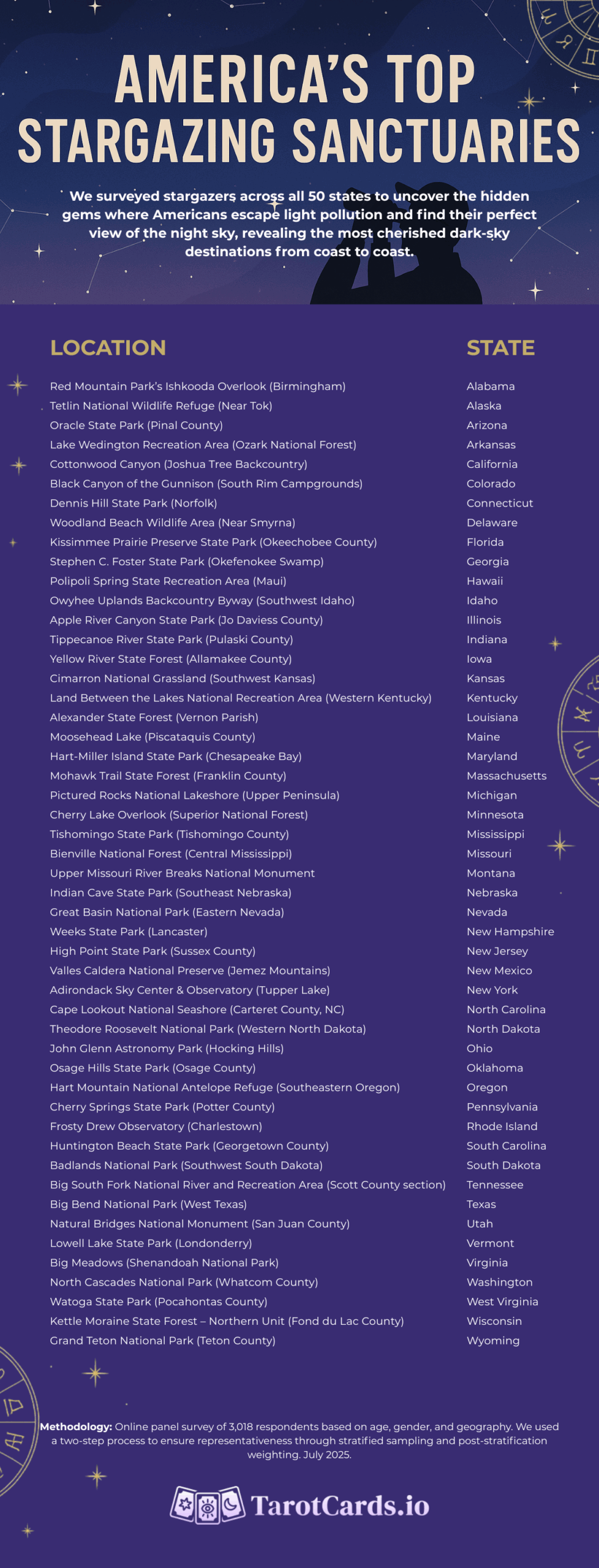
The table below shows the winning location in each state — the spot survey respondents named first when asked where the night sky truly comes alive near them.
| State | Winning location |
|---|---|
| Alabama | Red Mountain Park's Ishkooda Overlook (Birmingham) |
| Alaska | Tetlin National Wildlife Refuge (Near Tok) |
| Arizona | Oracle State Park (Pinal County) |
| Arkansas | Lake Wedington Recreation Area (Ozark National Forest) |
| California | Cottonwood Canyon (Joshua Tree Backcountry) |
| Colorado | Black Canyon of the Gunnison (South Rim Campgrounds) |
| Connecticut | Dennis Hill State Park (Norfolk) |
| Delaware | Woodland Beach Wildlife Area (Near Smyrna) |
| Florida | Kissimmee Prairie Preserve State Park (Okeechobee County) |
| Georgia | Stephen C. Foster State Park (Okefenokee Swamp) |
| Hawaii | Polipoli Spring State Recreation Area (Maui) |
| Idaho | Owyhee Uplands Backcountry Byway (Southwest Idaho) |
| Illinois | Apple River Canyon State Park (Jo Daviess County) |
| Indiana | Tippecanoe River State Park (Pulaski County) |
| Iowa | Yellow River State Forest (Allamakee County) |
| Kansas | Cimarron National Grassland (Southwest Kansas) |
| Kentucky | Land Between the Lakes National Recreation Area (Western Kentucky) |
| Louisiana | Alexander State Forest (Vernon Parish) |
| Maine | Moosehead Lake (Piscataquis County) |
| Maryland | Hart-Miller Island State Park (Chesapeake Bay) |
| Massachusetts | Mohawk Trail State Forest (Franklin County) |
| Michigan | Pictured Rocks National Lakeshore (Upper Peninsula) |
| Minnesota | Cherry Lake Overlook (Superior National Forest) |
| Mississippi | Tishomingo State Park (Tishomingo County) |
| Missouri | Bienville National Forest (Central Mississippi) [see note] |
| Montana | Upper Missouri River Breaks National Monument |
| Nebraska | Indian Cave State Park (Southeast Nebraska) |
| Nevada | Great Basin National Park (Eastern Nevada) |
| New Hampshire | Weeks State Park (Lancaster) |
| New Jersey | High Point State Park (Sussex County) |
| New Mexico | Valles Caldera National Preserve (Jemez Mountains) |
| New York | Adirondack Sky Center & Observatory (Tupper Lake) |
| North Carolina | Cape Lookout National Seashore (Carteret County, NC) |
| North Dakota | Theodore Roosevelt National Park (Western North Dakota) |
| Ohio | John Glenn Astronomy Park (Hocking Hills) |
| Oklahoma | Osage Hills State Park (Osage County) |
| Oregon | Hart Mountain National Antelope Refuge (Southeastern Oregon) |
| Pennsylvania | Cherry Springs State Park (Potter County) |
| Rhode Island | Frosty Drew Observatory (Charlestown) |
| South Carolina | Huntington Beach State Park (Georgetown County) |
| South Dakota | Badlands National Park (Southwest South Dakota) |
| Tennessee | Big South Fork National River and Recreation Area (Scott County section) |
| Texas | Big Bend National Park (West Texas) |
| Utah | Natural Bridges National Monument (San Juan County) |
| Vermont | Lowell Lake State Park (Londonderry) |
| Virginia | Big Meadows (Shenandoah National Park) |
| Washington | North Cascades National Park (Whatcom County) |
| West Virginia | Watoga State Park (Pocahontas County) |
| Wisconsin | Kettle Moraine State Forest – Northern Unit (Fond du Lac County) |
| Wyoming | Grand Teton National Park (Teton County) |
Key Findings
Some states just can’t pick one.
Hawaii, Wyoming, Montana, Arizona, Texas, Florida, California, New Mexico, and a few others each had multiple stargazing hotspots mentioned, suggesting their residents couldn’t agree on just one ideal place.
It’s a sign of sky-rich terrain and passionate local campers who all have their personal “perfect” view of the stars.
The Mountain West shines brightest.
States like Utah, Colorado, and Wyoming appeared repeatedly, thanks to their combination of elevation, dry air, and minimal light pollution.
These spots aren’t just popular for stars – they’re ideal for spiritual retreats and digital detoxes too.
Dark sky love in unexpected places.
Delaware, Rhode Island, and New Jersey might not be known for vast wilderness, but each still has its stargazing loyalists.
Parks like Trap Pond and Frosty Drew Observatory show that even small coastal states can have strong ties to the stars – if you know where to look.
East Coast states leaned observatory-friendly.
Many Northeastern entries (like Cherry Springs in PA or Weeks State Park in NH) had official observatories or designated dark sky zones.
There’s a pattern here: more densely populated areas seem to favor curated experiences, while wide-open western states go for pure, off-the-grid views.
Waterfront views made a cosmic splash
From Maine’s Katahdin Woods to Michigan’s Pictured Rocks and California’s Indian Valley Reservoir, locations near lakes, rivers, or coastlines were common picks.
Stargazing beside water seems to tap into something deeply calming – perhaps the twin awe of stars above and reflections below.
The South shows stargazing pride.
Tennessee, Kentucky, Alabama, Georgia, and South Carolina all had well-loved night-sky destinations, often tied to national forests or lesser-known preserves.
Stargazing here often pairs with storytelling, hiking, and a distinct sense of cultural place.
Cosmic tourism meets cultural heritage.
Places like Mauna Kea Access Road in Hawaii or Chiricahua National Monument in Arizona blend Indigenous history, geological wonder, and astronomy.
These stargazing destinations offer more than just a view – they connect to deeper cultural narratives.
Final Thoughts
This wasn’t just a ranking of dark skies – it was a window into how different communities connect with the cosmos.
Whether it’s through rugged camping in a Utah canyon or quiet reflection on a New England mountaintop, the stars above remain one of the few constants that unite us across state lines.
And if there’s one thing our survey makes clear, it’s that stargazing isn’t just about seeing – it’s about feeling.
Frequently asked questions
What is the best place to stargaze in the US?
It depends on the state — our survey of 3,018 stargazers surfaced a favourite in all 50. Nationally famous picks that also won their states include Cherry Springs State Park (Pennsylvania), Big Bend National Park (Texas), Great Basin National Park (Nevada) and Natural Bridges National Monument (Utah).
How were the best stargazing spots chosen?
We ran an online panel survey of 3,018 respondents, sampled by age, gender and geography, and asked where they go for the best view of the night sky. The winning location for each state is shown in the table above; the full approach is described in the methodology below.
Which states are best for stargazing?
Mountain West states — Utah, Colorado and Wyoming — came up repeatedly, thanks to their combination of elevation, dry air and minimal light pollution. Hawaii, Montana, Arizona, Texas, Florida, California and New Mexico each had multiple hotspots named.
Methodology
Online panel survey of 3,018 respondents based on age, gender, and geography. Internal data sources are used to obtain population data sets. We used a two-step process to ensure representativeness through stratified sampling and post-stratification weighting.
Respondents are carefully chosen from a geographically representative online panel of double opt-in members. This selection is further tailored to meet the precise criteria required for each unique survey. Throughout the survey, we design questions to carefully screen and authenticate respondents, guaranteeing the alignment of the survey with the ideal participants.
To ensure the integrity of our data collection, we employ an array of data quality methods. Alongside conventional measures like digital fingerprinting, bot checks, geo-verification, and speeding detection, etc. each response undergoes a thorough review by a dedicated team member to ensure quality and contextual accuracy. Our commitment extends to open-ended responses, subjecting them to scrutiny for gibberish answers and plagiarism detection.
About this data
About us: We provide our users with ai-powered online tarot reading completely for free.
Related guides
Sources & further reading
- TarotCards.io — online panel survey of 3,018 US respondents, July 2025 (methodology above).
- DarkSky International — International Dark Sky Places
- US National Park Service — Where to Stargaze (Night Skies program)
Curious about what lies ahead?
Get a free AI tarot reading and explore guidance designed just for you. Discover the messages the cards have to share and gain insight into your path.
Get a free tarot reading


