



Death Tarot Card Meaning: Upright and Reversed
Table of Contents
- Upright / Reversed keywords
- Death description
- Symbolism: what’s in Death? (1–10)
- What does Death mean?
- How to read Death in a spread
- What does Death mean in love?
- What does Death mean for career?
- What does Death mean for money?
- Death as feelings
- Death as actions
- Is Death a yes or no?
- What does Death reversed mean?
- Reversed: love, career and money
- Timing
- Death card combinations
- Astrology
- Conclusion
Meaning at a glance
Death: upright and reversed
Upright
Death represents an ending and the change that follows it. The emphasis is on recognizing what has run its course, making room for grief, and releasing an old attachment or pattern. Its imagery is symbolic, rather than a prediction of literal death.
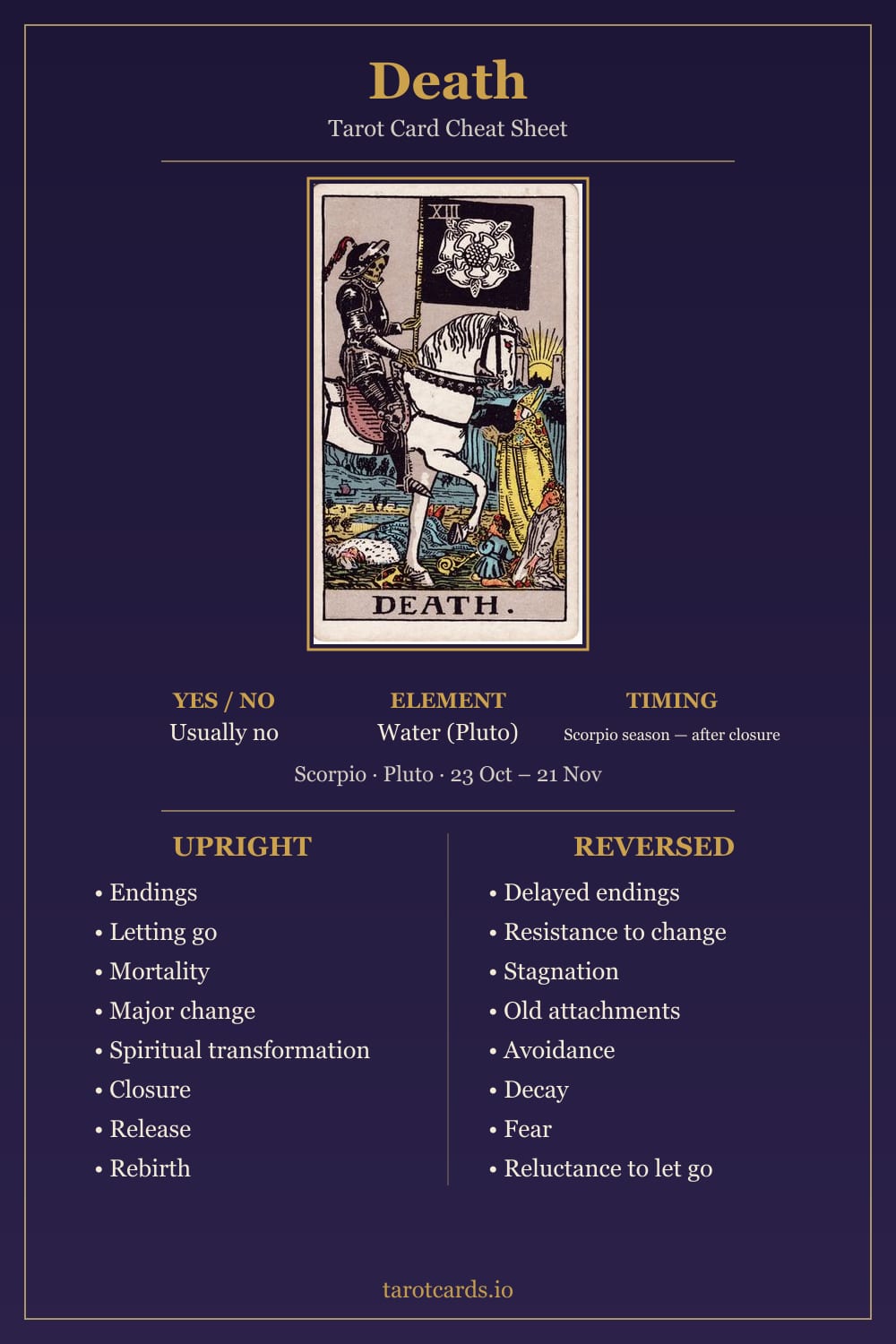
Keywords: Endings, letting go, mortality, major change, spiritual transformation, closure, release, rebirth
Reversed
Reversed, Death explores resistance to an ending: holding on, postponing a necessary decision or staying between chapters. Consider whether a familiar pattern still serves you and what makes change difficult. Letting go can be gradual; the card does not demand an immediate break.
Keywords: Delayed endings, resistance to change, stagnation, old attachments, avoidance, decay, fear, reluctance to let go
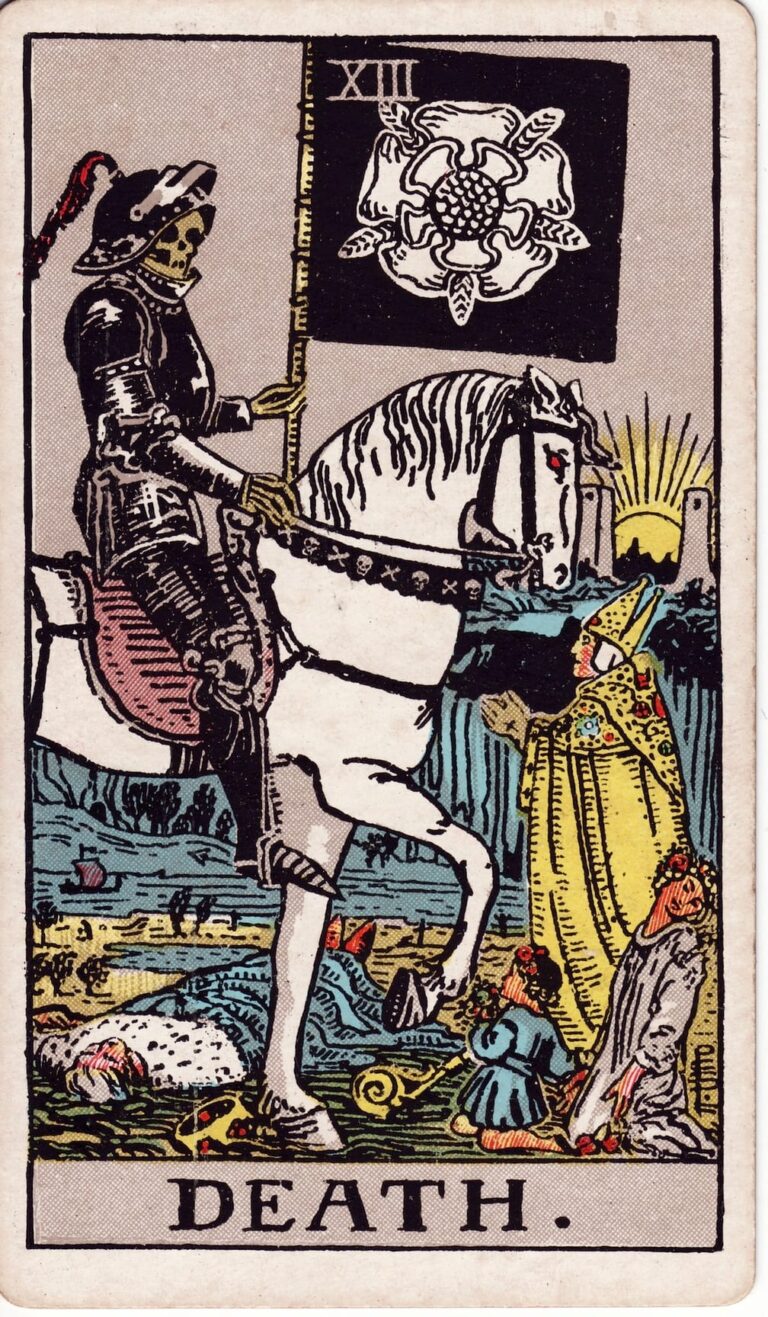
The Death card represents an ending and the changes that follow: a role, relationship pattern or way of working may have reached the point where it needs to change. It is not a prediction of literal death or a promise that change will feel easy. In a reading, it invites you to recognise what has ended, make room for grief where needed and consider what can grow once you release an old pattern.
Death description
In the Rider-Waite-Smith deck, Death is marked XIII at the top of the card. Far behind the main figures, the sun rises between two distant towers, with a river running past the nearer bank.
A skeleton in black armour rides across the scene on a white horse. A red plume rises from the rider’s helmet, while one hand holds a black banner bearing a white, five-petalled rose. The horse moves forward above a fallen king, whose crown has dropped beside him.
Ahead of the horse stands a bishop in a fish-mouth mitre, facing the rider with his hands raised in appeal. Nearby, a maiden kneels with her face turned away from the rider. A child stays close beside her. The figures range from king and bishop to maiden and child, all placed before the same advancing rider while the distant sun remains visible beyond them. From the horizon down to the fallen crown, each part of the scene sits within the rider’s steady advance.
Also known as: the unnamed arcanum (L’Arcane sans nom) — many Tarot de Marseille decks leave card XIII untitled. The Thoth deck keeps the name Death; this guide focuses on Rider–Waite–Smith imagery, rather than treating the decks as interchangeable.
Symbolism: what’s in Death? (1–10)
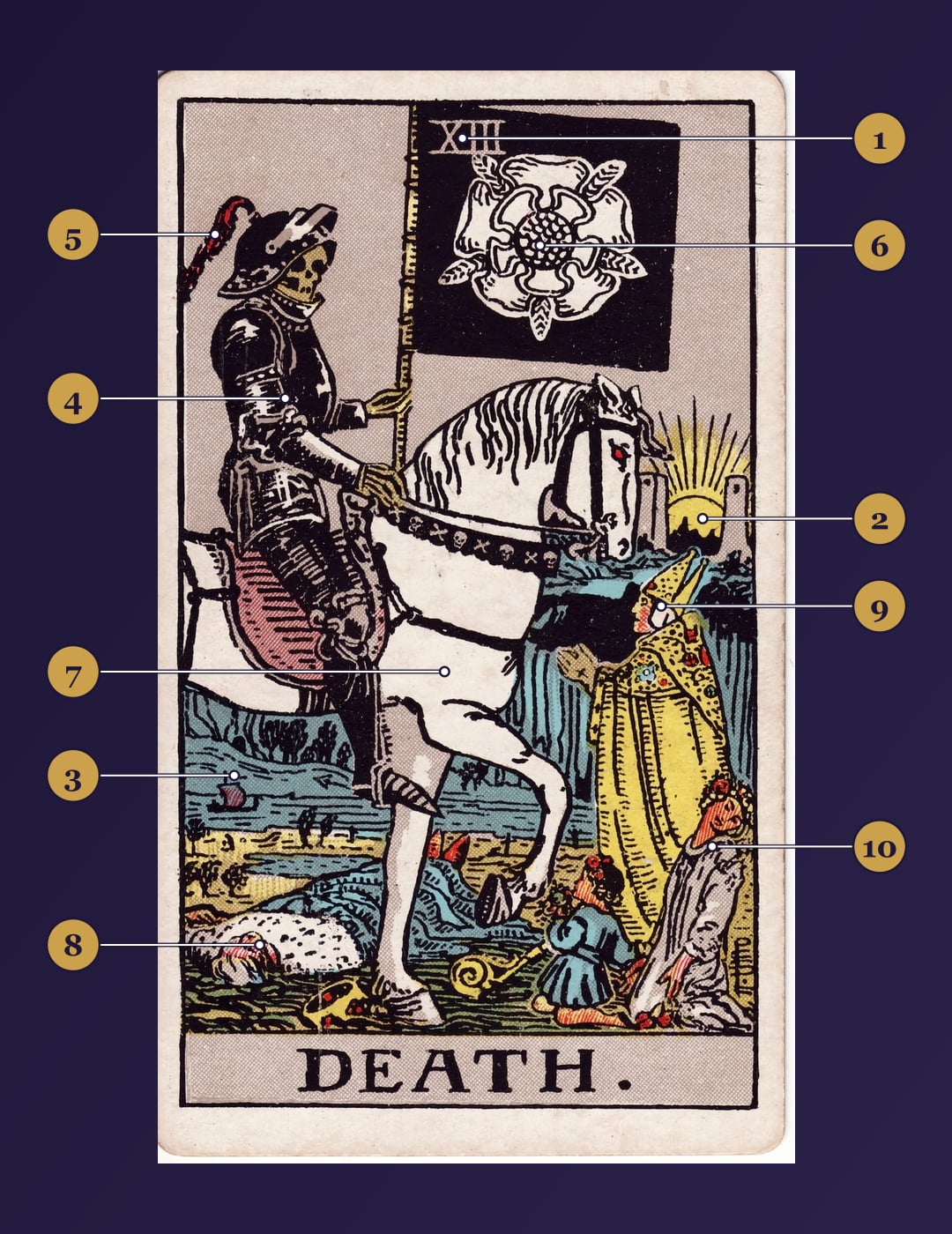
Choose a labelled symbol to highlight its number.
Read the numbered explanationsThe Death card contains ten marked elements, from Roman numeral XIII at the top to the kneeling maiden and child below.
- Roman numeral XIII. The number at the top names Death as the thirteenth Major Arcana card and places an ending at the heart of the descent arc. Before the eye reaches any person in the scene, XIII sets the terms: this is the point where something must finish.
- Sun rising between two distant towers. Waite’s “sun of immortality” places the route onward on the horizon. The towers form the same gateway seen close up in The Moon, so the ending does not erase what comes next; the way forward is already present, though still distant.
- River flowing past the near bank. The river carries an echo of the Styx, the boundary associated here with death. Its current keeps moving while the figures face an ending on land, making the image clear: one scene can finish without stopping the larger movement of life.
- Skeleton in black armour. The skeleton points to the indestructible part of us, while the armour shows why Death cannot be defeated, delayed by rank, or persuaded to choose favourites. This rider is invincible and impartial; everyone in the card must meet the same force.
- Red plume on the helmet. The plume is the same life-feather The Fool wears at the start of the journey. It keeps a trace of vitality on Death’s own helmet, suggesting that life has not vanished from the image even while an ending is taking place. Loss and life occupy the same figure.
- Black banner with a white five-petalled Mystic Rose. The white rose blooms against a black field, holding purity and life inside the image of an ending. Its contrast matters: Death does not make the scene empty. Beauty remains visible in the very emblem the rider carries forward.
- White horse. The horse is the force of change itself: pure, powerful, and unhurried. It does not charge in panic or stop to negotiate with the people before it. Its steady advance shows transformation as something that proceeds in its own time once an ending has begun.
- Fallen king with dropped crown. The king lies down and his crown has fallen away, showing that status offers no exemption. Power is the first thing the ending strips from him. Whatever title or authority mattered before, it cannot bargain with the force moving through the scene.
- Bishop in a fish-mouth mitre. The bishop remains standing and pleads directly with Death. Faith meets the ending upright rather than hiding from it, yet even this figure must yield. The card gives belief dignity here, but not special protection from what has reached its close.
- Kneeling maiden and child. The maiden turns her face away while the nearby child looks toward the rider. These different responses can be read as reluctance and curiosity in the face of change. Their response differs from rank and authority, but they stand before the same unavoidable change.
What does Death mean?
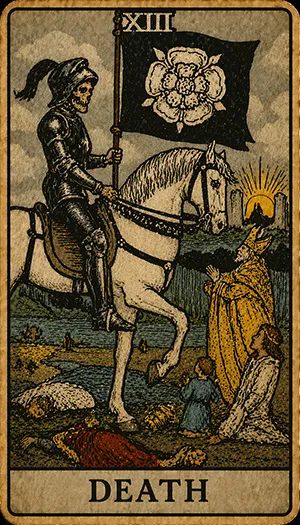
Upright, Death represents closure and the transition that follows it. If something in your life has genuinely ended, the card can help you reflect on acknowledging that loss rather than treating the old phase as unfinished. Its symbolism is not a prediction of physical death, and it does not require pretending that every change is welcome.
An attachment, identity, habit, relationship, or phase may have run its course. The change that follows can be necessary and even freeing, but the card does not ask you to skip grief on the way there. A clean ending can still hurt. Mortality is part of the card’s language because Death puts you in contact with what cannot be kept forever.
The figures on the card show different responses to that fact. Power falls, faith pleads, innocence looks up, and the rider keeps moving. That social cross-section matters because the same ending reaches status, belief, and youth without making exceptions for any of them. Your task is not to make the ending pleasant or to force an immediate new beginning. It is to recognise what is over, let the loss be real, and allow the space left behind to become available for what follows.
Put the meaning into practice
How to read Death in a spread
An illustrative reading, not a real client story.
- Question
- What needs to change in a project that no longer feels useful?
- Position
- Advice in a three-card project review.
One way to read it
Read Death as an invitation to examine what has finished serving its purpose. The focus might be an old goal, a repeated task or a way of working. Making room for a different approach can begin with acknowledging what you would miss.
A practical check: Look at what the project currently produces, who still benefits and which tasks continue mainly through habit. Ask the people involved what they would keep, change or stop before deciding on a practical next step.
Keep in mind: This card alone cannot tell you to abandon the project. Use the review, your commitments and the people affected to decide whether an ending is appropriate.
Why this interpretation?
In an advice position, the imagery of an ending becomes a question about release. In an obstacle position, the same card might prompt reflection on difficulty accepting change. Naming the position prevents a broad theme from becoming an automatic instruction.
Death or The Tower?
Death
Death centers on closure: recognizing that a chapter, role or pattern may have reached its limit and considering what release would involve. Grief and transition belong in that reflection.
The Tower
The Tower centers on disruption and exposed assumptions. It offers a way to examine what happens when a structure or belief no longer holds up, especially after unexpected information.
The useful distinction: Ask whether your reading concerns an ending to acknowledge or a foundation to question. Both can describe change; neither establishes that a disaster is about to happen.
What does Death mean in love?
In love, Death can symbolise the end of a relationship pattern, an attachment or a phase of being together. That might mean a separation, but it can also mean a fundamental change within a continuing bond: an engagement, for example, closes one phase as another begins. The card alone cannot decide whether a relationship should end; consider what both people say, want and do.
If you are single, this card often points to letting a past love or old attachment finish properly before you make room for someone new. The loss may still be painful, and the card does not rush you through it. Clinging to what has already ended is what keeps love fixed in its old form; letting it close gives something more honest the space to emerge.
What does Death mean for career?
For career, Death can represent a role, project or professional identity reaching a transition. This can show up as redundancy, a career change, the close of a major project, or an industry shifting beneath work that once felt secure. Use the theme to consider what has actually changed and what can still be adapted.
If you have built years of identity around one job or field, that closure can feel like losing part of yourself as well as losing familiar work. Death says the door may need to shut fully before another one opens. Trying to keep one foot in a finished role can prolong the uncertainty without restoring what has already changed.
In a work reading, compare the card’s theme with observable changes: a project’s objectives, the role’s responsibilities or the opportunities still available. Decide what needs to end or evolve from that information, rather than assuming that drawing Death proves your work has reached its limit.
What does Death mean for money?
For money, Death can prompt a review of financial habits or risk choices that may no longer fit your circumstances. This is not a career message about earning more or changing jobs; it is about what you do with money once it is in your hands.
You might use this card to review a repeating spending habit or a level of risk that no longer fits your circumstances. If an investment or financial commitment comes to mind, revisit the original reasons for it and the current facts before deciding what to do. The useful question is whether “I have always done it this way” has replaced a considered decision; drawing Death is not itself a reason to sell or close a position.
That does not make every financial change easy. Letting go can mean accepting a loss, giving up a familiar comfort, or abandoning an investment idea you were attached to. The card’s strength is in ending the behaviour cleanly rather than feeding it because you dislike admitting it is over.
Death as feelings
As feelings, Death can symbolise a significant change in how a connection is experienced. It may suggest grief, detachment or the recognition that an old pattern cannot continue unchanged. The card cannot tell you that another person’s feelings are permanently over; their words and behavior are needed to understand what has actually changed.
If the connection is changing, consider whether the question is about adapting an old pattern, grieving a loss or deciding what can continue. Those possibilities can feel different even when the same card appears. Allow room for the other person to explain their experience instead of treating one interpretation as their settled position.
Death as actions
As actions, Death can describe closing a chapter, withdrawing from an old arrangement or clearing away a pattern that no longer works. In an advice position, the question is what you are ready to change and how to do that responsibly. In a predictive position, an ending is a possible theme rather than knowledge of what another person will choose.
A constructive expression is to be clear about a decision that has actually been made, while allowing time for practical loose ends and feelings. A decisive change does not have to be abrupt or irreversible in every respect. The surrounding situation matters more than trying to make events fit the card.
Is Death a yes or no?
In yes-or-no conventions, Death usually leans no to continuing unchanged and can lean yes to change or closure. This is an interpretive shorthand, not a factual prediction. There is a genuine split between reading traditions, though, and some readers give Death a yes when the question itself is about change, closure, or ending something.
For practical use, keep the wording of your question in view. Death rarely supports continuation; it supports the completion of what has already reached its limit.
What does Death reversed mean?
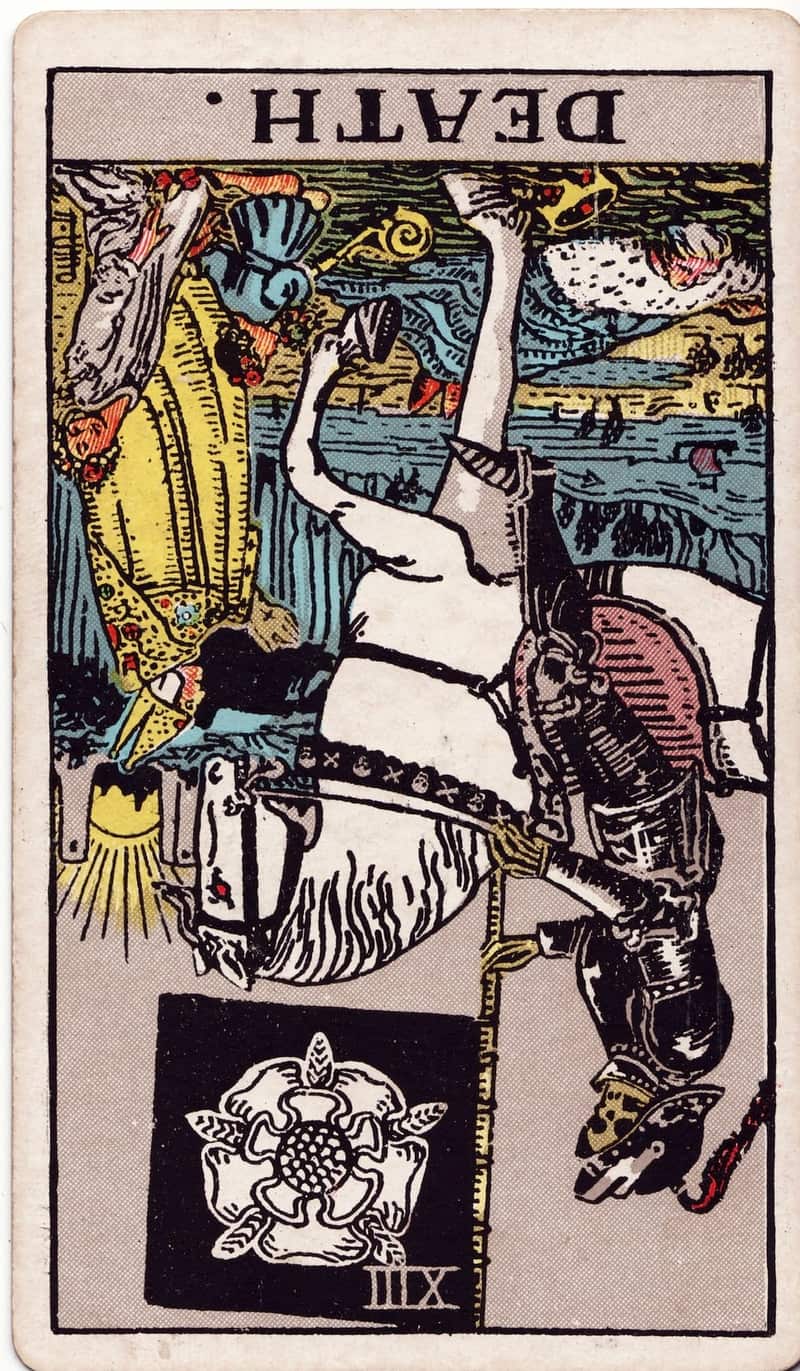
Death reversed can represent resistance to change, a delayed decision or uncertainty about letting go. This is not simply the upright card with its meaning flipped. The question is whether you are preserving something that still has value or holding on mainly because change feels difficult.
That resistance can look like fear of change, refusal to let go of old habits, or staying attached to a situation because the alternative feels too uncertain. The result is often stagnation: nothing truly continues, but nothing can properly finish either. What might have been a clean loss becomes a long period of decay.
In readings, I use this reversal to explore the cost of postponing a change that the person already recognises is needed. It can describe bargaining, delay or fear of grieving what may be lost. That does not make an ending inevitable: ask what the hesitation protects, what information is missing and whether a gradual change would be more appropriate.
Reversed: love, career and money
Love
In love, Death reversed can invite you to examine whether a relationship pattern, resentment or past attachment is difficult to release. If you are attached, old issues may keep returning because they were never fully released. You may say something is forgiven while continuing to bring it back whenever conflict appears.
The card can also show staying in a loveless relationship because letting go feels more frightening than remaining unhappy. If you are single, an ex or unreturned love may still occupy the space where a new relationship would begin. The reversal stretches out the parting rather than restoring the old bond.
Grief can take time, but grief is different from trying to reverse an ending that has already happened.
Career
In career, Death reversed can describe hesitation about a work change that is already under consideration. You may stay in a familiar role, ignore signs that a project has run its course, or cling to an old professional identity while the work around you changes.
That resistance can turn into stagnation. Opportunities are easier to miss when your effort goes into preserving a position that no longer has room to grow. The card can also describe a necessary change repeatedly postponed because leaving your comfort zone feels worse than staying stuck.
Delay may preserve a useful option, or it may prolong a problem. Review what the work now requires and whether your reasons for staying still fit those conditions.
Money
In money, Death reversed can prompt a review of a financial pattern you find difficult to change. Look at recurring costs, commitments and any warning signs in the actual figures. The question is whether keeping the pattern serves your present needs, not whether the card predicts financial loss.
A familiar habit can be hard to change, and discomfort about a past loss can affect a new decision. Review current costs and risks independently of that discomfort; waiting or acting should each have a reason grounded in your circumstances.
If the evidence shows that a habit or strategy is costing you, acknowledge that information before deciding your next step. A past loss does not by itself determine which future choice is best.
Timing
Some tarot timing methods associate Death with Scorpio season, roughly 23 October to 21 November; others read it as the period around a transition. These are symbolic conventions, not dependable dates. Use the question to consider what needs to be completed or understood before the next phase can begin.
Death card combinations
When you get the Death card in your tarot spread, its meaning will also depend on its interactions with other cards. Some of the most interesting card combinations are discussed below.
Death and The High Priestess
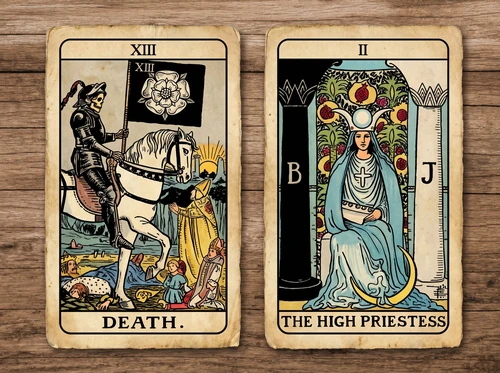
The High Priestess brings quiet reflection to Death’s theme of endings. Together, the cards can invite you to notice what an ending reveals before deciding what should follow. Growth is one possible response to change, not a requirement to welcome every loss. A useful question is: what do I understand now that I could not see while I was trying to preserve the old situation?
The transformation and changes you experience will also reveal some hidden truths about yourself and the world around you. You must trust yourself and follow your intuition to reach your full potential through the spiritual transformation. Some parts of you will die, but you will be wise enough to see the necessity behind the process.
Death and The Wheel of Fortune
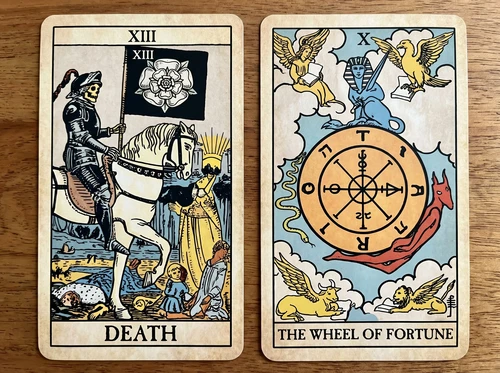
Both of these cards are your reminders of the cyclical nature of life. When paired together, their message is even stronger: some changes are outside your control, while your response and available choices still matter. Death is the only way to get reborn, and the end is the only way to begin something new.
These two cards also remind you that nothing lasts forever. Everything changes, and everything ends. Enjoy good things while they last; bad things will not last forever. If you are in a difficult period, consider what support and practical choices could help you move through it. When you feel like you are at the top of the world, do not think that you are invincible.
Death and The Tower
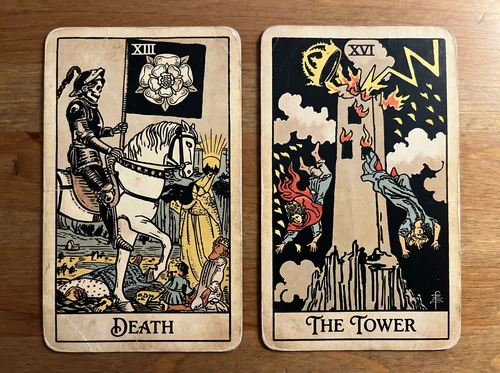
Death and The Tower combine themes of ending and disruption. They can be used to explore a change that feels unsettling or exposes a weak foundation. They do not establish that everything will collapse; ask which part of the situation is actually unstable and what could be changed, protected or rebuilt.
Think about the things in your life that no longer serve you and your well-being. You may be holding onto them out of habit even though letting go would free you. Letting go can be difficult, and its effects depend on the circumstances. Consider the likely costs, support available and realistic alternatives before deciding.
Death and The Moon
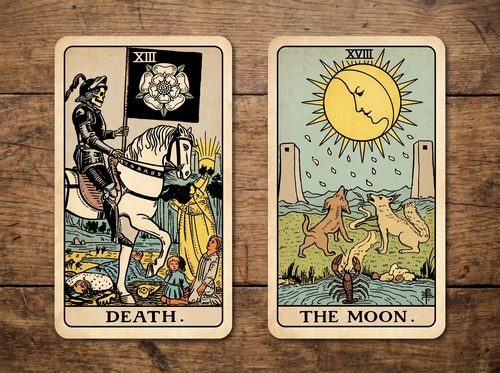
The Moon introduces uncertainty, incomplete information and feelings that are hard to name. Beside Death, it can suggest that a transition feels more frightening because its outcome is unclear. Treat doubts as questions to investigate, not proof of hidden enemies or betrayal.
Allow time to separate what you know from what you fear. A conversation, a second perspective or a practical check may help you understand what is changing. You do not need to label people as enemies or force a final decision simply because these cards appear together.
Death and The Hanged Man
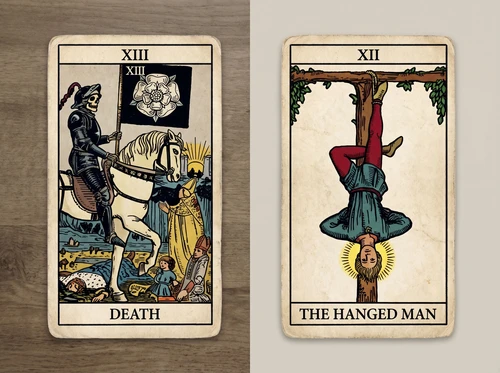
The Hanged Man is a striking card that represents a change of perspective and the act of letting go and surrendering yourself to higher powers. Together with Death, it can invite you to pause and reconsider your response to change. Ask what acceptance would mean in this situation, while keeping the choices that are still yours in view.
This act of acceptance will also teach you to see things from a different perspective, and things that looked like the end of the world earlier will start to look different once you accept them.
Astrology
The Death card has strong connections with several zodiac signs, the most significant being its connection to Scorpio and its ruling planet, Pluto. This connection is no coincidence: Scorpio and Pluto represent rebirth and transformation, concepts deeply linked to the Death card.
Rebirth and transformation are painful, but that pain can set you free and help you transition into a better version of yourself. Both Scorpio and the Death card are also symbols of what is unknown and mysterious. There is an aura of darkness around them, but that darkness should not scare you; it is a part of you as well.
Conclusion
The Death card asks you to treat an ending as real: grieve what is gone, stop feeding what cannot continue, and let change follow from closure rather than forcing a bright meaning onto loss. Upright, it clears the ground; reversed, it shows the cost of refusing to let the old chapter finish.
For a closer look at how this ending is showing up in your own reading, continue with the site’s reading tool.
Reading approach: Use these Rider–Waite–Smith interpretations to explore the question and context. A card does not establish another person’s feelings or a future outcome; check practical decisions against observable facts.
Curious about what lies ahead?
Get a free AI tarot reading and explore guidance designed just for you. Discover the messages the cards have to share and gain insight into your path.
Get a free tarot reading


