



The Hermit Tarot Card Meaning: Listen To Your Inner Voice
Table of Contents
- Upright / Reversed keywords
- The Hermit description
- Symbolism: what’s in The Hermit? (1–9)
- What does The Hermit mean?
- What does The Hermit mean in love?
- What does The Hermit mean for career?
- What does The Hermit mean for money?
- The Hermit as feelings
- The Hermit as actions
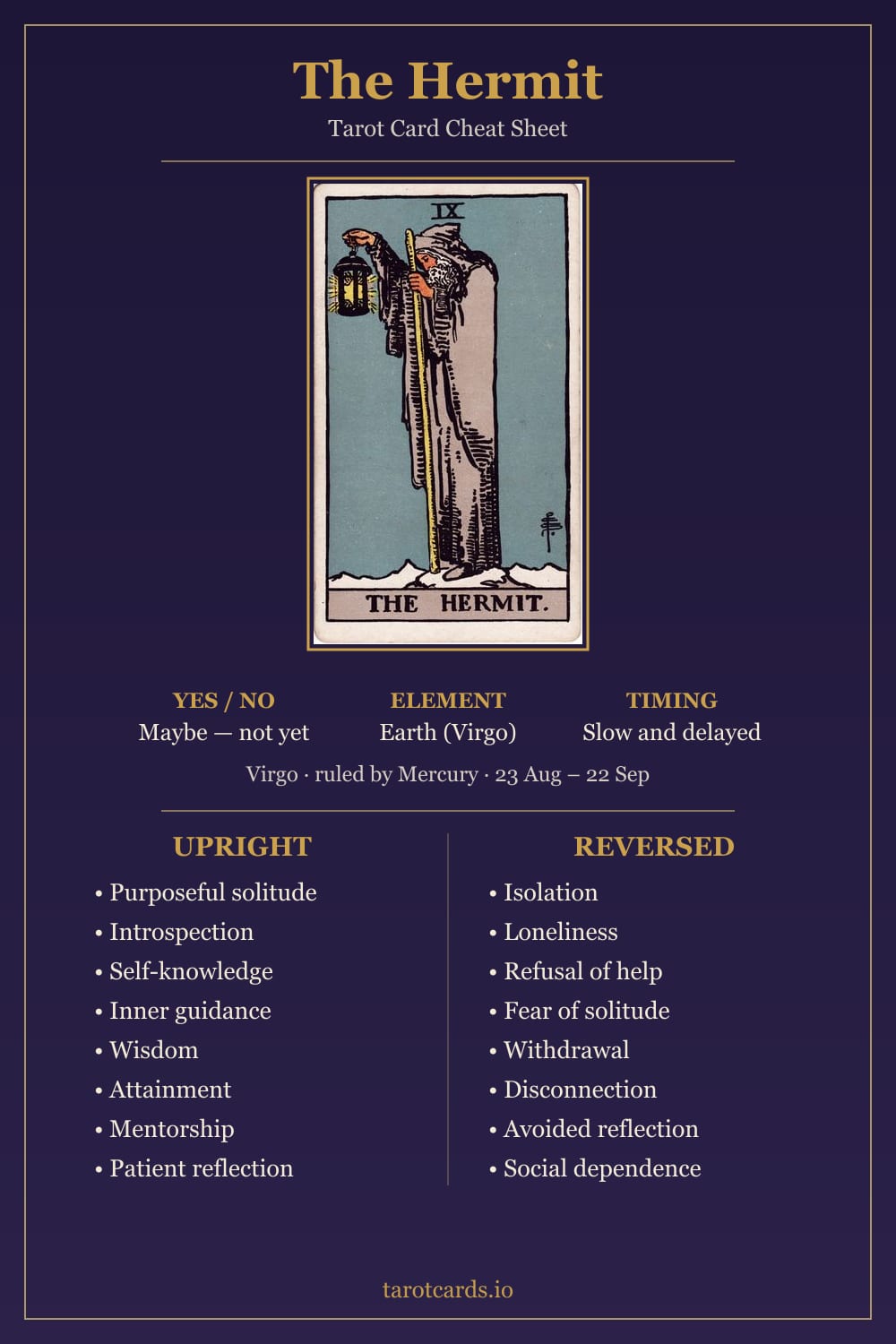
- Is The Hermit a yes or no?
- What does The Hermit reversed mean?
- Reversed: love, career and money
- Timing
- The Hermit card combinations
- Astrology
- Conclusion
Meaning at a glance
The Hermit: upright and reversed
Upright
The Hermit represents purposeful solitude and wisdom formed through experience. Stepping back can help you hear your own judgement, while the outward lantern suggests insight that can later guide others. Make room for reflection without losing the relationships that sustain you.
Keywords: Purposeful solitude, Introspection, Self-knowledge, Inner guidance, Wisdom, Attainment, Mentorship, Patient reflection
Reversed
Reversed, The Hermit asks whether solitude is serving its purpose. Privacy may have hardened into isolation, or constant company may keep reflection at bay. Seek a workable balance between time alone and contact with people whose support you can trust.
Keywords: Isolation, Loneliness, Refusal of help, Fear of solitude, Withdrawal, Disconnection, Avoided reflection, Social dependence
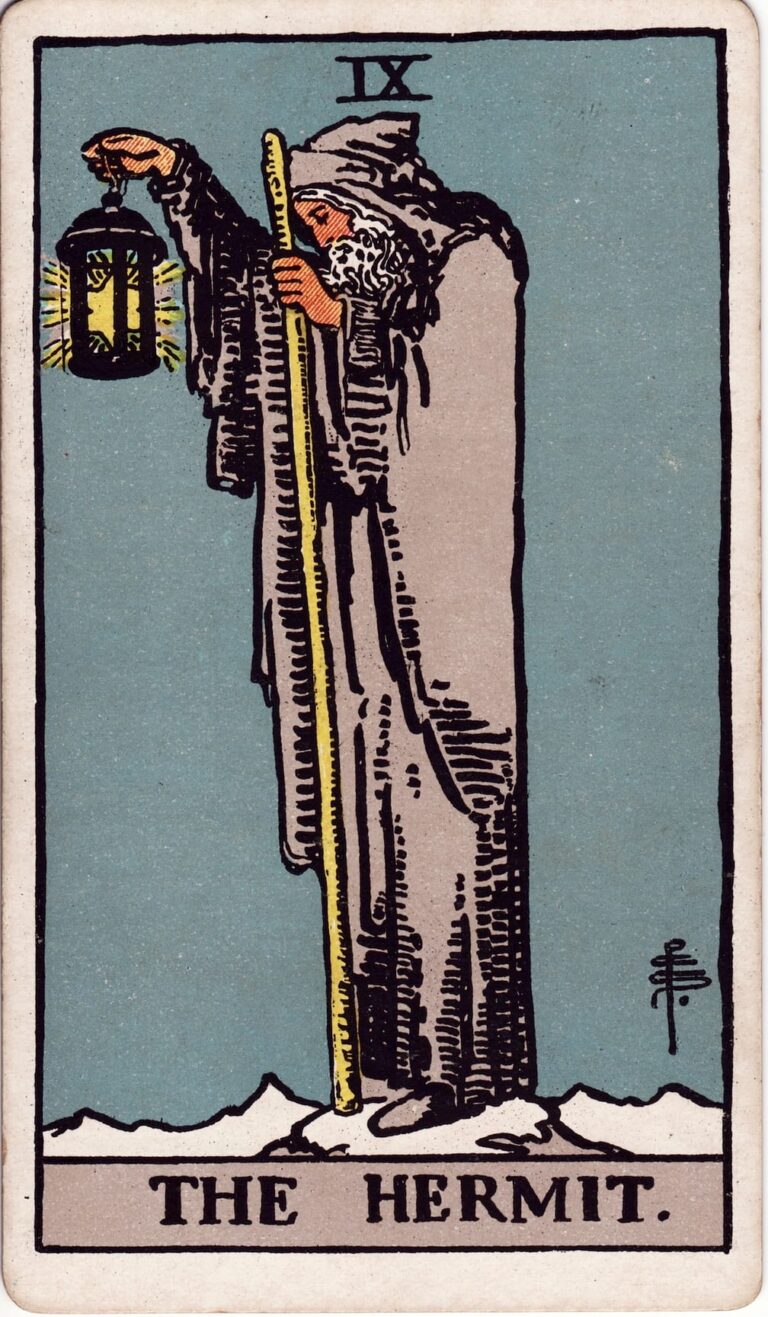
The Hermit is the ninth Major Arcana card, a picture of purposeful solitude, inner guidance and wisdom gained by stepping away from noise long enough to hear yourself clearly. He is not a sad wanderer who has lost his way: he stands at the height of attainment and holds his lantern out for others, while its limited glow shows that you are meant to see the next step rather than the entire path. In readings, The Hermit asks for a temporary retreat with a reason behind it—time to reflect, understand what experience has taught you and return with something useful to share.
The Hermit description
The Rider-Waite-Smith Hermit shows an elderly, white-bearded man standing alone on a snow-covered summit against a muted blue-grey background. He wears a long grey cloak with the hood pulled over his head. His posture bends slightly forward, with his head bowed and his eyes cast down. The cloak falls around him in a simple, unadorned shape, leaving his face, hands and the objects he carries as the main points of attention.
At chest height, his right hand extends a lantern in front of him. A warm light glows inside it, and the flame is drawn as a six-pointed star, commonly called the Seal of Solomon. His left hand rests on a tall staff. Icy mountain peaks sit below him, continuing the cold, high setting across the lower part of the card. The scene is spare and still, centred on the hooded figure, the lantern he holds outward and the staff supporting him on the summit.
Symbolism: what’s in The Hermit? (1–9)
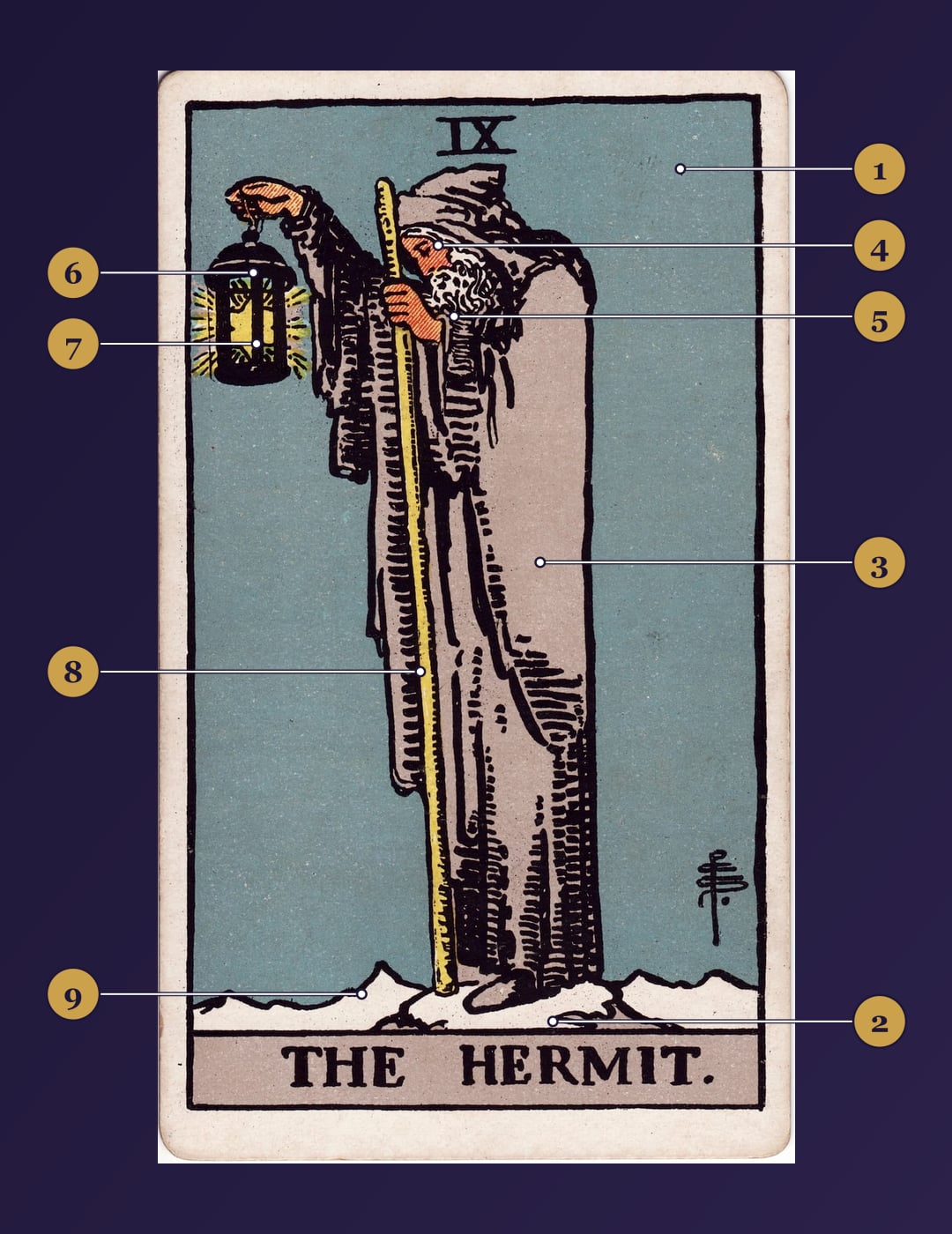
- Muted blue-grey background. The spare background places little distraction around the figure. Its subdued colour supports a reading of quiet attention, where ordinary activity recedes and there is room to reflect.
- Snow-covered summit. The Hermit stands on a snow-covered summit, the peak of attainment rather than the foot of a climb. It forms a bookend with The Fool: the distant mountains the Fool looks towards are now beneath the Hermit’s feet, marking experience earned rather than possibility imagined.
- Grey hooded cloak. His grey hooded cloak strips away display and colour. Its austerity makes him visually inconspicuous, as if ordinary status has been set aside so that attention can move inward. The renunciation is purposeful: less to look at outside, more room for clear seeing within.
- Bowed head and downcast eyes. The Hermit’s bowed head and downcast eyes show where his attention is directed. He is not scanning the horizon for an answer; his gaze turns inward. Here, introspection is a method rather than a mood, a deliberate way of examining what experience has already placed inside him.
- White beard. The white beard marks the Hermit as an elder whose mastery comes from lived experience. What he knows has been tested over time and distilled into patience. His authority is not hurried or showy; it comes from having stayed with experience long enough to understand what it can teach.
- Lantern held out at chest height. The lantern sits at chest height and is held outward, not lifted beyond reach or hidden under the cloak. That placement matters: the light is offered to those who come behind him. His solitude has produced something shareable, turning private insight into guidance for others.
- Warm glowing core within the lantern. The warm core inside the lantern is wisdom made visible. It does not flood the mountains with light or reveal every turn ahead; it gives enough illumination for the next step. The Hermit promises sufficient clarity for now, not a complete map of what comes later.
- Patriarch’s staff. In his left hand, the patriarch’s staff is the mature counterpart to The Fool‘s carefree wand. What once looked light and untested has become a practical support at altitude. The same basic tool has aged with experience, showing possibility converted into steadiness and earned authority.
- Icy peaks below him. Below him, the icy peaks carry the card’s emotional temperature. Feeling has not disappeared, but it is held in stillness long enough to become clear. From this height, heat and reaction are suspended; the Hermit can see what remains once immediate emotion has cooled.
What does The Hermit mean?
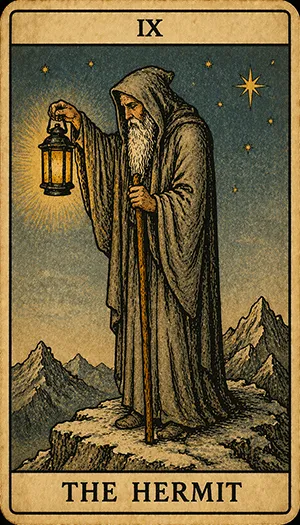
The Hermit means purposeful solitude, inner guidance, earned wisdom and attainment that can eventually help someone else find their way. In readings, this card usually lands when outside noise has made it harder to hear what you already know. The answer is not to disappear from life forever. It is to step back deliberately, make room for self-reflection and let experience settle into understanding.
The image changes the emphasis. The Hermit has reached the mountain heights The Fool once looked towards, and the Fool’s wand has matured into a staff. Waite’s own framing presents this figure as someone who has attained something, not a lost man searching blindly. The lantern is held outward because what has been learned can guide those following behind. The point is not withdrawal for its own sake, but clarity that can be carried back into ordinary life.
That is why I don’t read the upright Hermit as simple loneliness. Its solitude has a task and a limit. You withdraw so you can see clearly, then return with a steadier sense of your own truth. The lantern also keeps the message practical: you do not need every answer at once. You need enough light for the next step, then enough patience to let the step after that reveal itself in time.
What does The Hermit mean in love?
In love, The Hermit means a season of solitude or extra space that helps you understand what you genuinely need from connection. Distance can allow reflection, but the card cannot tell you whether someone is processing feelings or choosing to disengage. Clarify the meaning of a quiet spell through communication rather than assuming either affection or rejection.
If you’re single, The Hermit suggests that searching harder is not the best use of this moment. Time alone can show you what you want, what you no longer want to repeat and which parts of yourself need your attention before another relationship takes centre stage. Self-knowledge matters more than forcing a new connection.
If you’re attached, one partner may need more room to think, reflect or simply be alone for a while. That need does not automatically mean the relationship is unstable. Give the request for space a clear shape and communicate it sensitively, so temporary withdrawal does not turn into avoidable alienation.
What does The Hermit mean for career?
For career, The Hermit means stepping back from professional noise so you can see your work, ambitions and next move more clearly. If you have been forcing a decision while surrounded by other people’s opinions, this card favours a quieter stretch before you commit.
That can look like a sabbatical, a period of deep solo work or simply creating enough distance from the usual pace to ask whether your current path still fits. The point is not inactivity for its own sake. It is focused reflection that helps you identify what kind of work you want to keep doing and what has stopped feeling meaningful.
The Hermit can also describe mentorship. You may benefit from seeking someone whose experience has already taken them where you hope to go, or you may be the person with enough knowledge to guide someone else. What does not help is trying to force certainty while the room is still too loud to hear your own judgement.
What does The Hermit mean for money?
For money, The Hermit means reducing noise around spending, risk and investment choices so you can make decisions from a calmer, more self-aware place. It asks you to look at the behaviour beneath the numbers, especially if material security has started taking up more of your attention than it should.
You may need to rein in spending that is trying to fill an emotional gap. The same reflective approach applies to investing: understand your own appetite for risk rather than following excitement or outside pressure. If you are financially secure, The Hermit still asks what that security is for. If you are overspending, it favours restraint and a quieter reassessment of what you actually value before the next purchase or investment decision.
The Hermit as feelings
As feelings, The Hermit can represent private reflection, emotional distance or a need for solitude. Someone may be trying to understand a connection before speaking about it, but the card cannot distinguish that from reduced interest on its own. Treat the interpretation as a question to explore rather than proof of concealed affection.
If someone has asked for space, discuss what that means and what contact is comfortable for both of you. Respecting their boundary need not mean ignoring your own need for clarity. Quietness alone does not establish why they have withdrawn or whether they will reconnect.
The Hermit as actions
As actions, The Hermit points to withdrawal, quiet and deliberate reflection before making a decision. Under this card’s influence, a person is likely to pull back from contact, reduce outside input and spend more time thinking through what they have learned and what they want to do next.
In practical terms, that could mean reducing distractions, postponing a non-urgent decision or taking time to review what experience has taught you. If the card is being read about someone else, use their stated needs and actual behaviour to understand any distance; the image does not promise a considered return.
Is The Hermit a yes or no?
The Hermit is a maybe, with a strong sense of “not yet.” The answer needs withdrawal and reflection before it can become clear, so pushing for a quick yes can miss the point of the card.
The emphasis here is delay rather than refusal: step away, listen inwardly and return to the question when you can assess it without the surrounding noise. This is an interpretive prompt, not a reliable forecast of the answer.
What does The Hermit reversed mean?
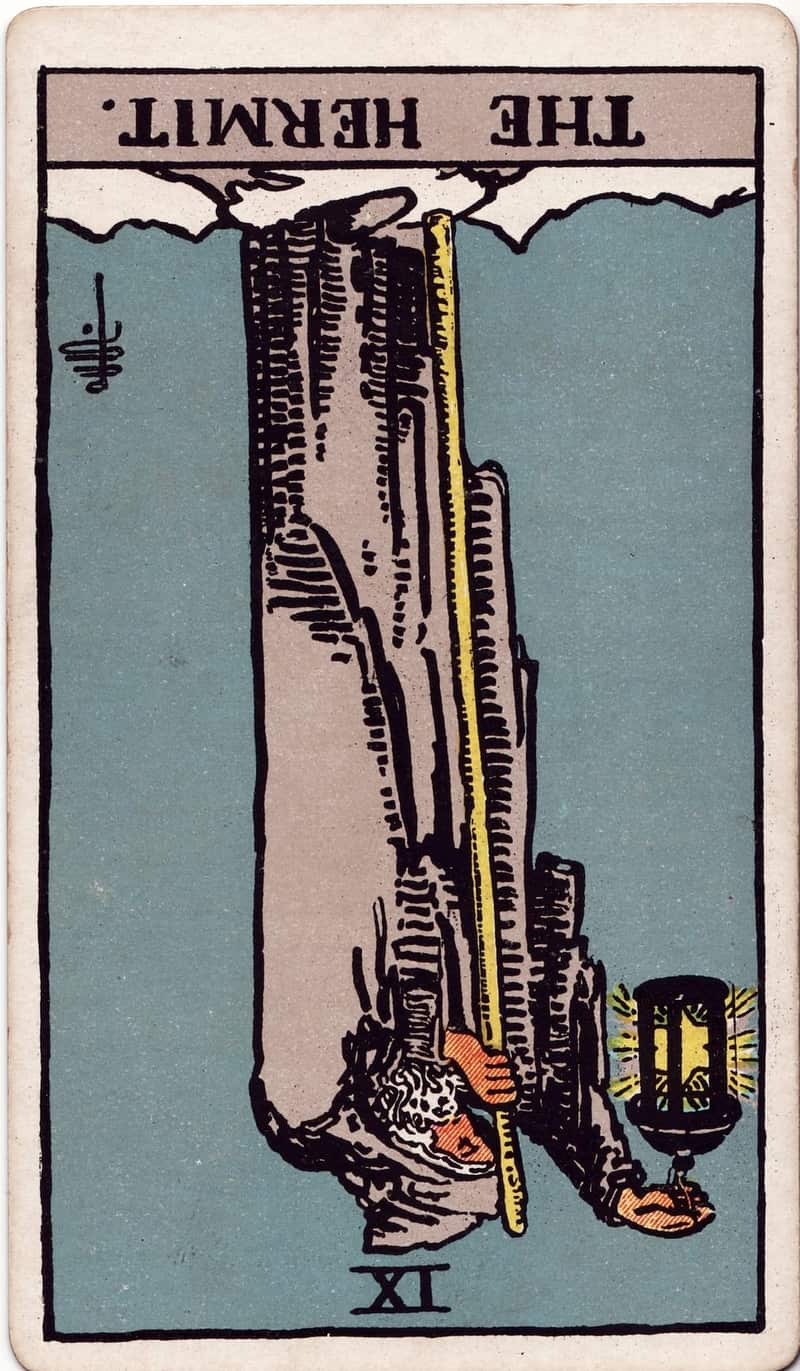
The Hermit reversed means that solitude has fallen out of balance: healthy retreat may have hardened into loneliness and refusal of help, or fear of being alone may be preventing the reflection you actually need. The reversal is not simply the upright meaning turned into its opposite. It shows the same need for inward space being handled in the wrong measure.
At one extreme, you may have stayed apart so long that privacy has become disconnection. Advice, affection or useful support can be available, yet you keep the door closed because remaining alone feels safer or easier. At the other extreme, being by yourself may feel so uncomfortable that you keep filling the silence with other people and their opinions.
Both patterns avoid the card’s real work. The Hermit needs enough separation for honest self-examination, but not endless exile. Reversed, it asks you to notice which side is off: too much isolation, or too little tolerance for your own company. The correction is measured solitude that leaves room for help and for eventual reconnection.
Reversed: love, career and money
Love
In love, The Hermit reversed warns that necessary space has become either emotional isolation or an inability to be alone. If you’re attached, one partner may be withdrawing so completely that the other feels excluded, turning private reflection into disconnection. The answer is not to eliminate alone time, but to communicate its purpose and limits.
If you’re single, the opposite problem can appear: fear of solitude may keep you searching for company when you would be better served by sitting with your own needs for a while. In either case, the reversal asks for balance between closeness and privacy rather than retreat without end or connection at any cost.
Career
For career, The Hermit reversed suggests that professional isolation is now limiting your judgement or progress. You may be trying to solve every work problem alone, refusing mentorship, networking or useful input even when those connections could help you see what you are missing.
The opposite form is just as possible: you may be so dependent on colleagues’ opinions that you never create enough quiet to decide what you think about your role, ambitions or projects. Either way, the correction is specific. Seek guidance when isolation has become stubbornness; make room for independent thought when other voices have crowded out your own. Do not force a major work decision from either extreme.
Money
For money, The Hermit reversed warns that isolation or overwhelm is making your financial behaviour harder to understand and control. You may avoid looking closely at spending because the subject feels intimidating, then refuse help even when another person’s advice could make the situation clearer.
The other extreme is leaning so heavily on outside opinions that you lose contact with your own risk tolerance and priorities. Advice can help, but it cannot replace your judgement. Bring the numbers back into view, reduce avoidant spending and ask for support where your knowledge is thin. The aim is a calmer relationship with money, not dependence on someone else to make every choice for you.
Timing
The Hermit corresponds to Virgo in the Golden Dawn system. Readers using zodiac timing may choose roughly 23 August to 22 September, while others read the card simply as a period of reflection. Neither convention can establish when an outcome will arrive; practical deadlines and the information still needed are more useful guides.
The Hermit card combinations
Tarot meanings aren’t written in stone—they are fluid and depend on many factors. One such factor is the interaction of your selected card with the other cards. The Hermit has some interesting interactions with other cards, as shown below.
The Hermit and The High Priestess
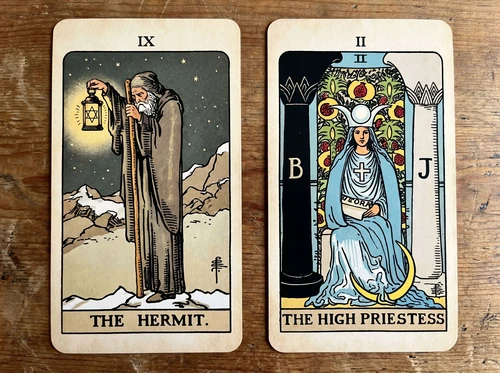
The High Priestess is the second card of the Major Arcana and has a similar meaning to The Hermit. Both cards represent self-reflection, inner wisdom, hidden knowledge, intuition and spiritual enlightenment. When you see them together, the message is clear: you need to work on yourself to reach your full potential and recognise your personal power.
The Hermit and Wheel of Fortune
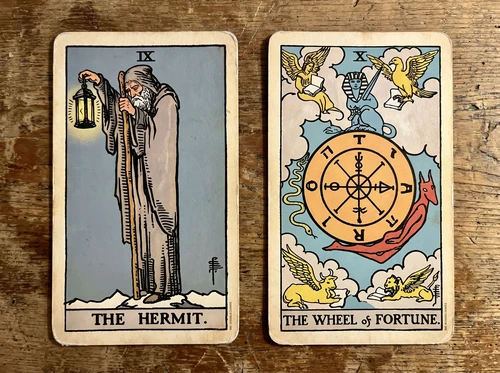
Wheel of Fortune is a card that reminds us how everything in this life has to change. But life isn’t a straight line—it is a circle, or better said, a cycle. Within this cycle, you will go through many different seasons of your life, and the start of each one is a good time to work on your personal growth.
When you see The Hermit beside Wheel of Fortune, it is a message that you must work on yourself even in times of chaos and turmoil. Even when everything around you changes, you can find peace, strength and consistency within yourself.
The Hermit and Strength
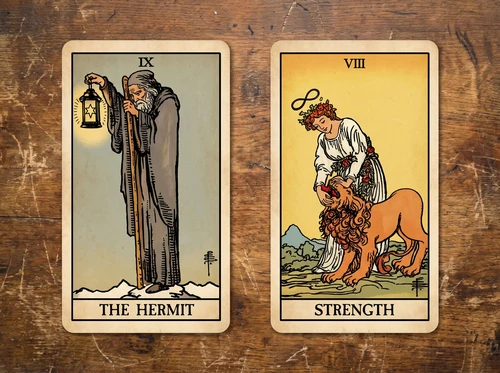
Let’s be honest: working on yourself can be exhausting in the long term, and sometimes you will feel tempted to take the easy road. When you look into your soul for too long, you won’t always like what you see. However, this is completely fine and natural; you just need to stay strong and keep going.
Strength and The Hermit together are your message that you shouldn’t give up easily. Exploring the depths of your soul will be hard and uncomfortable sometimes, but it is necessary for your spiritual development.
Astrology
The Hermit corresponds to Virgo in the Golden Dawn system. In astrology, Virgo is ruled by Mercury and is often associated with discrimination, careful study and useful service. Those symbolic themes complement the card’s emphasis on reflection and mentorship; they do not determine the personality of every person born under that sign.
Conclusion
The Hermit asks you to step away from noise long enough to recognise what experience has already taught you, without demanding the whole answer at once. Its solitude has a purpose: find the light you need for the next step, then hold that light where someone behind you can see it when you return. Continue exploring the Major Arcana with Strength or Wheel of Fortune.
Reading approach: Use these Rider–Waite–Smith interpretations to explore the question and context. A card does not establish another person’s feelings or a future outcome; check practical decisions against observable facts.
Curious about what lies ahead?
Get a free AI tarot reading and explore guidance designed just for you. Discover the messages the cards have to share and gain insight into your path.
Get a free tarot reading


