



Four of Cups Tarot Card Meaning: Overcoming Apathy & Embracing New Opportunities
Table of Contents
- Upright / Reversed keywords
- Four of Cups description
- Symbolism: what’s in the Four of Cups? (1–8)
- What does the Four of Cups mean?
- What does the Four of Cups mean in love?
- What does the Four of Cups mean for career?
- What does the Four of Cups mean for money?
- The Four of Cups as feelings
- The Four of Cups as actions
- Is the Four of Cups a yes or no?
- What does the Four of Cups reversed mean?
- Reversed: love, career and money
- Timing
- Other Cards with the Four of Cups
- The Four of Cups and its Astrological Sign
- Conclusion
Meaning at a glance
Four of Cups: upright and reversed
Upright
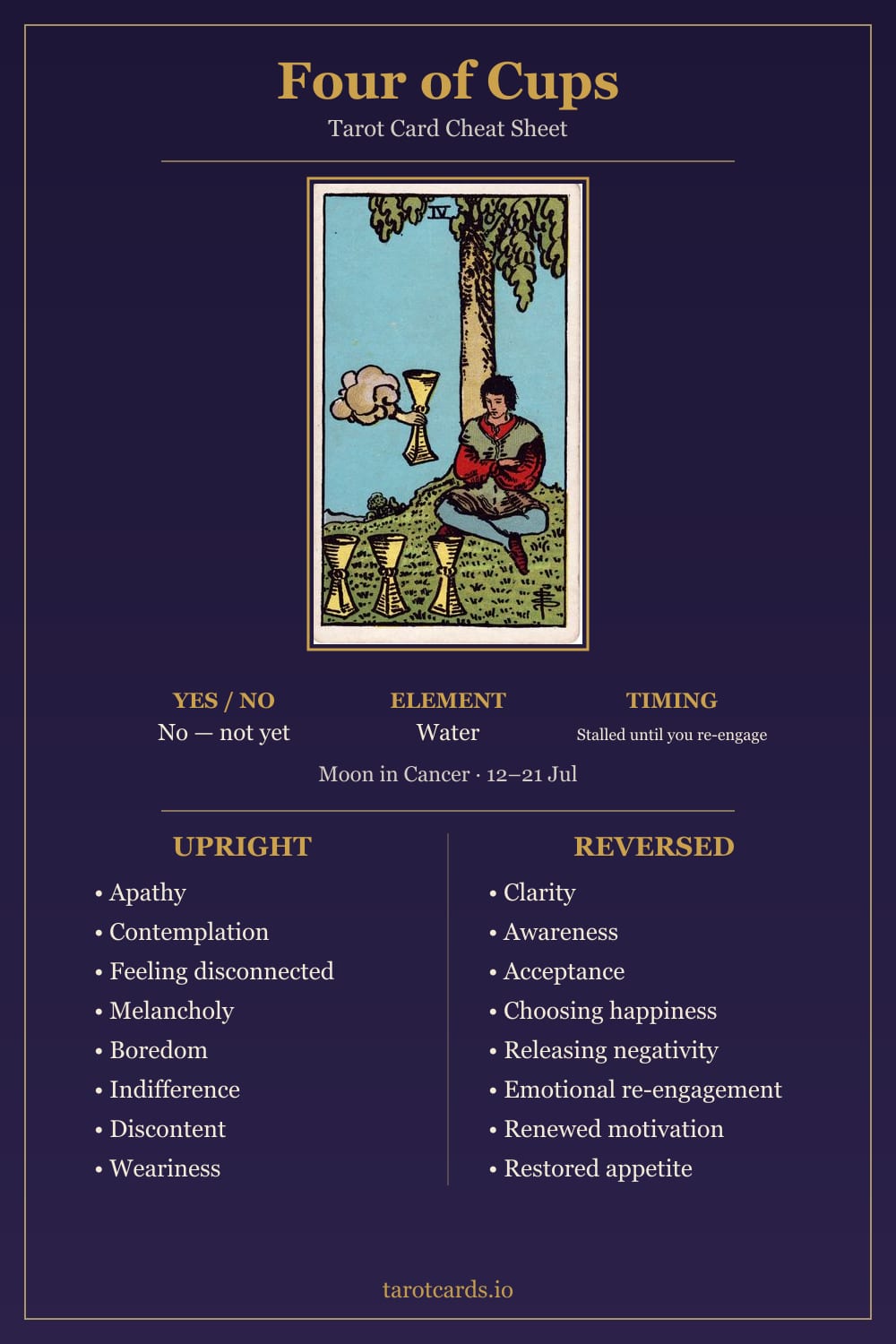
The Four of Cups represents withdrawal when familiar pleasures or offers no longer engage you. A pause can clarify what you need, but disengagement may hide a worthwhile possibility. Ask whether reflection is helping you choose or keeping every option at a distance.
Keywords: Apathy, contemplation, feeling disconnected, melancholy, boredom, indifference, discontent, weariness
Reversed
Reversed, the Four of Cups suggests interest returning after an emotionally flat period. An overlooked offer or fresh perspective may become easier to consider. Re-engage at a pace that feels workable, with attention to what has changed in your willingness to participate.
Keywords: Clarity, awareness, acceptance, choosing happiness, releasing negativity, emotional re-engagement, renewed motivation, restored appetite
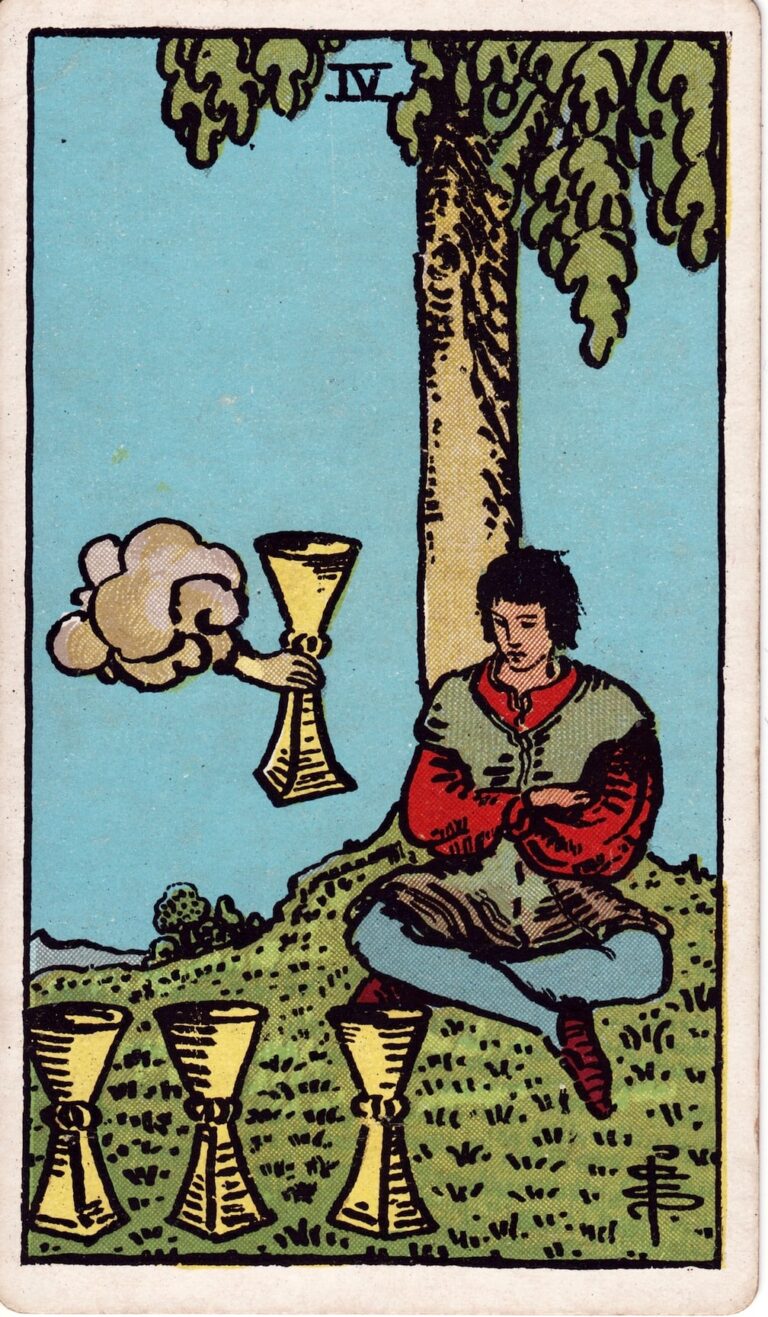
The Four of Cups appears when familiar pleasures have gone flat and you pull back from what is being offered; after the Three of Cups feast, satiety turns your attention inward and makes fresh interest hard to recognise. This refusal may be sound discernment or simple blindness: the card does not decide, and the surrounding cards show whether you are wisely declining more of the same or failing to notice the Ace of Cups being offered again.
Four of Cups description
In the Rider-Waite-Smith Four of Cups, a young man sits on a green hillside beneath a broad tree canopy. His legs are crossed, and his arms fold across his chest. He faces forward, while his level, unfocused gaze passes over the scene in front of him.
Three cups stand in a row on the grass below. They sit together as one group, separate from the young man. A small cloud appears beside him, carrying a hand that presents a fourth cup.
The fourth cup remains apart from the row. A clear stretch of open space lies between the offered cup and the three cups on the ground. Above, the canopy shelters the seated figure; beyond it, the sky is plain and open. The composition places the young man between the row on the grass and the single cup held out from the cloud. All four cups are visible, but none is in his hands.
Also known as: the Four of Chalices or Four of Goblets (Coupes in the Tarot de Marseille). The Thoth deck keeps the name Cups, and in playing-card decks the suit maps to Hearts; this guide focuses on Rider–Waite–Smith imagery and interpretation, which may differ from those traditions.
Symbolism: what’s in the Four of Cups? (1–8)
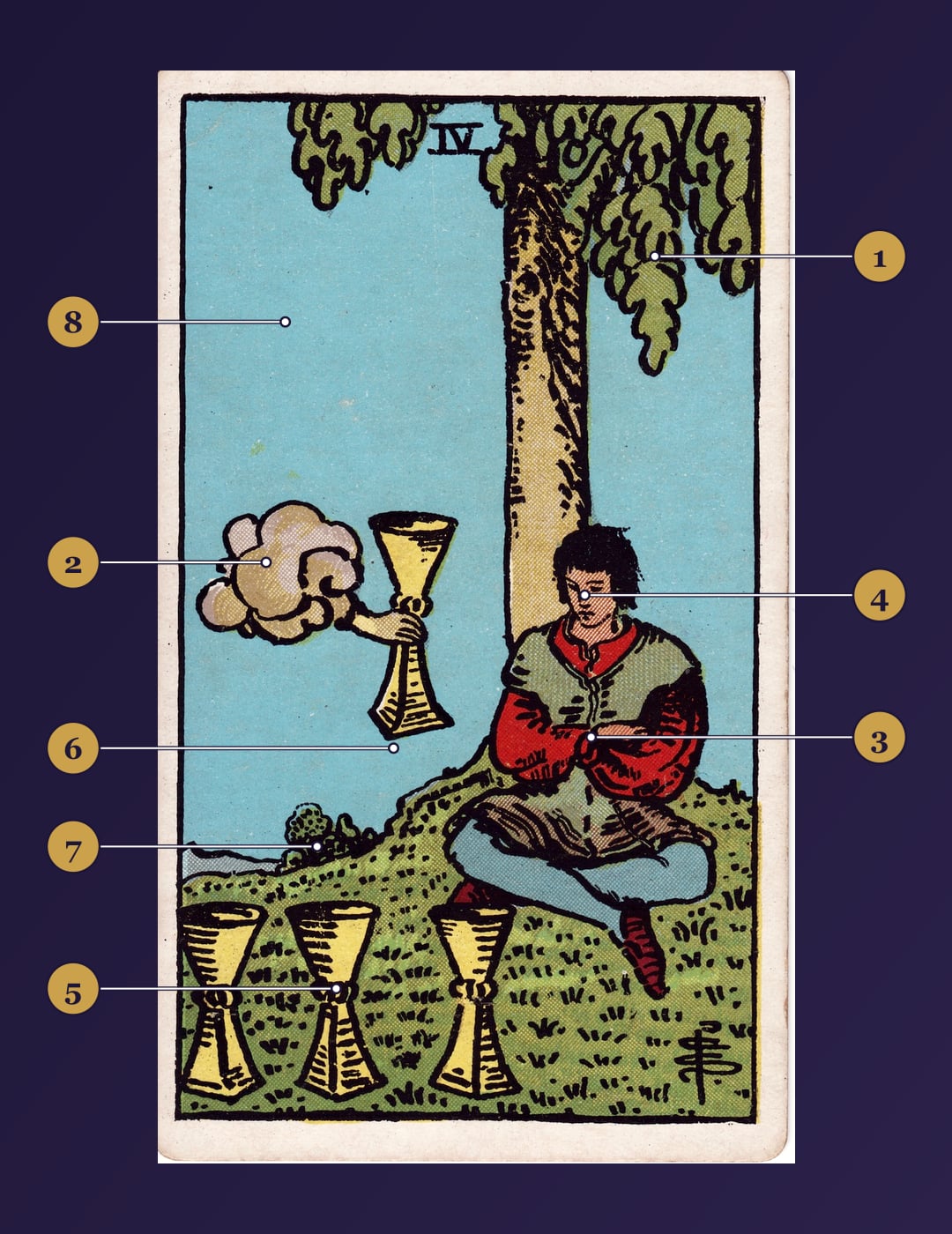
Eight marked symbols appear in the Four of Cups, each sharpening the difference between chosen retreat and missed opportunity.
- Tree canopy sheltering the figure. Above the seated figure, the canopy creates shelter and separation. It frames his withdrawal as contemplation rather than simple sulking, which can recall images of meditation beneath a tree. He has stepped away from activity to sit with what he feels.
- Small cloud offering a fourth cup. The cloud carries the same kind of hand seen in the Ace of Cups, extending that offer once again. Grace has returned, but the young man does not acknowledge it. The composition places a fresh possibility beside someone who has stopped looking for one.
- The young man’s crossed arms and legs. His posture is closed from shoulders to feet. Before he weighs the offer, his body has already answered, “not now”. The folded limbs create a defended boundary, showing how quickly a pause can harden into refusal before the mind has fully decided.
- His level, unfocused gaze. He looks ahead without fixing on the three cups or the new one. His attention has turned inward and slides past everything outside him. This is not active rejection so much as absorption: he is present in the scene, but not available to what the scene contains.
- Three cups in a row on the grass. These are the known options, set out plainly and already familiar. After the fullness of the Three of Cups, they have been tasted and found flat. Their neat row suggests repetition, the same emotional choices waiting where he left them.
- Gap between the cloud-cup and the row. The space makes the new possibility distinct from the three familiar cups, yet it also keeps that possibility at arm’s length. This cup is offered, not delivered. It will not place itself in his hand or close the distance for him.
- Green hillside. He has not withdrawn into a barren place. The ground beneath him is fertile and comfortable, making this a pause with life still around it. That comfort is the trap: nothing hurts enough to force him to move, look up or choose.
- Plain open sky. There is no storm, spectacle or changing weather to break the stillness. The sky holds an emotional flatline rather than visible distress. With no outside drama pressing on him, any change must begin inside the figure and show itself through a voluntary reach.
What does the Four of Cups mean?
The upright Four of Cups means you have withdrawn from what is available because familiar pleasures no longer satisfy you. In readings, it usually lands as a pause in appetite. After the sociability and fullness of the Three of Cups, you have had enough, and another helping of the same holds little appeal.
Boredom is only part of the message. The card is not a diagnosis of depression. Waite’s language points to weariness and “blended pleasure”, a contemplative satiety in which enjoyment has gone flat through repetition. That withdrawal may be wise. You could need privacy, a firm refusal or time to work out what you actually want before accepting another offer.
The fourth cup complicates the picture because it is not one of the old three. Behind it, the cloud-hand recalls the Ace of Cups, showing a fresh offer made to someone who has stopped looking. Your closed posture may be protecting your attention, or it may be preventing you from seeing the one option that is genuinely different.
The card does not settle that tension by itself; the surrounding cards do. Refusing more of the same can be discernment. Turning down the new cup without seeing it is blindness. Give yourself the pause, then look closely enough to know which refusal you are making.
What does the Four of Cups mean in love?
In love, the Four of Cups means emotional disengagement: someone is no longer fully registering the affection or possibilities in front of them.
If you are single: You may feel jaded with the options available, especially when each new introduction seems like another version of what has already disappointed you. That weariness can be honest discernment, but the fourth cup warns that a real offer may be sitting in plain sight. Judge the person or invitation in front of you, rather than letting the last three cups make the decision.
If you are attached: One partner may be emotionally checked out, taking the other for granted or responding without much warmth. The relationship can feel dull because attention has turned inward and ordinary affection is no longer being noticed. A period of space may be needed, but silence can look like rejection when the other person cannot tell retreat from indifference. Name what feels stale before assuming the bond itself has nothing left to offer.
What does the Four of Cups mean for career?
For career, the Four of Cups means boredom or low motivation has left you unmoved by your role, projects or the pitches around you. You may be doing the work without feeling invested in it, or dismissing each new possibility because you expect another version of the same old choice.
The fourth cup is the opportunity sitting right under your nose. It could be a role, project or pitch that deserves a closer look, yet your attention is so fixed on dissatisfaction that you barely examine it. The card does not tell you to accept work that fails to interest you. It asks you to separate considered refusal from automatic dismissal.
Do not make a rash exit simply to escape the flatness. Review what is actually on the table, identify what has gone stale, and notice whether one option differs from the three you already know. A clear no can protect your ambition; an unseen offer cannot help it.
What does the Four of Cups mean for money?
In a money reading, the Four of Cups means financial apathy or dissatisfaction is shaping how you spend, save and assess risk. The problem is not necessarily shortage or abundance. You may be stable and still feel unimpressed by your position, especially when comparison makes someone else’s finances seem more rewarding.
That flat mood can lead you to ignore an investment, reject a useful option without review or spend simply to interrupt the boredom. Treat any new financial choice as the fourth cup: examine whether it is genuinely different from what has already disappointed you, and check the terms before deciding it has nothing to offer.
Neither envy nor indifference gives you a sound measure of risk. Bring your attention back to your own money behaviour, then choose from the facts in front of you rather than the feeling that every option is the same.
The Four of Cups as feelings
When this card describes someone’s feelings towards you, it suggests they are apathetic, distracted or too absorbed in their own inner state to register what you are offering. It does not clearly say that they feel nothing; their attention is turned inward, so even sincere affection can pass unnoticed.
They may take your presence for granted, miss your signals or respond without much warmth because they have already decided that nothing will interest them. The surrounding cards show whether this is a temporary retreat or settled disinterest.
The Four of Cups as actions
As actions, the Four of Cups shows withdrawal and disengagement. It can describe ignoring offers, responding without enthusiasm or turning inward instead of participating; it cannot establish that another person will behave this way.
Because nothing currently on the table interests them, they are likely to remain passive and miss opportunities instead of seeking a better option. They do less than the situation requires, even while the offer remains available. The body says “not now”: arms crossed, attention elsewhere and no hand reaching for the cup. Until their interest returns, little outward movement follows.
Is the Four of Cups a yes or no?
The Four of Cups is a no, or at least not yet. In this reading convention, apathy, withdrawal and missed engagement weigh against a clear yes.
Another interpretation is maybe, since the offered cup is still present, but nothing changes while you remain closed to it. The answer becomes more favourable when you look up, reassess what is being offered and choose to engage.
What does the Four of Cups reversed mean?
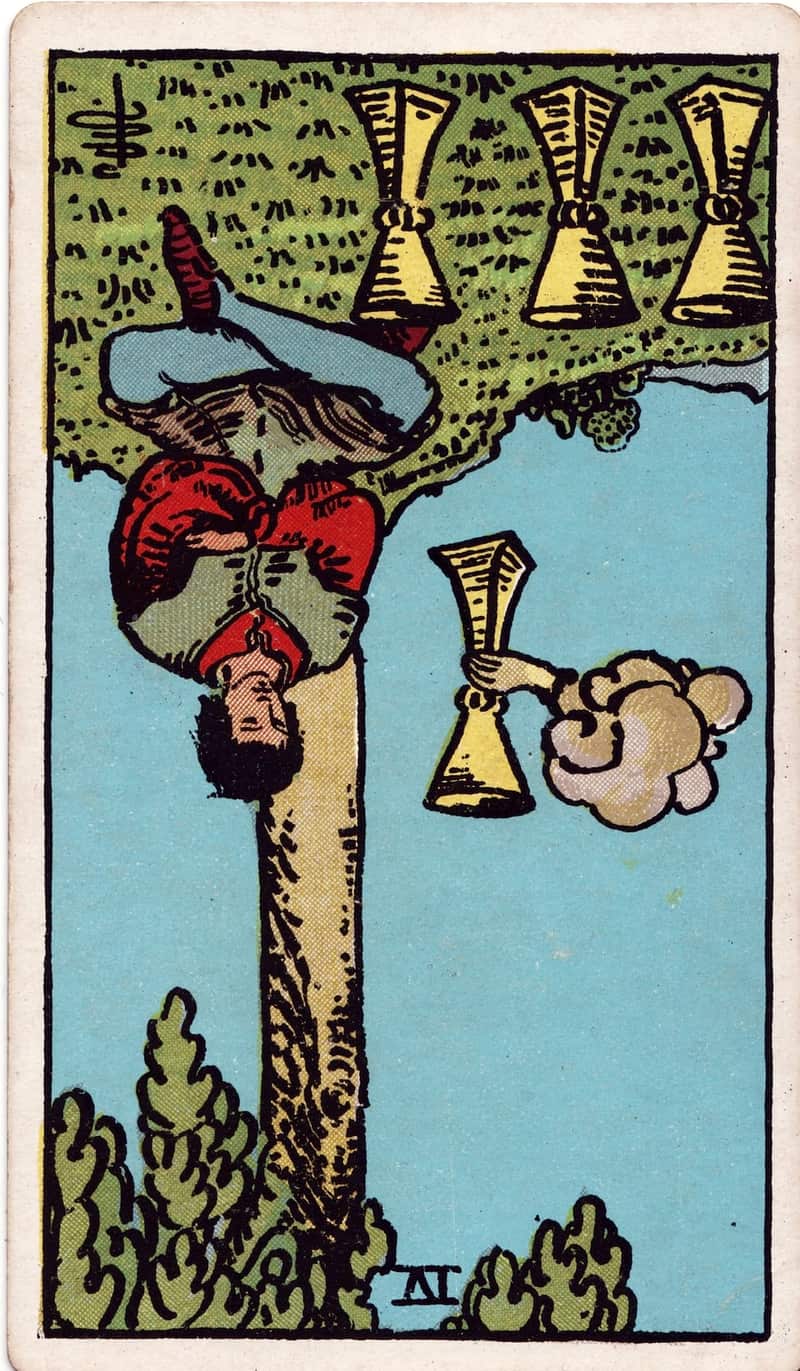
Reversed, the Four of Cups means the emotional flatness is beginning to lift and you are ready to re-engage. This is not the upright card sinking further into despair. It is the stir: the seated figure notices the offered cup and begins to move a hand towards it.
Interest returns after a period of weariness. You may reconsider an offer you dismissed, accept that the old options no longer satisfy you or feel enough motivation to make a new start. The shift can be quiet, but it changes the reading because you are participating again rather than waiting for something outside you to break the mood.
Re-engagement does not make every offer right. It gives you the willingness to assess what is present instead of rejecting it from a closed position. In readings, this reversal often marks renewed appetite, clearer awareness and a conscious choice about what deserves your attention. The fourth cup has been waiting; now you are willing to see what it contains.
Reversed: love, career and money
Love
In love, the reversed Four of Cups means emotional availability is returning. If you are single, you may be ready to stop viewing every possibility through the disappointment of a past relationship. Someone you overlooked can now receive a fairer look, or you may simply feel willing to meet new affection without automatic refusal.
If you are attached, apathy begins to loosen. You recognise where you have taken your partner or the relationship for granted and become more willing to respond, speak and take part. The change comes through renewed attention to the bond already in front of you.
Career
For career, the reversed Four of Cups means your interest in work is returning and an overlooked option can now receive a fair hearing. You may revisit a role, project or pitch that you dismissed while bored, or bring fresh focus to the position you already hold.
Comparison loses some of its grip as you turn back towards your own ambition. You are no longer waiting passively for work to excite you; you are willing to examine the fourth cup, decide what is useful and make a deliberate move instead of remaining stuck in dissatisfaction.
Money
In financial matters, the reversed Four of Cups means renewed attention to spending, investment choices and your appetite for risk. You may review an option you previously ignored, notice where indifference has shaped your decisions or become open to a financial opportunity without assuming it will disappoint you.
The reversal favours informed openness rather than automatic optimism. Take the fourth cup into your hand long enough to inspect it, compare its terms with the familiar choices and decide from awareness. Re-engagement improves your judgement because you are looking again, not because every offer is favourable.
Timing
Some readers use the Moon-in-Cancer correspondence as a symbolic link to mid-July; this site’s seasonal convention places Cups in spring. Neither gives a reliable date. For this card, a more useful timing question is what would make you ready to reassess the offer, and whether any real-world deadline needs attention.
Other Cards with the Four of Cups
Other cards can help distinguish a restorative pause from a missed opportunity. Read these combinations in relation to the question and the actual situation.
Some of the most interesting combinations with the Four of Cups tarot card are:
The Four of Cups and the Ace of Cups
When the Four of Cups tarot card is presented with the Ace of Cups tarot card this offers a clear insight into our emotional wellbeing. The Four shows a seated person overlooking an offered cup; the Ace shows a hand extending a cup, without a person receiving it. Together, the images invite reflection on whether an emotional opening is being noticed and welcomed.
Drawing these cards together could mean that you’re experiencing an emotional struggle, have a negative emotional state, or that you have a problem you haven’t yet found a solution to. Give yourself time and room to reflect, then consider what information or support could help.
The Four of Cups and the Fool
When the Four of Cups tarot card and the Fool tarot card present themselves together this is sending a clear message. Don’t live with regret. Instead of thinking about all the things that could go wrong, take a leap of faith and follow your dreams to your true desires. A small, considered step can help you test a new possibility without assuming that courage guarantees the result.
The Four of Cups and the Emperor
The Four of Cups and the Emperor is a very interesting tarot card reader combination because the focus here is on balance. Rather than be cautious or take a big leap, instead when you see these cards together you are encouraged to find a balance between the two. Plan your actions, make big changes but do so with caution. Use the plan to test whether the change is workable. But if you try something that fails, have an exit strategy or a plan B so that you won’t fall without a safety harness.
The Four of Cups and its Astrological Sign
The Zodiac sign most closely associated with the Four of Cups tarot card is Cancer. This is no real surprise because Cancer is a Water sign, and Cups is the tarot suit associated with Water; the other Minor Arcana suits have different elemental correspondences.
The Cancer association provides a symbolic link with emotional security and inward attention. It does not explain someone’s mental health or prove that a zodiac sign is controlling their feelings. In the card’s imagery, the useful question remains whether retreat is helping you reflect or making an offer difficult to see.
Conclusion
The Four of Cups asks you to respect the pause without letting comfort harden into blindness. Your refusal may be wise, but the fourth cup deserves a clear look before you turn away; the surrounding cards show whether you need rest or renewed participation. Take that question back to your reading and see what changes when you finally meet the offered cup with open eyes.
Reading approach: Use these Rider–Waite–Smith interpretations to explore the question and context. A card does not establish another person’s feelings or a future outcome; check practical decisions against observable facts.
Curious about what lies ahead?
Get a free AI tarot reading and explore guidance designed just for you. Discover the messages the cards have to share and gain insight into your path.
Get a free tarot reading


