



Five of Wands Tarot Card Meaning: Conflict, Competition, and Challenges
Table of Contents
- Upright / Reversed keywords
- Five of Wands description
- Symbolism: what’s in the Five of Wands? (1–8)
- What does the Five of Wands mean?
- What does the Five of Wands mean in love?
- What does the Five of Wands mean for career?
- What does the Five of Wands mean for money?
- The Five of Wands as feelings
- The Five of Wands as actions
- Is the Five of Wands a yes or no?
- What does the Five of Wands reversed mean?
- Reversed: love, career and money
- Timing
- Saturn
- Leo
- Other Cards With the Five of Wands
- The Five of Wands and Its Astrological Sign
- Conclusion
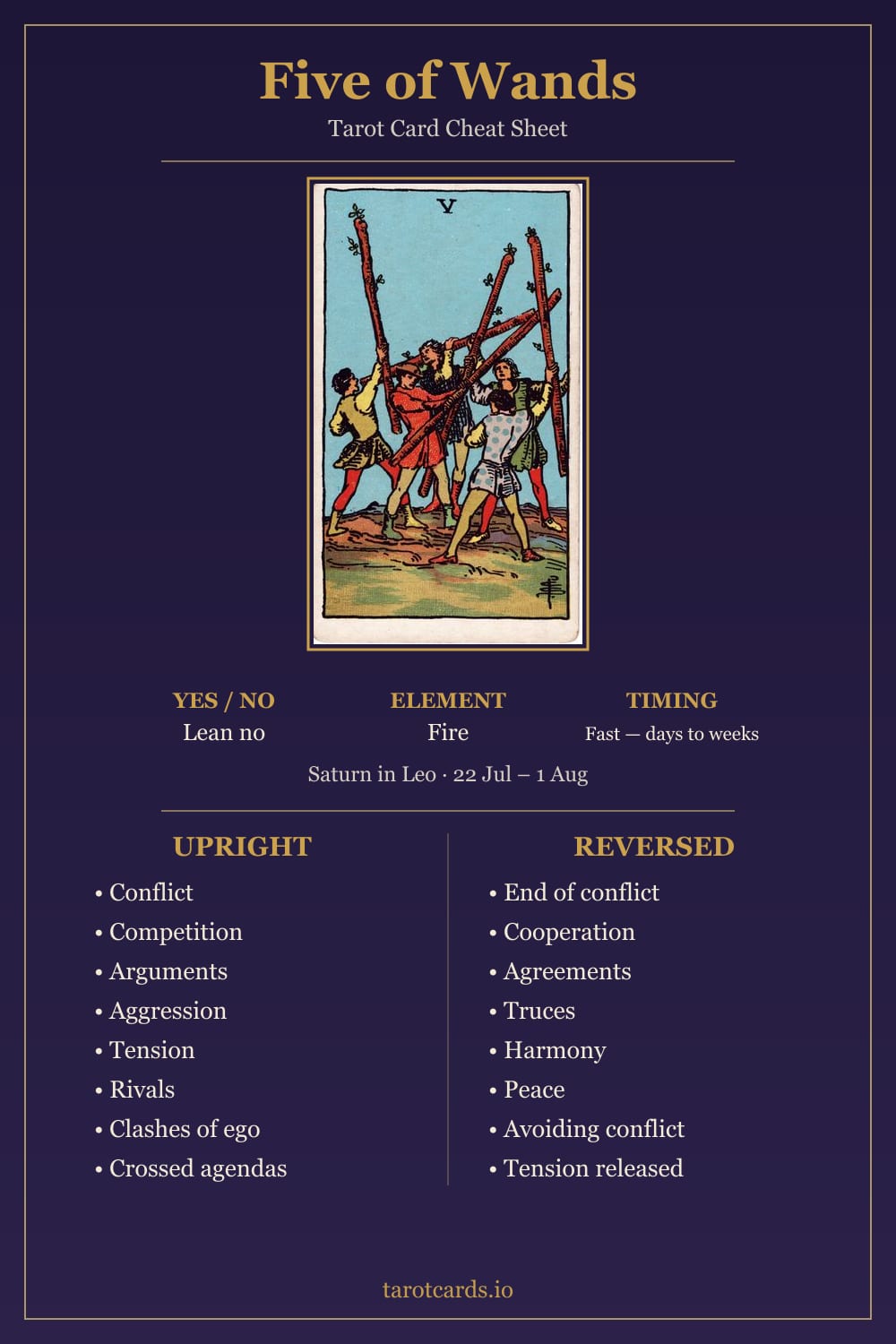
Meaning at a glance
Five of Wands: upright and reversed
Upright
The Five of Wands represents competing energies, disagreements and crossed agendas. People may be engaged but poorly coordinated, so friction does not always mean serious hostility. Clarify the shared task and give differences a useful form before treating everyone as an opponent.
Keywords: Conflict, competition, arguments, aggression, tension, rivals, clashes of ego, crossed agendas
Reversed
Reversed, the Five of Wands asks whether tension has been resolved or merely swallowed. A truce can free energy for cooperation, but avoiding disagreement may leave the problem intact. Look for workable agreements and enough openness to address what still matters.
Keywords: End of conflict, cooperation, agreements, truces, harmony, peace, avoiding conflict, tension released
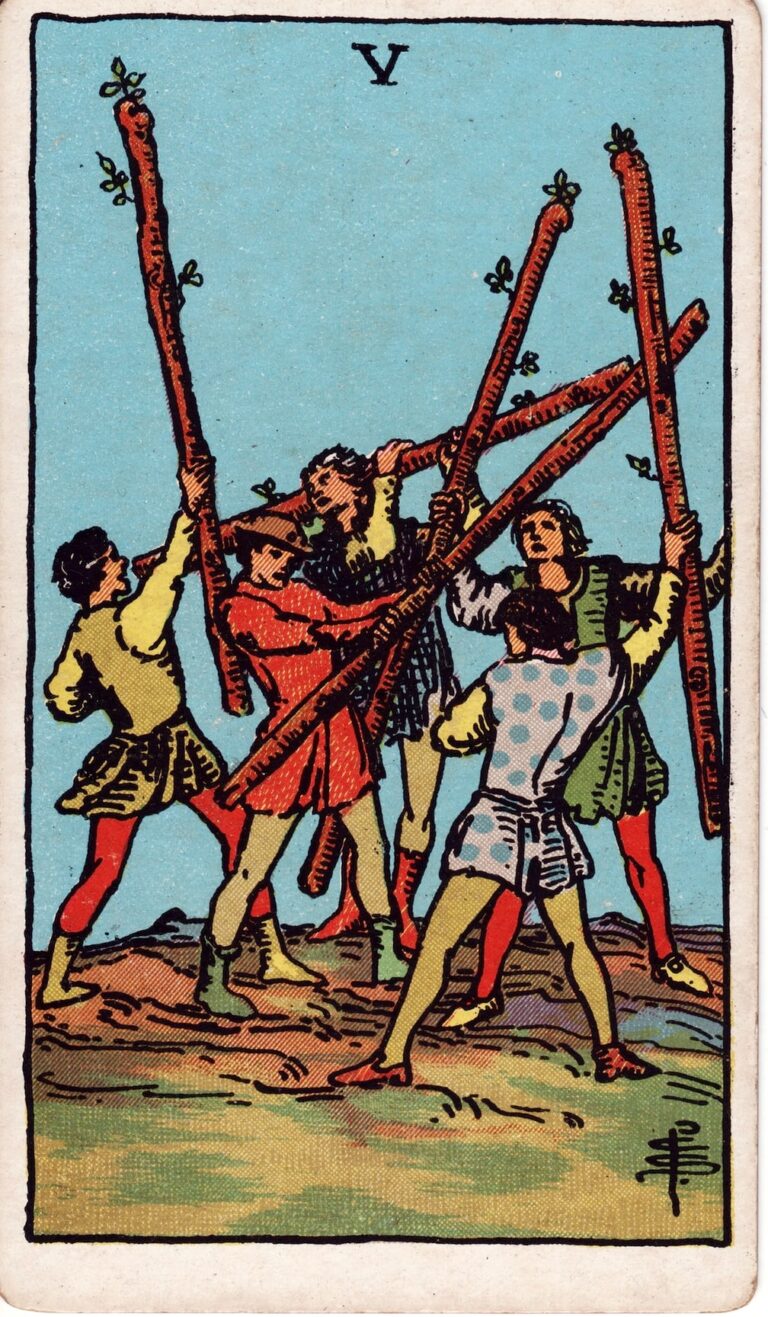
The Five of Wands is a card of competition and clashing agendas, with heat rising when several people want the same space, outcome, or say, especially when strong personalities are all trying to lead at once. It is often overread as outright hostility, but the Rider-Waite-Smith scene is Waite’s “mimic warfare”: nobody is wounded and no blow clearly lands, so in readings this five usually points to noisy jostling and useful friction rather than the cruelty of Five of Swords.
Five of Wands description
In the Rider-Waite-Smith Five of Wands, five youths stand beneath a pale, open sky. Each youth is dressed differently, and each grips only his own staff. The five staves rise into the centre of the scene and clash mid-air, crossing at several angles. Small leaves visibly sprout from the staffs.
The figures hold themselves in mock-battle postures. Their raised staffs overlap in the same crowded space, but the image shows no wound, no blood, and no clear blow connecting with another person. All five youths are engaged at once, each holding his own staff into the tangle rather than sharing or exchanging it with someone else.
Beneath them is uneven, bare ground. Above them, the pale open sky remains clear while the five staves occupy the space between the figures. From top to bottom, the picture is made from a few repeated elements: open sky, crossed staves with sprouting leaves, five differently dressed youths in mock-battle poses, and rough bare ground underfoot.
Also known as: the Five of Rods, Five of Staves or Five of Batons — the suit’s names in the Tarot de Marseille and older decks. The Thoth deck keeps the name Wands, and in playing-card decks the suit maps to Clubs; this guide focuses on Rider–Waite–Smith imagery and interpretation, which may differ from those traditions.
Symbolism: what’s in the Five of Wands? (1–8)
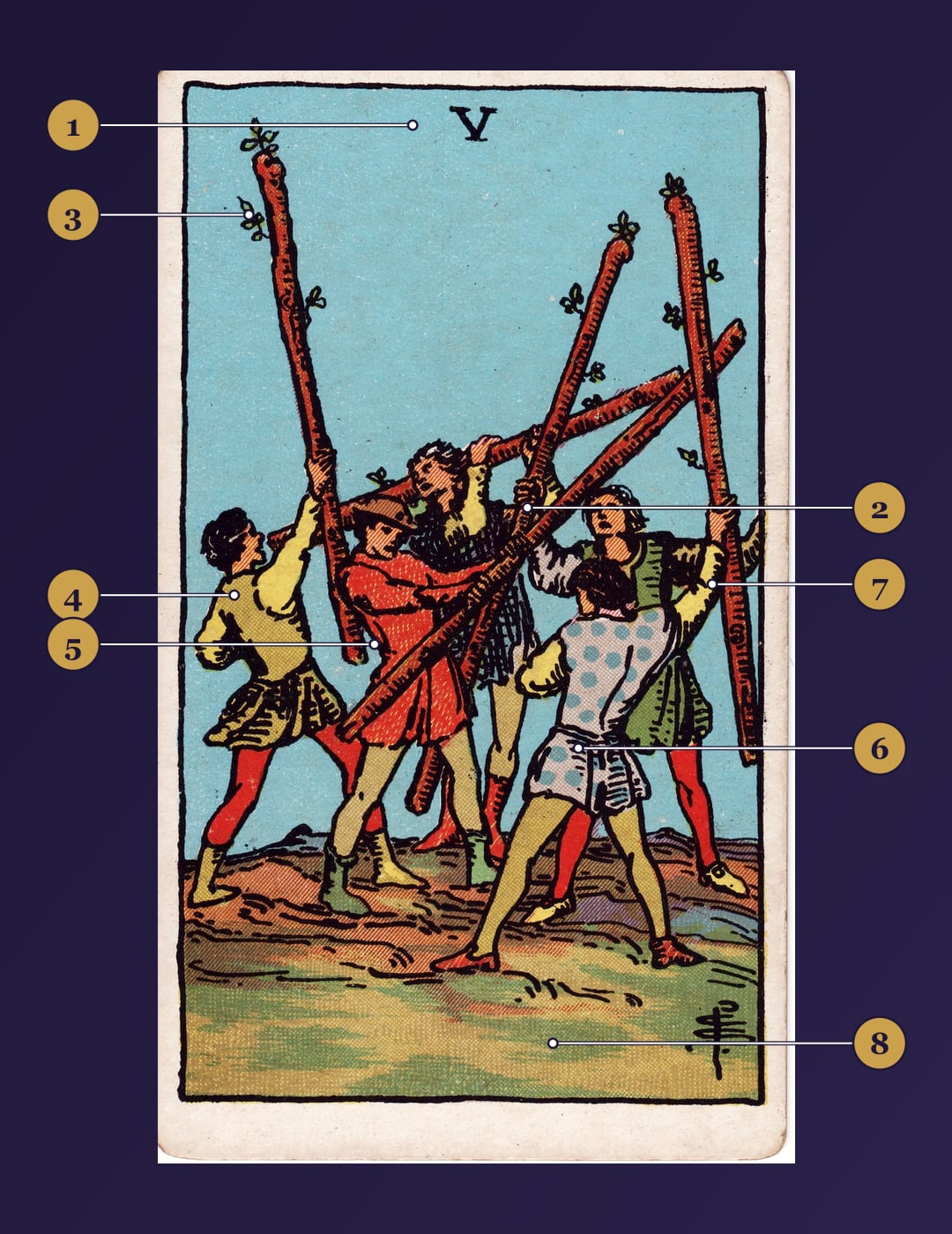
Choose a labelled symbol to highlight its number.
Read the numbered explanationsThe Five of Wands uses eight visible details to turn apparent combat into a picture of open competition, crossed intentions, and energy without a common plan.
- Pale open sky. The empty sky keeps the confrontation in plain sight. Nothing in the image suggests secrecy, an ambush, or a hidden attacker. Whatever the disagreement is, everyone can see it. This is friction expressed openly, with positions exposed rather than concealed.
- Five staves clashing mid-air. The staffs cross above the group like five agendas occupying the same space at once. They create plenty of noise and obstruction, but not one visible blow actually lands. The problem is interference: everyone is acting, yet their efforts keep colliding.
- Sprouting leaves on the staves. These are living branches, not dead weapons. The leaves give the clash a generative edge, suggesting that the energy inside the dispute can still produce something. Argument, testing, and competition may irritate, but they can also sharpen what survives them.
- Five youths, no two dressed alike. Their different clothing makes individuality impossible to miss. Each person arrives with his own background, viewpoint, and way of doing things. The resulting friction comes from difference itself, especially when several perspectives compete without an agreed method for combining them.
- Mock-battle postures. Waite described the scene as “mimic warfare”, and the poses support that reading. The youths look as though they are sparring, practising, or jockeying for position rather than fighting a war. Pride and competition are active here, but lethal intent is not.
- No wounds or blood anywhere. For all the raised staffs, nobody appears injured. That keeps the stakes around pride, status, and position rather than survival. It also separates this card from the cruelty associated with Five of Swords: this conflict is noisy, but it is not shown as vicious.
- Each figure gripping only his own staff. Nobody shares a staff or takes hold of another person’s plan. Each youth is fully occupied with what he is carrying, which mirrors a group where everyone is committed to his own approach. Cooperation fails because attention stays fixed on individual aims.
- Uneven, bare ground. The group has no obvious common footing beneath it. The rough, unstructured ground mirrors the lack of organisation above: activity is everywhere, but there is no stable base or shared formation. Before this energy can become coordinated effort, the group needs firmer common ground.
What does the Five of Wands mean?
The Five of Wands means competition, disagreement, crossed agendas, and the strain of several people pushing at once without enough coordination. In readings, this card usually lands as noisy friction rather than serious hostility. Waite’s “mimic warfare” matters: the figures look combative, but nobody is wounded and their staffs do not clearly connect.
Think of it as five fires in one field. There is plenty of heat, movement, and willingness to act, but each flame wants room. That can show up as rivalry, argument, jostling for recognition, or a group where everyone has a different answer and nobody is yet listening. The problem is not a lack of energy. It is energy working at cross-purposes.
This is why the card can be useful as well as irritating. A strong debate can expose weak ideas and force a group to discover what it actually agrees on. Competition can also refine effort when the contest has a real purpose. If ego takes over, though, the same energy becomes wasted effort and endless one-upmanship.
Waite also attached a secondary meaning of “gold, gain, opulence” to the card: strife in pursuit of riches. That fits the wider picture of people contesting position or reward, especially when the prize is worth competing for.
What does the Five of Wands mean in love?
In love, the Five of Wands means competition for attention, bickering, or attraction expressed through friction rather than easy agreement. The card does not automatically point to a serious rupture; its own scene is closer to sparring than harm.
If you’re single: you may be dealing with rivals, a crowded dating field, or someone whose attention is divided between several possibilities. There can be chemistry here, but it may come out as teasing, debate, one-upmanship, or trying to stand out. You may feel as though you have to compete to be noticed.
If you’re attached: repeated arguments can be less about deep incompatibility and more about unspent energy between you. Sexual tension may come out sideways as provocation or playful sparring. The useful question is whether the friction gives both of you somewhere to put that energy, or whether every small difference is becoming a contest for position.
What does the Five of Wands mean for career?
For career, the Five of Wands means competition, office politics, and work that suffers when a team pulls in several directions at once. You may be interviewing against a strong field, trying to distinguish yourself among capable colleagues, or working inside a group where every person has a different priority.
This card can describe meetings where people talk over one another, projects slowed by competing plans, or professional environments where recognition has to be fought for. It does not say that the work will fail. It says the work needs a clearer way to contain all that ambition.
There is a productive side to the card, especially in brainstorming or critique. Strong disagreement can improve an idea when people are testing the work rather than defending their status. If the room is heated, separate useful challenge from simple jockeying. The former can sharpen a project; the latter burns time without moving it forward.
What does the Five of Wands mean for money?
For money, the Five of Wands means competing financial priorities, a heightened appetite for risk, or pressure to prove yourself through spending and investment choices. Money may feel like another arena where several impulses are demanding the same resources at once.
You might be weighing different investments, feeling pulled towards aggressive bets, or trying to fund several competing goals at once. The card asks you to notice when competition is making you more reactive with money than you would normally be. Its secondary association with “gold, gain, opulence” also keeps the pursuit of material reward close to the meaning.
When several expenses or ambitions are competing, give each one a place instead of funding whichever demand shouts loudest. The issue here is not simply scarcity; it is financial energy scattered across too many contests.
The Five of Wands as feelings
As feelings, the Five of Wands suggests that someone feels stimulated, scattered, and competitive around you. You get a reaction from them, but that reaction is not settled. They may feel pulled to impress you, challenge you, or win your attention while also struggling with conflicting impulses.
The stimulation can be real, yet the person may still be weighing you against other options or trying to work out where they stand. Their feelings are active rather than calm, and they may express that tension through debate, rivalry, or testing instead of straightforward ease.
The Five of Wands as actions
As actions, the Five of Wands points to sparring rather than cooperating. Someone under this card’s influence may compete for attention, play devil’s advocate, stir debate, or keep introducing friction to see how you respond. They are likely to test position and push against other people’s plans instead of joining them immediately.
The picture lends itself to a reading of sparring or competitive friction, but that does not establish someone’s motives. Judge actual behaviour on its own terms; repeated intimidation or cruelty should not be dismissed because the card is sometimes read as mock battle.
Is the Five of Wands a yes or no?
In a yes-or-no reading, the Five of Wands often leans no or not yet. It brings obstacles, competition, crossed intentions, and extra effort between you and a clean result, so the path is unlikely to be simple.
Some readers can treat it as a hard-won maybe when you actively relish the contest and are willing to fight for position. Even then, the card does not promise ease; it says any yes is likely to come through friction first.
What does the Five of Wands reversed mean?
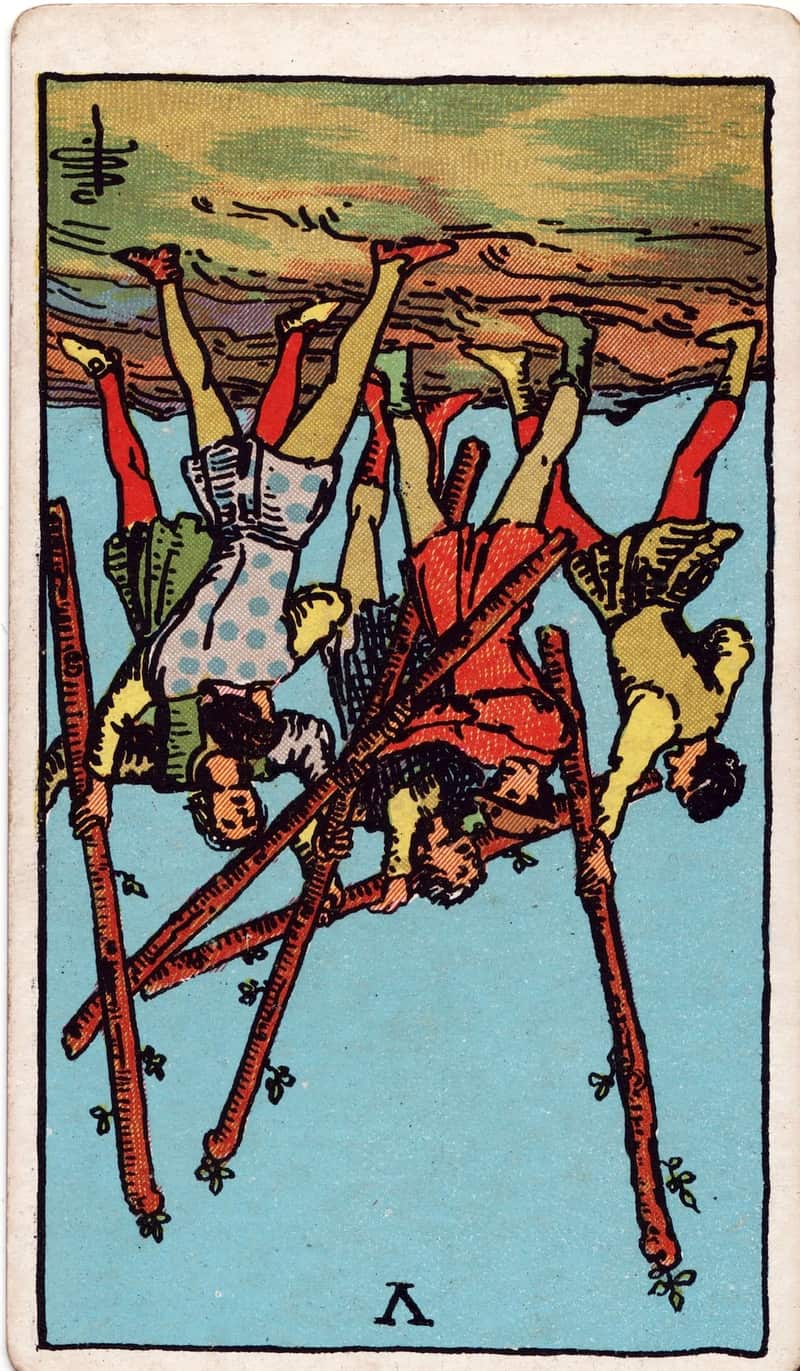
The Five of Wands reversed means either conflict being released or conflict being swallowed, and the surrounding cards help show which direction is active. This reversal is not simply the upright meaning turned off. It asks what has happened to the friction.
In the first direction, people stop competing long enough to reach agreement. Arguments cool, rivalry loses its grip, and a messy situation can move towards compromise, cooperation, or a truce. Energy that was being spent on jostling becomes available for the actual issue.
In the second direction, the surface grows quiet because nobody wants the confrontation. You may be withdrawing from a dispute, smoothing things over too quickly, or suppressing a disagreement that still needs to be addressed. The absence of open argument does not always mean the problem is settled.
This is why context matters so much with the reversed card. Relief feels different from avoidance. One clears tension because people have worked through it; the other hides tension because nobody wants to touch it.
Reversed: love, career and money
Reversed Five of Wands—Love Meaning
In love, the reversed Five of Wands can show romantic tension easing or an uncomfortable issue being pushed out of sight. If you’re single, the dating scene may feel less competitive, and past frustration can begin to loosen its hold. You may be more open to connection because you are no longer treating every interaction like a contest.
If you’re attached, arguments can settle and compromise becomes easier. The caution is false peace: if you and your partner stop arguing only because one or both of you refuse to raise the real issue, the tension has been swallowed rather than resolved. This reversal works best when calm follows an honest clearing of the air.
Reversed Five of Wands—Career Meaning
For career, the reversed Five of Wands can mean workplace rivalry cooling, professional disputes being resolved, or a team finally agreeing on how to proceed. You may leave a highly competitive environment, step out of office politics, or find that clearer goals reduce the need for everyone to fight for control.
The other direction is quieter but less useful: people stop challenging one another because disagreement feels uncomfortable. In that case, a project can lose the productive friction that once tested its weak points. The card asks for collaboration without complacency. Agreement should help the work move; it should not prevent necessary criticism from being voiced.
Reversed Five of Wands—Finances Meaning
For money, the reversed Five of Wands can show financial disputes settling, competing priorities becoming clearer, or a more structured plan reducing the sense that every expense is fighting for attention. Shared-money disagreements may become easier to resolve when each person stops defending a separate position.
The avoidance side appears when you refuse to look at a spending conflict, delay an investment decision because every option feels contentious, or lose useful financial drive simply to escape pressure. Calmer money choices are helpful; disengagement is different. The aim is to reduce reactive competition around money without becoming passive about the decisions that still need making.
Timing
The Golden Dawn links the Five of Wands with Saturn in the first decan of Leo, roughly late July. Number-based timing varies between readers and cannot establish a five-day or five-week deadline. For a practical timing question, focus on what needs to be agreed before the situation can move.
Saturn
Saturn represents discipline, obstacles, and the lessons learned through perseverance. In the Five of Wands, it signifies the need to overcome conflicts, work through limitations, and find structure amid chaos.
Leo
Leo is a sign of leadership, self-expression, and ambition. However, its fiery nature can also bring pride and ego-driven clashes, which align with the competitive energy of the Five of Wands.
Read symbolically, Saturn in Leo brings limits into conversation with the wish to be recognised. The question is whether a challenge can teach something useful or is simply consuming time and energy.
This astrological connection reminds us that healthy competition and constructive challenges can lead to success. It encourages you to treat struggle as part of the process while learning patience and resilience.
Other Cards With the Five of Wands
The Five of Wands represents tension, competition, and conflict, but its meaning can shift depending on the cards surrounding it. Some combinations emphasize growth through struggle, while others warn of unnecessary battles or the need for cooperation. Here’s how the Five of Wands interacts with key tarot cards in a reading.
Five of Wands + The Fool: Learning through challenges and new experiences
This combination suggests that you are entering an unfamiliar situation where you must prove yourself. The Fool represents fresh starts and risk-taking, while the Five of Wands signals competition or obstacles along the way. You may be stepping into a new career, relationship, or personal challenge that requires persistence. This pairing encourages embracing the journey, even if it comes with struggles. Try pulling a single card when a group is clashing and you can’t tell if that’s productive or destructive to focus the broader reading on your own next step.
Five of Wands + The Magician: Using conflict as motivation to succeed
When these two cards appear together, they invite you to consider which skills and resources could help you navigate the challenge. The Magician represents personal power and manifestation, while the Five of Wands suggests competition or opposition. This could mean turning rivalries into opportunities or using obstacles as motivation to improve your position.
Five of Wands + The Tower: A major upheaval caused by conflict
The Tower’s presence amplifies the disruptive energy of the Five of Wands, suggesting that tensions may reach a breaking point. This can indicate a sudden change in relationships, career, or personal stability due to arguments or external challenges. While this may feel overwhelming, it may require a substantial change in how the conflict is handled. Be prepared for unexpected disruptions and focus on rebuilding stronger foundations.
Five of Wands + The Lovers: Relationship struggles or differing opinions
This combination suggests disagreements in relationships, whether romantic, platonic, or professional. The Lovers represent choices and deep connections, while the Five of Wands indicates tension or conflicting desires. There may be differences in values, communication styles, or future goals that need to be resolved. Honest conversations and compromise will be key to overcoming these struggles.
Five of Wands + The Ten of Pentacles: Family or financial disputes
The Five of Wands alongside the Ten of Pentacles points to disagreements over family matters, inheritance, or financial responsibilities. This can indicate differing opinions within a household or tension surrounding long-term financial planning. While challenges may arise, focusing on stability and shared goals can help navigate these difficulties.
The Five of Wands combinations offer different ways to examine conflict: competition, clashing priorities or a failure to cooperate. Compare those themes with what people are actually doing. The surrounding cards can help frame questions, but they cannot determine whether a dispute will end in a breakthrough or a prolonged difficulty.
The Five of Wands and Its Astrological Sign
The Five of Wands is associated with Saturn in Leo, blending the disciplined, restrictive energy of Saturn with the bold, creative nature of Leo. This planetary influence highlights both the struggles and opportunities that come with competition, personal expression, and learning through challenges.
- Saturn question: What rule, boundary or agreed process would make the disagreement more manageable?
- Leo question: Is someone’s need for recognition preventing the group from hearing a useful idea?
- Together: Can you keep room for individual contribution while agreeing on one shared goal?
Constructive challenge has a purpose and workable limits. If a contest has become repetitive or harmful, leaving it or changing the terms can be more useful than proving your resilience.
Conclusion
The Five of Wands asks you to tell the difference between friction that sharpens a situation and friction that only burns energy; most of the time, its noise is about people jockeying for position rather than trying to do real harm. If everyone can stop swinging their own staff long enough to find common ground, the same heat can become useful momentum.
Reading approach: Use these Rider–Waite–Smith interpretations to explore the question and context. A card does not establish another person’s feelings or a future outcome; check practical decisions against observable facts.
Continue exploring the tarot: revisit Four of Wands, or move on to Six of Wands.
Curious about what lies ahead?
Get a free AI tarot reading and explore guidance designed just for you. Discover the messages the cards have to share and gain insight into your path.
Get a free tarot reading


